Measured by the lab
2.8283
Can the correlations between two entangled particles be explained by any theory in which each particle carries predetermined answers fixed at emission (a 'local hidden variable') — or does nature refuse to be locally real?
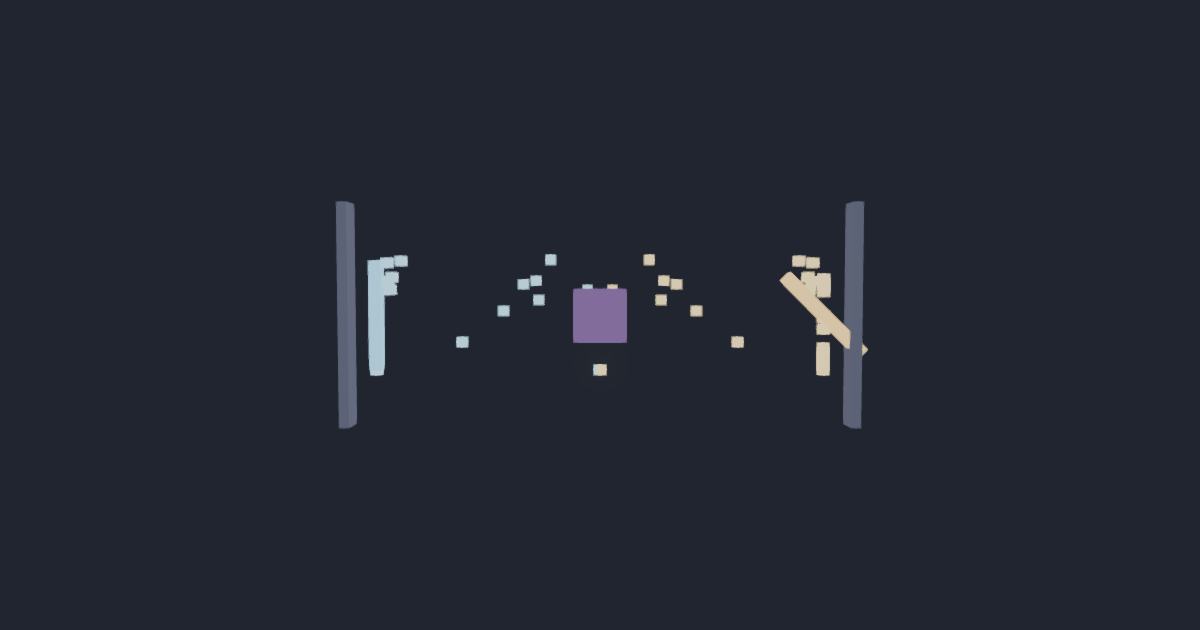
▶ Run the simulationSee the measured result
Units: dimensionless (CHSH correlator S = 2√2, Tsirelson's bound)
Emit two spin-½ particles in the singlet Bell state |ψ⁻⟩ = (|↑↓⟩ − |↓↑⟩)/√2 toward two distant analyzers. Alice measures spin along an axis at angle a, Bob along b, each getting ±1; quantum mechanics gives the correlation E(a,b) = ⟨AB⟩ = −cos(a−b). Monte-Carlo-sample the ±1 outcomes from the QM joint distribution (never the formula for S), estimate the four correlators from the counts, and form the CHSH combination S = E(a,b) − E(a,b′) + E(a′,b) + E(a′,b′) at the optimal angles a=0°, a′=90°, b=45°, b′=135°, swept across 24 seeds. Controls: an explicit local-hidden-variable model (shared emission angle λ, deterministic local response), and a Werner state of tunable visibility V.
Tsirelson's bound S = 2√2 ≈ 2.828 — recovered from the sampled counts to ±0.01, with EVERY seed exceeding the local-realist bound |S| ≤ 2 by ≈ 0.83 (the violation is unambiguous on each single run). This is Bell's theorem, measured: no theory of local hidden variables can reproduce quantum mechanics. Two controls falsify local realism — the explicit local-hidden-variable model, scanned over all analyzer settings, never climbs past S = 2 (it saturates there but cannot reach 2√2); and a Werner state gives S(V) = 2√2·V, so the violation switches off CONTINUOUSLY and crosses the classical bound exactly at V = 1/√2 ≈ 0.707. The bound 2√2 is never plugged in — it emerges from the sampled outcomes. Bell (1964) / CHSH (1969) / Tsirelson (1980), confirmed by Aspect (1982) and the loophole-free tests (2015), Nobel Prize 2022 — the lab's first world about quantum entanglement and nonlocality
Two particles, four dials, and a number that decides whether the world carries its answers with it. Nothing on this page is stored: the local bound is the exact integer 2, the no-signalling bound the exact integer 4, and Tsirelson's ceiling is ASSEMBLED as 2·√2 = 2.8284271247461903 — never pasted, never reached through a cosine. Everything else is built from the analyzer angles you type. The singlet correlator is E(a,b) = −cos(a−b), and the CHSH combination of four of them is bounded by 2 for ANY theory in which each particle left the source carrying predetermined answers. Quantum mechanics reaches 2√2 and stops there. THE ONE-PARAMETER FAMILY IS WHERE THIS PAGE EARNS ITS KEEP, because it turns the theorem into a function you can differentiate: put the four dials at 0, φ, 2φ, 3φ and S(φ) = 3cos φ − cos 3φ, whose maximum sits at φ = 45° EXACTLY — dS/dφ = 3(sin 3φ − sin φ) vanishes when 3φ = π − φ — and equals 4/√2 = 2√2 there. Feed the SAME four angles to the best local hidden variable, a shared emission direction with deterministic local responses, and its triangular correlator returns −2 for every φ in the band: local realism has a PLATEAU exactly where quantum mechanics has a PEAK, and the peak is taller by a factor of √2. THE EXCESS OVER THAT PLATEAU IS THE PHYSICS, and it is the hardest number here to compute. S(φ) − 2 differences two quantities that both tend to 2, so the obvious spelling destroys it: scored against a 400-bit fixed-point truth, (3cos φ − cos 3φ) − 2 is 5.9e-5 wrong at φ = 1e-6 rad, 48% wrong at 1e-8, and 100% wrong at 1e-10, where it returns a flat zero against a true excess of 3e-20. Written as the versine 2sin²(3φ/2) − 6sin²(φ/2) it is correctly rounded everywhere measured — and at the peak it returns the correctly-rounded double for 2√2 − 2 while the obvious 2·SQRT2 − 2 lands TWO ulps high. That subtraction is exact — add 2 back and fl(2√2) returns bit-for-bit — and it is wrong anyway, because fl(2√2) was rounded at a quantum four times coarser than the answer's own and an exact subtraction cannot give back a bit the rounding already spent. The violation margin is the one number in Bell's theorem that has to be positive, so this page assembles it cancellation-free and reuses that value wherever it is needed. Three more things fall out of it. The three ceilings are in geometric progression — 2, 2√2, 4, each step exactly √2 — so quantum mechanics climbs precisely half way from what a lookup table can do to what causality alone permits, and nothing in relativity says why it stops. The margin 2√2 − 2 = 2(√2−1) = 0.8284 is ALSO the symmetric detection efficiency a CHSH test must beat before the fair-sampling loophole closes, which is why loophole-free tests waited until 2015. And the statistics are gentler than the reputation: each correlator is a mean of ±1 draws, so SE(S) = √(4(1−E²)/N) = √(2/N) at the optimal angles, and a five-sigma violation needs N = 2z²/(2√2−2)² — seventy-three pairs per setting. The difficulty of these experiments was never the counting statistics. The engine's trig is disclosed rather than hidden: at the optimal settings all four correlators are 1/√2 in exact arithmetic and the engine returns two distinct doubles among them, so the assembled |S| misses fl(2√2) in the last place — a fact about cosines, not about spin. Three things this page will NOT do. It will not derive E(a,b) = −cos(a−b): that is the Born rule applied to the singlet, i.e. quantum mechanics itself, and Bell's theorem takes those correlations as given. It will not tell you whether an experiment closed a loophole — that is a question about spacelike separation and real detectors, not about four numbers. And it will not correct a single value the finding recovered; it prices closed forms against them and reports the gap rather than choosing a winner.
E(a,b) = −cos(a−b) · S = E(a,b) − E(a,b′) + E(a′,b) + E(a′,b′) · local realism |S| ≤ 2, quantum |S| ≤ 2√2 = 2.8284271, no-signalling |S| ≤ 4 · optimal family a=0, b=φ, a′=2φ, b′=3φ: S(φ) = 3cos φ − cos 3φ, max at φ = 45° exactly · S − 2 = 2sin²(3φ/2) − 6sin²(φ/2) · Werner: S(V) = 2√2·V, threshold V* = 1/√2 · SE(S) = √(4(1−E²)/N) = √(2/N) at the optimal angles, N = 2z²/(2√2−2)² pairs per setting