Measured by the lab
0.002898005
Why does a hot object glow the colour it does — and why did classical physics predict it should radiate infinite energy?
▶ Run the simulationSee the measured result
Units: m·K (Wien displacement constant b; companion σ = 5.670374419e-8 W m⁻² K⁻⁴, both exact in the 2019 SI)
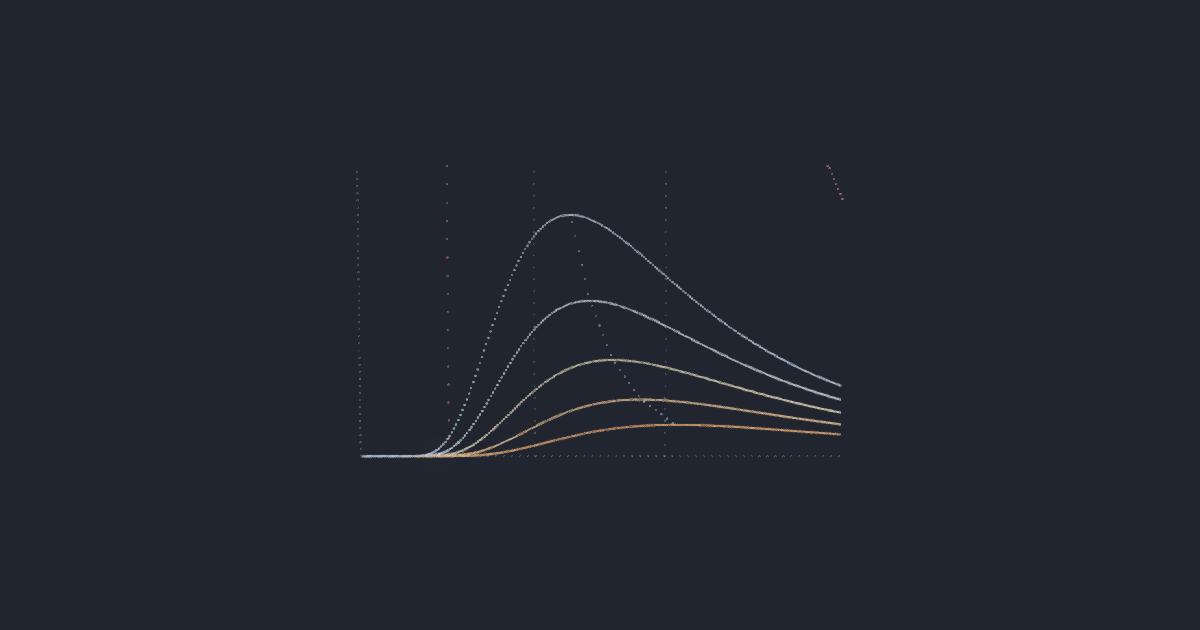
Plot the Planck spectral radiance B_λ(λ,T) = (2hc²/λ⁵)/(e^{hc/λk_BT}−1) for several temperatures, alongside the classical Rayleigh–Jeans curve. Then measure the laws directly: find each curve's peak wavelength numerically (Wien), integrate ∫B dλ across many temperatures and log–log fit the exponent (Stefan–Boltzmann), and compare classical vs quantum at short wavelength.
Wien's displacement law λ_peak·T = 2898 µm·K (constant ⇒ hotter is bluer, recovered to machine precision); the Stefan–Boltzmann law P ∝ T⁴ (fitted exponent 4.000, with σ = 5.67×10⁻⁸ W m⁻²K⁻⁴ backed out); and the ultraviolet catastrophe — Rayleigh–Jeans over-predicts Planck by ~10¹¹× at 100 nm and diverges as λ→0, while Planck's quantization of energy (E=hν, so short-wavelength modes are too costly to excite) turns the curve over and keeps it finite. The 1900 result that forced energy to come in lumps and started quantum theory
Everything on this page is built out of h, c and k in the boxes below, and the two constants it is named after are SOLVED here rather than stored. Setting dB_λ/dλ = 0 on Planck's curve leaves the transcendental x = 5(1 − e^{−x}); Newton finds its only positive root in four steps at x* = 4.965114231744277, and Wien's displacement constant is then b = hc/(k·x*) = 2.8977719551851722×10⁻³ m·K — the 2019 SI value to 6.4×10⁻¹¹, which is the float rounding of a root and not a claim about nature. The Stefan–Boltzmann constant is assembled the same way, σ = 2π⁵k⁴/(15h³c²) = 5.670374419184×10⁻⁸ W m⁻² K⁻⁴ (3.3×10⁻¹¹ from the SI value), so zeroing every measured box on this page leaves all of it standing: there is no b and no σ typed anywhere in the body that computes them. Six directions come out of that. The first displaces a peak — 502.04 nm at the Sun's 5772 K, green, which is the answer to why a hot thing glows blue and a warm thing does not. The second is the trap the textbooks split over: a spectrum has no peak until you say per unit WHAT, so the same curve peaks at 502.04 nm per unit wavelength, at 3.393316×10¹⁴ Hz per unit frequency — whose c/ν is 883.48 nm, not 502.04 — and redder again if you count photons instead of joules, the three conditions being x = 5(1−e^{−x}), y = 3(1−e^{−y}) and z = 4(1−e^{−z}), with x*/y* = 1.759781 as the whole of the discrepancy. The third does Stefan–Boltzmann in both directions and sizes a star: fed the Sun's nominal luminosity and effective temperature, R = √(L/4πσT⁴) lands 1.19×10⁻⁶ from the IAU nominal solar radius, an external check that touches nothing this lab simulated. The fourth evaluates the radiance itself and prints the ultraviolet catastrophe as a NUMBER — the classical Rayleigh–Jeans density over Planck's is exactly (e^x − 1)/x, every constant cancelling but that group, which is 1.082361×10⁹ at 100 nm and 6000 K, the ratio this world's own HUD rounds to 1.1e+9. The fifth prices the strongest pre-Planck rival: Wien's 1896 exponential drops the (1 − e^{−x}) that quantization puts into the mean energy, so its displacement condition degenerates to x = 5 exactly and its constant is hc/5k, low by 0.70% — and the ratio of the two laws is exactly 1 − e^{−x}, which is 0.095 at x = 0.1, the ten-fold long-wavelength gap Rubens and Kurlbaum measured in October 1900. The sixth re-executes the shipped module's own init measurement — its 4001-sample coarse scan, its 100 golden-section bisections, its 40000-node midpoint integral, 740000 evaluations of Planck's law in the browser — and then decomposes the deficit between its σ and the assembled one into a truncation stage and a quadrature stage that sum to it with nothing left over. Four things this page will NOT do. It will not re-run the simulation above, whose recovery is a different route entirely: the lab COUNTS lattice modes and sums Boltzmann weights over E_n = nhν with no Planck formula in the path at all, and its 24-seed b sits 0.29 standard errors from the closed form here. It will not model a real surface — no wavelength-dependent emissivity, no view factors, no atmosphere, and the ε box is a grey body, which is a fiction that happens to be a useful one. It will not tell you a colour: 502 nm is where the peak sits, not what the eye reports, because the eye integrates the whole curve against three overlapping response functions and returns white for the Sun. And it will not correct a single number the finding recovered — it prices closed forms and re-executes a module, and the measured values belong to the oracle.
λ_peak·T = b = hc/(k·x*) with x* = 5(1−e^{−x*}) · σ = 2π⁵k⁴/(15h³c²) · P = εσA(T⁴ − T_env⁴) · B_λ = (2hc²/λ⁵)/(e^{hc/λkT} − 1) · b_ν = y*k/h with y* = 3(1−e^{−y*}) · Wien 1896: b_W = hc/5k