Measured by the lab
-3.992
Is the atom's positive charge smeared through it (Thomson's plum-pudding) or concentrated in a tiny core — and how do you tell from how alpha particles bounce off?
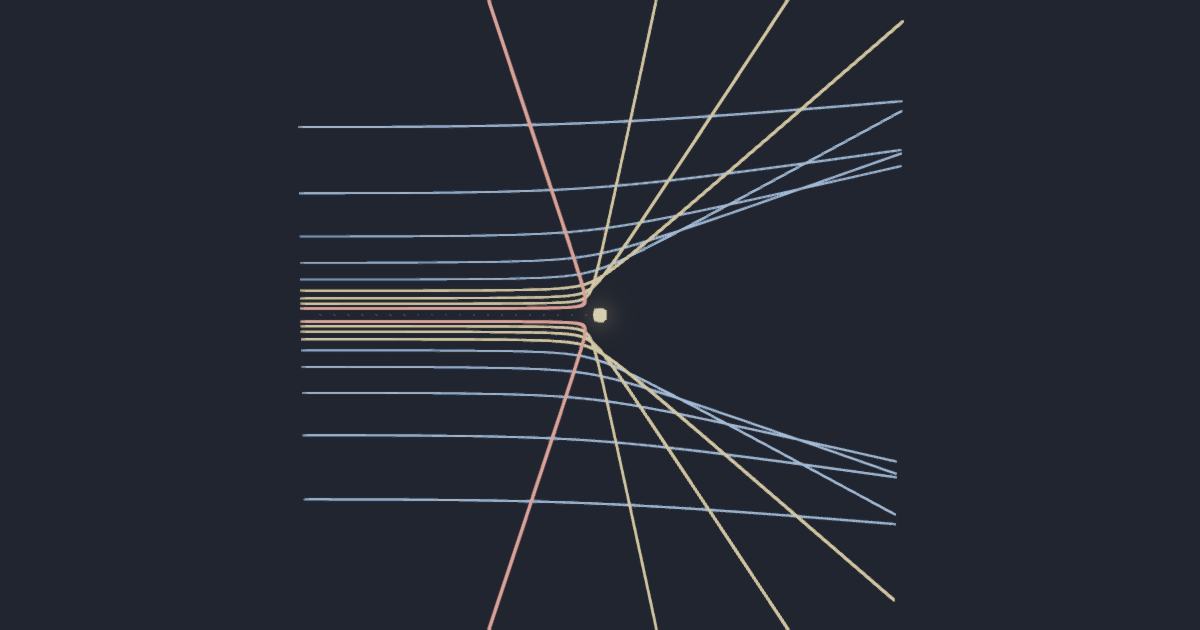
▶ Run the simulationSee the measured result
Units: dimensionless (log–log slope of dN/dΩ vs sin(θ/2), i.e. dσ/dΩ ∝ 1/sin⁴(θ/2))
Fire 7.7-MeV alpha particles (Z=2) at gold (Z=79) and treat each as a pure repulsive-Coulomb (1/r²) two-body problem. One length sets the whole pattern — the head-on closest approach D = k_e·Z₁Z₂e²/E — and the closed-form deflection of an alpha with impact parameter b is θ = 2·arctan(D/2b) (cross-checked by verlet-integrating the Coulomb hyperbola). Monte-Carlo a million alphas with impact parameters spread uniformly over the beam disk, histogram the deflection into solid-angle bins, and least-squares fit log(dN/dΩ) against log(sin(θ/2)).
the Rutherford exponent −4 — recovered as the SLOPE of a single straight line on log–log axes, giving the differential cross section dσ/dΩ = (D/4)² / sin⁴(θ/2). A 1/sin⁴(θ/2) tail is the unique fingerprint of scattering from a point Coulomb charge; Thomson's diffuse plum-pudding sphere has no such large-angle tail at all — it can never turn a fast, massive alpha straight back ("as if a 15-inch shell bounced off tissue paper"). From the same D the lab bounds the nuclear size: a head-on alpha gets no closer than D ≈ 3×10⁻¹⁴ m, so the gold nucleus is smaller than that — thousands of times smaller than the atom (~10⁻¹⁰ m), which is therefore almost entirely empty space. Geiger & Marsden's 1909 result and Rutherford's 1911 analysis — the discovery of the nucleus, the foundation under Bohr's hydrogen and Franck–Hertz
The experiment that found the nucleus, priced rather than quoted. Fire alpha particles at a gold foil and almost all of them go straight through - but about one in ten thousand comes back, and Rutherford called that as surprising as a fifteen-inch shell bouncing off tissue paper. What this page computes is the closed form that explains it, and it computes the whole of it out of a SINGLE LENGTH. D = ke*Z1*Z2*e^2/E, the head-on distance of closest approach, is assembled here from the two charges, the beam energy and two CODATA constants you type - nothing is stored - and every other number on the page is that one length wearing a different hat: the deflection theta(b) = 2*arctan(D/2b), its inverse b(theta) = (D/2)*cot(theta/2), the cross-section dsigma/dOmega = (D/4)^2/sin^4(theta/2), and the fraction of a beam that comes back past any angle, pi*b(theta)^2 per nucleus. THE INTERESTING NUMBER IS AN EXPONENT. Everything in front of sin^4 is a constant no detector measures absolutely; what Geiger and Marsden could measure is how the count FALLS with angle, and the answer is the fourth power. So this page tests it the way they did - as a ratio in which every constant cancels - and reads the exponent straight off as log(ratio)/log(sin ratio), which comes back -4.00000000000000 against the -4.00 the simulation above recovers as a least-squares fit over 40 angle bins without ever being told it. NO APPROXIMATED FUNCTION REACHES ANY FIGURE HERE. The arctangent is folded to z<=1 and halved five times through z/(1+sqrt(1+z^2)) - every term positive, so the reduction cancels nothing - then summed; the logarithm is reduced to [2/3,4/3) by exact halving and summed as 2*atanh((m-1)/(m+1)); and the sine and cosine are folded IN DEGREES rather than radians, which is the one choice on this page that beats the engine outright. For 45 <= h <= 90 the subtraction 90-h is exact in binary, so a cosine near its zero becomes the sine of a small exact angle: at h = 89.9999 degrees Math.cos is 1.2e-11 adrift while the fold used here is exact to the last bit against a double-double reference. That corner is not academic - it is cot(theta/2) at back-scattering, which is the entire subject. The rival is a ceiling rather than a name: spread the same charge uniformly through the atom and the field inside is capped, so one atom can deflect an alpha by at most D/R ~ 0.0125 degrees and a whole foil only reaches 0.49 degrees RMS - making 90 degrees a 182-sigma excursion with probability near 10^-7183. Thomson's atom cannot produce the observation at all, which is why one experiment killed it. Three things this page will NOT do. It will not integrate a trajectory - the simulation above verlets the Coulomb hyperbola from scratch and confirms the closed form to better than 0.5%, and that cross-check belongs to the lab. It will not do screened, relativistic or Mott scattering, which are different formulas for different questions. And it will not correct a single number the finding recovered: it prices closed forms, and the measured values belong to the simulation.
D = k_e·Z₁Z₂e²/E · θ(b) = 2·arctan(D/2b) · b(θ) = (D/2)·cot(θ/2) · dσ/dΩ = (D/4)²/sin⁴(θ/2) · σ(>θ) = πb(θ)² · Thomson cap θ ≈ D/R, θ_rms ≈ √N·θ