Measured by the lab
1.7239
How do frost, lightning, and mineral dendrites get their branching fractal shape — and how fractal is it?
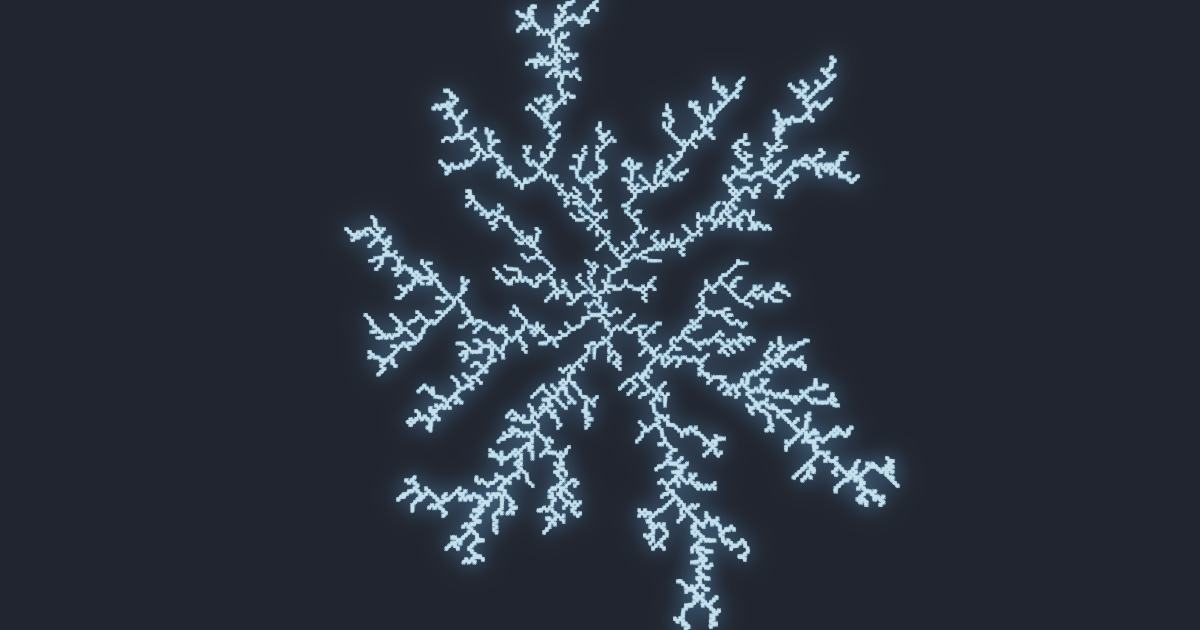
▶ Run the simulationSee the measured result
Units: dimensionless (mass fractal dimension D of 2-D diffusion-limited aggregation; secondary knowns: solid disk D = 2 exact, radial line D = 1 exact, Eden compact growth D = 2)
Grow a cluster from a seed by releasing random walkers that stick on first contact; measure D from the mass–radius scaling N(r) ∝ rᴰ over its scaling region, and — since one small cluster is a noisy sample — average D over many regrown clusters.
a branching, screened fractal with 1 < D < 2 (between a 1-D arm and a 2-D filled disk); ⟨D⟩ ≈ 1.65 (cluster-to-cluster spread ±0.06), stable across the cluster sizes reached, below the off-lattice canonical 1.71 — a square-lattice, cumulative-N(r) estimate honestly reads ~1.6–1.7 rather than exactly 1.71
A particle wanders in from far away and freezes where it first touches. Repeat a few thousand times and you get a branched aggregate — a copper deposit, a viscous finger, a lichen — whose mass grows with its radius as a power that is neither 1 nor 2. This page computes that power and everything that follows from it. Nothing this world measured is stored in the computation: every dimension below is ASSEMBLED as a logarithmic slope of a mass against a radius you supply, and the lab's nine readings are carried for SCORING only — zero every one of them and not a single computed number moves. The page defaults carry two real checkpoints from the oracle's own 16-cluster ensemble (N = 500 at ⟨R_g⟩ = 24.73113, N = 3600 at 77.973988), so the calculator starts from measurements rather than from a number chosen to make it agree. Three results here are not restatements of the finding above. The headline excess over the canonical 1.71 is, on its own, NOT statistically resolved — at 16 clusters it stands under one standard error, and 180 clusters would be needed to bring it to 3σ, which is exactly why the finding rests its finite-size claim on the paired band drift instead. The Eden rival, by contrast, needs no ensemble at all: it is separated by more than six standard deviations from a SINGLE cluster. And the screening that makes DLA fractal has a price in arithmetic nobody had taken — a cluster grown nine times heavier ends up only 70.33% as dense as it started, and would end up exactly as dense if D were 2. The one thing this page will not do is hand you DLA's dimension from a formula. There isn't one.
N ∝ R_g^D · D = ln(N₂/N₁) / ln(R_g₂/R_g₁) · R_g = (N/k)^(1/D) with k = N/R_g^D · ρ ∝ R^(D−d) · ρ₂/ρ₁ = (N₂/N₁)^(1−d/D) · n = (z·SD/Δ)² clusters to resolve a dimension gap Δ · rivals: Eden & solid disk D = 2, radial line D = 1, mean field (d²+1)/(d+1)