Measured by the lab
6.0247e-20
Why is energy quantized? When a quantum particle is trapped, can it have any energy — and what decides which energies are allowed?
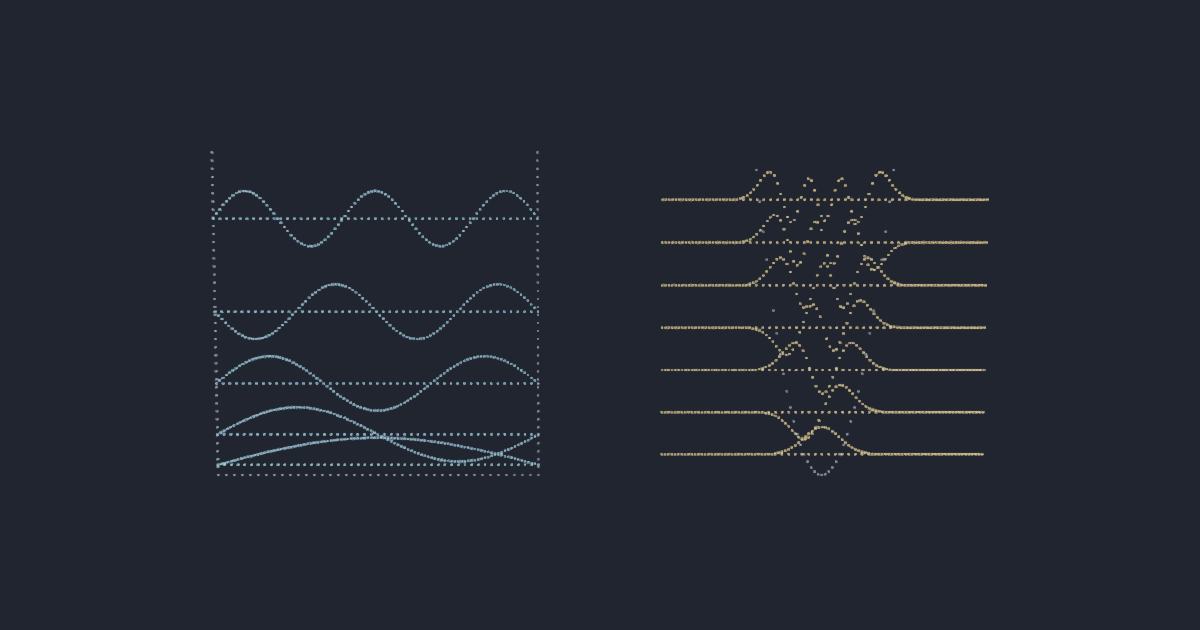
▶ Run the simulationSee the measured result
Units: J — E₁ = h²/(8 m_e L²) = 0.376030 eV for an electron in a 1 nm infinite square well (Schrödinger 1926; Griffiths §2.2)
Solve the time-independent Schrödinger equation −½ψ'' + V(x)ψ = Eψ by discretizing the Hamiltonian into a symmetric tridiagonal matrix and finding its eigenvalues with Sturm-sequence bisection (machine precision) and its eigenfunctions by inverse iteration. Compare two traps: the infinite square well and the harmonic oscillator V=½x².
only a DISCRETE ladder of energies survives — the wavefunction has to fit the trap, like a string's harmonics — and the SHAPE of the trap sets the spacing law. The box (∞ square well) gives E_n ∝ n² (levels fanning apart, recovered as E_n/E_1 = 1, 4, 9, 16, 25), because the particle is a standing wave with n half-wavelengths. The harmonic oscillator gives a perfectly EVEN ladder E_n = ω(n+½) — and a non-zero ground state E_0 = ½ω, the zero-point energy: Heisenberg forbids the particle from sitting still at the bottom. The energy levels are measured numerically (not assumed) and match the exact formulas to <0.01%
Trap a quantum particle and it stops being able to have any energy it likes. The wavefunction has to fit between the walls the way a guitar string fits between its bridges, so only whole half-wavelengths survive, and the surviving energies are n²h²/(8mL²) — a ladder whose rungs SPREAD apart as n² rather than stepping evenly. That spread is the whole fingerprint of a hard-wall trap, and it is what separates Schrödinger's answer from the one the old quantum theory gave: Planck's 1900 quantum was an equal-step ladder, and applied as a universal rule it puts the fifth level at five times the ground state where a box puts it at twenty-five. This lab fitted that exponent FREELY — ln E_n against ln n, levels indexed by rank order of energy and never by the law — and got 1.999996 ± 2.54e-6, which is 393,699 standard errors from the rival. Change the shape of the trap and the law changes with it: a harmonic well gives a perfectly even ladder ℏω(n+½), whose intercept is the zero-point energy that keeps a bond vibrating at absolute zero, and the same free fit recovers both the spacing and the half. None of those numbers is typed here. The level is assembled out of h, m and L; ℏ is h/2π; the trap's stiffness is assembled from a measured band wavenumber; and the module direction re-executes the shipped simulation's own Sturm-sequence eigensolver in your browser, twelve eigenvalues bisected from scratch, so you can watch all seven of its on-screen numbers round onto their theory labels while the doubles underneath never quite reach them. The measured-energy box holds the lab's own dynamically recovered 6.024692e-20 J rather than the textbook value, which is why inverting it returns 0.999997959 nm instead of a clean nanometre. Three things this page will not do: finite walls (real wells leak, and their levels sit below these), more than one particle, and any claim that the simulation above is exact — its own discretization bias is printed under the module direction, priced against the tridiagonal's exact spectrum.
E_n = n²h²/(8mL²) · L = n·h/√(8mE) · ΔE = (n′²−n²)h²/(8mL²), λ = hc/ΔE · E_n = ℏω(n+½), ω = 2πc·ν̃ · E_n/E_1 = n^p, p = 2 (box) vs 1 (equal-step rival)