Measured by the lab
4.9029
When an electron collides with an atom, will the atom accept any amount of energy (as a classical object should) — or only specific lumps?
▶ Run the simulationSee the measured result
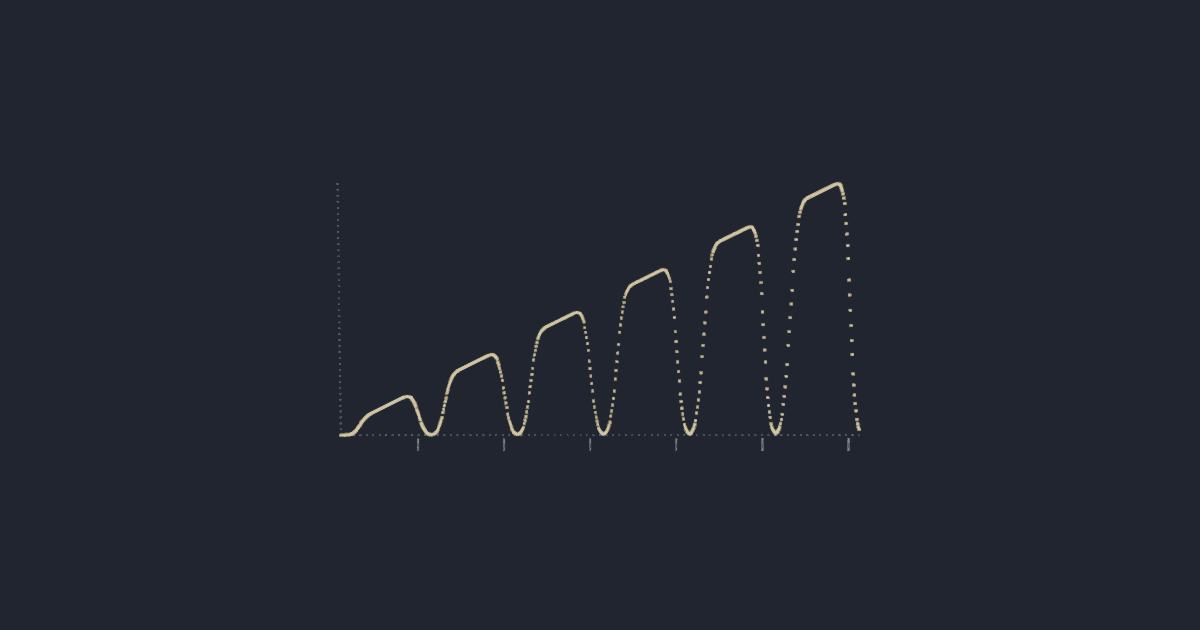
Fire electrons through mercury vapour, accelerated by a voltage V, past a small retarding potential V_r to a collector. Forward-model the collector current from energy bookkeeping: an electron excites a Hg atom (dumping E_exc = 4.9 eV) each time its running kinetic energy reaches that lump, and reaches the collector only if its residual energy clears V_r. Sample the I–V curve, detect the current dips, and least-squares fit each dip voltage against its index n.
the excitation energy E_exc = 4.90 eV — recovered as the SLOPE of a single straight line through the equally-spaced current dips (the dips repeat every 4.9 V because the mercury atom takes ONLY the one lump that lifts it 6¹S₀→6³P₁, never any energy offered); the de-excitation light λ = hc/E_exc = 254 nm, exactly the mercury UV resonance line Franck & Hertz saw the tube glow with; and from it Planck's constant h = E_exc·e·λ/c, the SAME h the blackbody, photoelectric, hydrogen, Compton and de Broglie worlds give. A classical atom, able to absorb a little from every collision, would give a smooth dip-free current — the dips exist only because energy comes in steps. Franck & Hertz's 1914 result (Nobel 1925), the direct collisional confirmation of Bohr's quantized levels and the sixth pillar of early quantum theory
An energy level, measured with a voltmeter. Franck and Hertz fired electrons through mercury vapour in 1914, raised the accelerating voltage, and watched the collector current collapse — not once, but again and again at equal intervals, roughly every 4.9 volts. That is the whole of it: an atom will not take any energy a passing electron offers, only one lump, and the lump is the interval between the collapses. The number on this page is therefore a SPACING and never a position, which is why E_exc is typed nowhere in the direction that recovers it: you hand it dip voltages and it hands back the slope of the straight line they lie on. Reading the energy off the FIRST dip instead is the classic mistake and this page prices it — the first dip sits about 0.73 V too high, because the tube's retarding potential and the contact potential between its electrodes ride on every absolute position and cancel out of every difference. The second half is the bridge to spectroscopy, and it is the most-used formula in the subject: an atom that took 4.9 eV gives it back as light, λ = hc/E, and with hc = 1239.84 eV·nm that lands at 253 nm — the ultraviolet line mercury lamps glow with, which Franck and Hertz saw their tube emit exactly at each dip. That conversion is assembled here out of h, c and e rather than typed, so moving any one of the three moves the answer, and it runs backwards too: the 253.65 nm line's own energy is 4.888 eV, which sits 0.25% BELOW the 4.9 V dip spacing. This page reports that gap rather than rounding it away — it is the contact potential, not a discrepancy in the physics. The rival is a dial rather than a paragraph: q mixes the two loss laws, so q = 1 reproduces the shipped simulation's comb bit for bit and q = 0 — an atom that absorbs a smooth, voltage-dependent fraction instead of a lump — produces a monotone current that the same dip detector throws out. Four things this page will not do: derive 4.9 eV from an atomic model (nothing here knows why mercury's level sits there), resolve the 6³P₁ from the 6³P₀ and 6³P₂ levels the real tube also excites, model ionization above 10.4 V, or claim that a dip voltage measured on a discrete sweep is finer than that sweep's own step.
V_n = n·E_exc + b ⇒ E_exc = slope of V_dip vs n · λ = hc/E_exc and E = hc/λ, hc assembled from h, c, e · ν = E·e/h · h = (E·e)·λ/c · dips in a sweep: N = ⌊(V_max−b)/E⌋ − ⌈(V_min−b)/E⌉ + 1 · grid bound on the slope: (ΔV/2)·Σ|n−n̄|/Σ(n−n̄)² · classical atom: R = T·E/(T+E), monotone, no comb