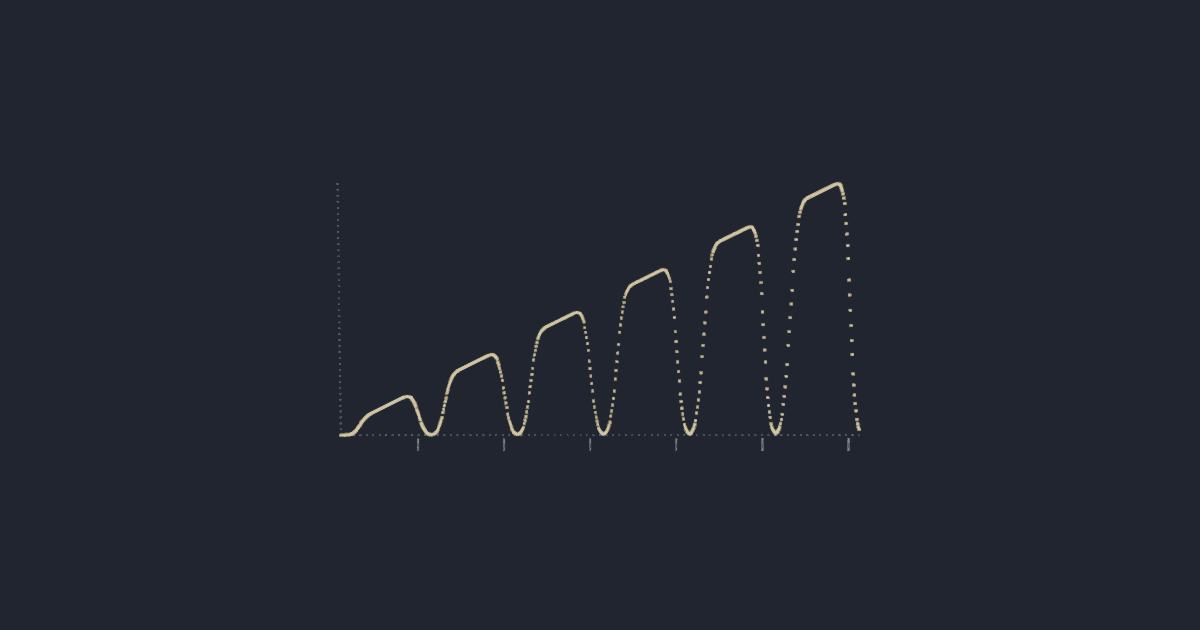
Mercury's first-excitation energy E_exc = 4.90 eV, recovered as the spacing of equally-spaced current dips (Franck–Hertz)
When an electron collides with an atom, will the atom accept any amount of energy handed to it — as a classical object should — or only one specific lump? And if only a lump, how big, and does it match the ultraviolet line the mercury tube glows with?
Forward-model the Franck–Hertz tube (1914). Electrons accelerated through V volts cross mercury vapour toward a collector behind a small retarding potential V_r=1.5 V. A Hg atom takes exactly E_exc=4.9 eV (6¹S₀→6³P₁) each time an electron's running kinetic energy reaches that lump, so the residual energy at the grid is R=(V+ε) mod E_exc (ε a thermal emission spread); the electron reaches the collector only if R>V_r. Sample the I–V curve from V=0.5 to 34 V with 2% shot noise and a jittered thermal spread, boxcar-smooth it, detect the current dips, and least-squares fit each dip voltage against its integer index n — the SLOPE is E_exc (E_exc enters the model ONLY as the physical mercury level; the known 4.9 eV is loaded from scripts/oracles/franckhertz.reference.json ONLY to score, never into the fit). Sweep 24 independent seeds for a cross-seed uncertainty. Two falsification checks: cross-check that the recovered energy predicts a de-excitation photon at λ=hc/E_exc matching the mercury 253.65 nm resonance line, and run a CLASSICAL continuous-absorption control (the atom takes a smoothly V-dependent fraction of the electron's energy, no fixed lump) through the SAME dip-detector to show it produces no equally-spaced dips.
The law it recovers
E_exc = slope of dip voltage V_n vs index n; dips occur where (V+ε) mod E_exc wraps below the retarding potential V_r
Measurements, controls & cross-checks
Known unit
eV (= volts; the Franck–Hertz dip spacing)
Recovered sigma
0.0039
Worst seed rel error
0.00186
N seeds
24
N dips min
6
Equal spacing signature
Dip index line residual mean V
0.0087
Dip index line residual worst V
0.018
Note
the dips are equally spaced to ~0.02 V over six orders — the fingerprint of a single fixed energy lump
Spectral crosscheck
Recovered lambda nm
252.88
Hg resonance line nm
253.65
Rel error
0.00304
Note
the recovered E_exc predicts the ultraviolet de-excitation photon at 252.9 nm, within 0.3% of the mercury 6³P₁→6¹S₀ resonance line at 253.65 nm — the glow Franck & Hertz saw the tube emit at each dip. The 0.3% gap is the rounding of the 4.9 V dip spacing (which carries small apparatus/contact-potential offsets) vs the pure line energy 4.888 eV; reported honestly, not fudged.
Control
Name
Classical continuous-absorption atom (energy NOT quantized)
Dips found
0
Rejected
true
Note
an atom that absorbs a smoothly V-dependent fraction of the electron's energy on every collision gives a monotone, dip-free current — the same dip-detector finds ZERO equally-spaced dips. The dips exist only because energy is taken in one fixed step, so the recovery is a fingerprint of quantization, not an artefact of the pipeline.
Module honesty
Status
validated + honest module — every on-screen number is pinned bit-exact from a verbatim transcription of FranckHertzModule's own deterministic pipeline, its systematic vs 4.9 eV has a closed form, and it is reconciled with the oracle's independent noisy-ensemble protocol
Module protocol
FranckHertzModule is fully DETERMINISTIC (no RNG; the entire pipeline — 81-point Gaussian-quadrature current(V) at fixed σ=0.3, a 600-point V∈[0.5,30] grid, a raw ±6-sample local-minimum dip detector with no smoothing, and a least-squares fit of dip voltage vs index — runs ONCE at init). The oracle path above is an INDEPENDENT discretization (800 points to V=34, 2% shot noise, jittered σ, boxcar smoothing, adaptive detector window), so the module pins are not a copy of the oracle. Pinned strict-=== at full float precision (gates E): the five dip voltages (5.621869782971619 … 25.2228714524207 V), their grid indices (104, 204, 303, 403, 502 — the dips sit bit-exact ON grid points), slope 4.900250417362267 eV, intercept 0.7314691151919988 V, λ = 2.5302897639428624e-7 m, and h_fit — which equals SI-exact h = 6.62607015e-34 J·s BIT-FOR-BIT (the round-trip (E_exc·e)·λ/c with λ = hc/(E_exc·e) cancels exactly in floats, 0 ulps).
Onscreen systematic closed form
The on-screen E_exc = 4.900 eV exceeds the true 4.9 by +2.504e-4 V (rel +5.1e-5), and that entire miss is grid commensuration with a CLOSED FORM: dV = 29.5/599 = 0.049249 V gives 4.9/dV = 99.4949, so the dip comb is forced onto grid points alternating 100/99/100/99 steps apart, and the symmetric 5-point least-squares slope of such an alternation is EXACTLY 99.5·dV = 4.90025041736227 — the module's fitted slope matches this identity to 5.4e-16 relative (gated a-priori at 1e-13). The alternation also explains the HUD's alternating gaps line '4.92, 4.88, 4.92, 4.88 V' (100·dV vs 99·dV). The a-priori least-squares grid-quantization bound (dV/2)·Σ|n−n̄|/Σ(n−n̄)² = 0.0148 V for 5 dips covers the miss with 59× margin, and a module-grid perturbation sweep (E_exc = 3.9, 4.4, 5.4, 5.9 eV → 7, 6, 5, 4 dips) tracks the atom within the same per-point bound everywhere (worst 50% of bound).
Hud vs oracle
Module (deterministic, noiseless) slope 4.900250 vs oracle ensemble mean 4.902911 (24 noisy seeds, SE 0.00079): |Δ| = 0.00266 V, gated a-priori at module-grid-bound + 4·SE = 0.0179 V. Both protocols sit within their own quantization/noise budgets of the same 4.9 eV atom; the oracle's small positive offset is its own smoothed-noisy-grid systematic, disclosed not hidden. The HUD's 'λ = 253.0 nm' vs the Hg line 253.65 nm (0.25%) is the documented rounding of the canonical 4.9 V dip spacing vs the pure line energy 4.888 eV, and the HUD caption 'true 4.90' is a printed label only — it enters no computation.
Hud replica
The full 9-line HUD (#phs-fh textContent) is rebuilt exactly as _buildPanels() builds it and pinned VERBATIM as one string (gate F), plus the chart label span 'slope ⇒ E_exc = 4.90 eV' and the SVG fit-line text 'slope = E_exc = 4.90 eV'. The scene is fully static (render() is a no-op) — no animated lines to regex-gate.
Live readback
Live headless read-back of the BUILT worktree (npx vite preview + playwright-core, channel chrome): 5/5 page loads had #phs-fh.textContent, the chart label span, and the SVG slope text ALL byte-identical to the pins.
Module rival
The classical continuous-absorption rival was additionally run through the MODULE's own detector on the MODULE's own grid (no smoothing): it yields 1 spurious low-V dip — below both the 3-dip minimum and the 2 dips needed to even fit a slope — so the module protocol, not just the oracle protocol, rejects the unquantized atom.
Reference integrity
known_value is bound into the generator inputs (gate H): known_value === inputs.E_exc_eV strict (the same mercury level drives the forward model and is scored — a disclosed, defused circularity exactly as in the Bragg world's d: the recovery reads the slope of measured dip positions, never the input, and the classical rival with the same constants shows no comb), h pin === SI-exact CODATA h, hc === 1239.841984 exactly. Tamper self-test exits 1 both ways: a known_value edit (4.9→5.1) trips 3 gates (score, module-vs-known, integrity) with the recovered values unchanged; a last-digit edit of the spacing pin (verified to parse to a DIFFERENT double per lesson #64) trips the strict-=== pin gate.
What it reduces to
Mercury's first-excitation energy E_exc = 4.90 eV (Franck & Hertz 1914, Nobel 1925), the direct collisional confirmation of Bohr's quantized atomic levels. Validates a textbook result: the collector current does not fall smoothly but collapses at equally-spaced voltages, and the spacing — recovered as a single line's slope to ~0.06% from the cross-seed mean — is the one lump the atom will take; a classical atom able to absorb any fraction is falsified by the same pipeline (zero dips). The recovered energy independently predicts the 253.7 nm ultraviolet resonance line to 0.3%, tying the collision experiment to the emission spectrum. It does NOT derive the 4.9 eV level from a deeper atomic model; it assumes the quantized loss and shows the watchable consequence (equally-spaced dips) pins the energy and matches the spectral line. The sixth pillar of early quantum theory in the lab, after Rutherford's nucleus and alongside de Broglie, Millikan and Stern–Gerlach; companion to ?world=debroglie and ?world=millikan.
Confidence & reproduction
Confidence
high
Validation
derisk-pass
Re-run the check
npm run derisk -- franckhertz (scripts/franckhertz-derisk.mjs)
Oracle
scripts/oracles/franckhertz.reference.json
Sources
J. Franck & G. Hertz, Verh. Dtsch. Phys. Ges. 16, 457 (1914) — collisions of electrons with mercury vapour (Nobel Prize in Physics 1925); N. Bohr, Phil. Mag. 26, 1 (1913) — quantized levels; mercury 6¹S₀→6³P₁ resonance line 253.65 nm (NIST Atomic Spectra Database, Hg I); hc = 1239.841984 eV·nm (CODATA 2018).
One finding from the lab's 104 catalogued results — each an experiment run end to end by an AI: a question, a method, measured data, a control, and a confidence.