Measured by the lab
0.499721
If individuals are mostly tolerant — happy unless TOO few neighbours match — does a mixed society stay mixed, or split apart?
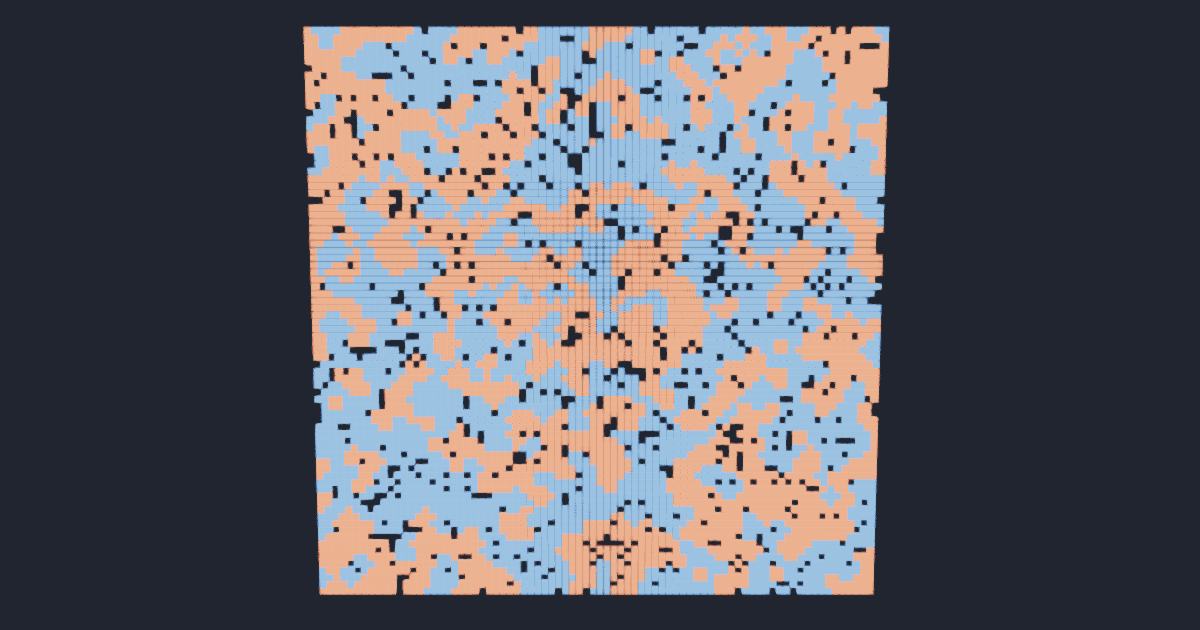
▶ Run the simulationSee the measured result
Units: E[S] on the initial random board — exact at every grid size and vacancy (binomial symmetry)
Two kinds of agent on a grid with a few empty cells; an agent hops to a random empty cell only when fewer than a tolerance fraction T of its occupied neighbours match. Sweep T and measure the segregation index S — the mean same-kind fraction over all neighbourhoods (random ≈ 0.50).
stark segregation from mild preference: S rises far above what anyone wants — at T ≈ 0.31 (each agent content with just ⅓ like-kind), S ≈ 0.76, three-quarters same-kind, with nobody unhappy. The tolerant micro-rule produces a starkly divided macro-pattern; only at T = 0 does it stay mixed (S ≈ 0.50). Demanding too much backfires: by T ≈ 0.875 no arrangement satisfies everyone, so the board never settles (perpetual churn) and segregation collapses back toward S ≈ 0.5