Measured by the lab
6.5932e-34
If light (a wave) carries particle momentum, does matter run the symmetry the other way — does a particle like the electron have a wavelength, and diffract?
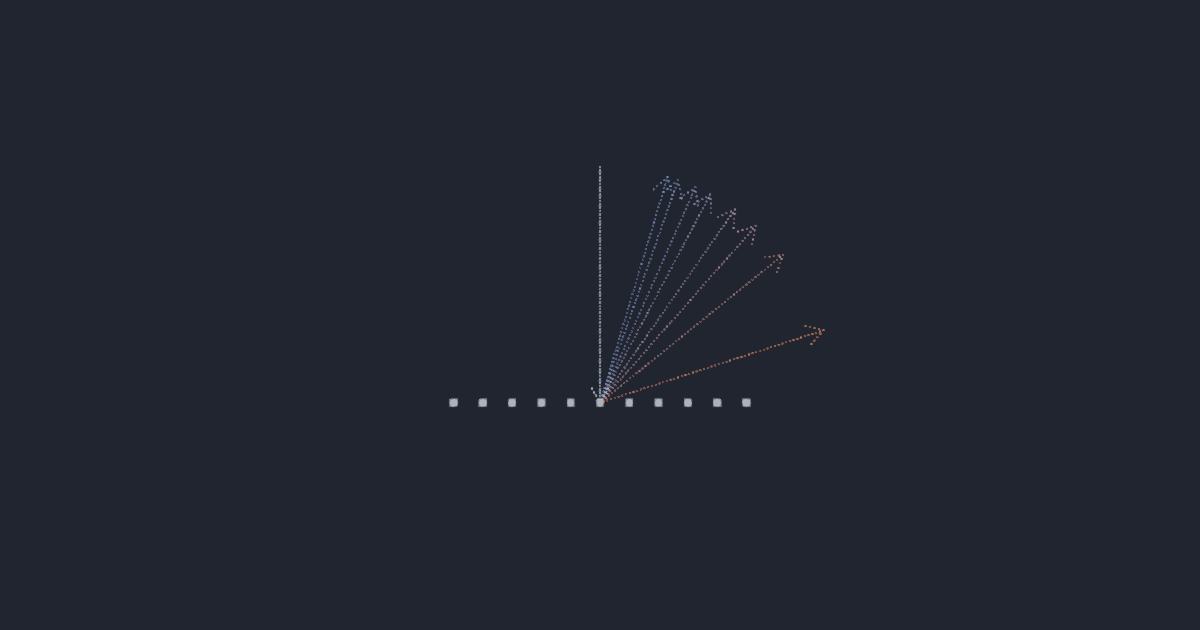
▶ Run the simulationSee the measured result
Units: J·s (CODATA-2018 Planck constant, exact since the 2019 SI)
From eV = p²/2mₑ for an electron accelerated through V volts, take de Broglie's hypothesis λ = h/p = h/√(2mₑeV). Treat a nickel crystal as a diffraction grating: surface atoms spaced d apart send a first-order peak to the angle φ where d·sin φ = λ. Read λ off each peak angle across eight accelerating voltages and least-squares fit λ against 1/√V.
Planck's constant h = 6.626×10⁻³⁴ J·s — recovered as the SLOPE of a single straight line through the origin (intercept ≈ 0), and it is the SAME h the blackbody and photoelectric experiments give for light: one constant for waves AND particles, the core of wave–particle duality. The de Broglie scaling exponent −½ (fit of log λ vs log V) is the matter-wave fingerprint — a photon of energy eV would give λ ∝ 1/V, exponent −1. Cross-checked against Davisson & Germer's actual 1927 datum: 54 V electrons peak at φ = 50°, λ = 1.65 Å, within ~1% of de Broglie's 1.67 Å. The fifth pillar of early quantum theory, and the exact converse of Compton scattering
Planck's constant, weighed with a protractor. Fire electrons at a nickel crystal, swing a detector until the beam flares, and the angle alone hands back h — because the wavelength is d·sin φ, a pure piece of geometry with no constant in it, and the momentum is √(2mₑeV), a pure piece of kinematics with no h in it, so their PRODUCT is Planck's constant and nothing on this page ever typed it. That is the whole of Davisson–Germer 1927, and it is the one thing this world's own on-screen readout cannot do: the simulation generates its wavelengths from CODATA h and fits them straight back, which the finding discloses as a self-consistency identity rather than a measurement. Here h is measured. Fed the actual 1927 datum — 54 V electrons peaking at 50° off rows 2.15 Å apart — it returns 6.538889508e-34 J·s, which is 1.3157% under the defined SI value, and that gap is not a defect of the arithmetic: it is the historical experiment's own, the same 1.3% the lab's finding quotes, arriving here as an output instead of a citation. The photon hypothesis dies on this page geometrically rather than statistically: a photon carrying 54 eV is 226.58 Å long, 105 times the row spacing, so it has no first-order angle to be found at — you would need 5.77 kV of X-rays before light could diffract off this crystal at all. And two clean voltages difference to an exponent of exactly 0.500000000 with no fit anywhere, against the lab's noisy eight-voltage −0.4987 ± 0.0015, which sits 0.87 bars away. Four things this page will not do: re-run the simulation, model the inner potential that really shifts nickel's peaks, resolve the Kα-style splitting of a thermal electron beam, or correct the finding above.
λ = h/√(2mₑeV) · d·sin φ = mλ · h = (d sin φ/m)·√(2mₑeV) · λ ∝ V^(−κ), κ = ½ matter / 1 photon · λ_rel/λ = 1/√(1 + eV/2mₑc²)