Measured by the lab
0.3353
Why does a growing surface get rough — and does a tiny change in the local growth rule change HOW rough it gets?
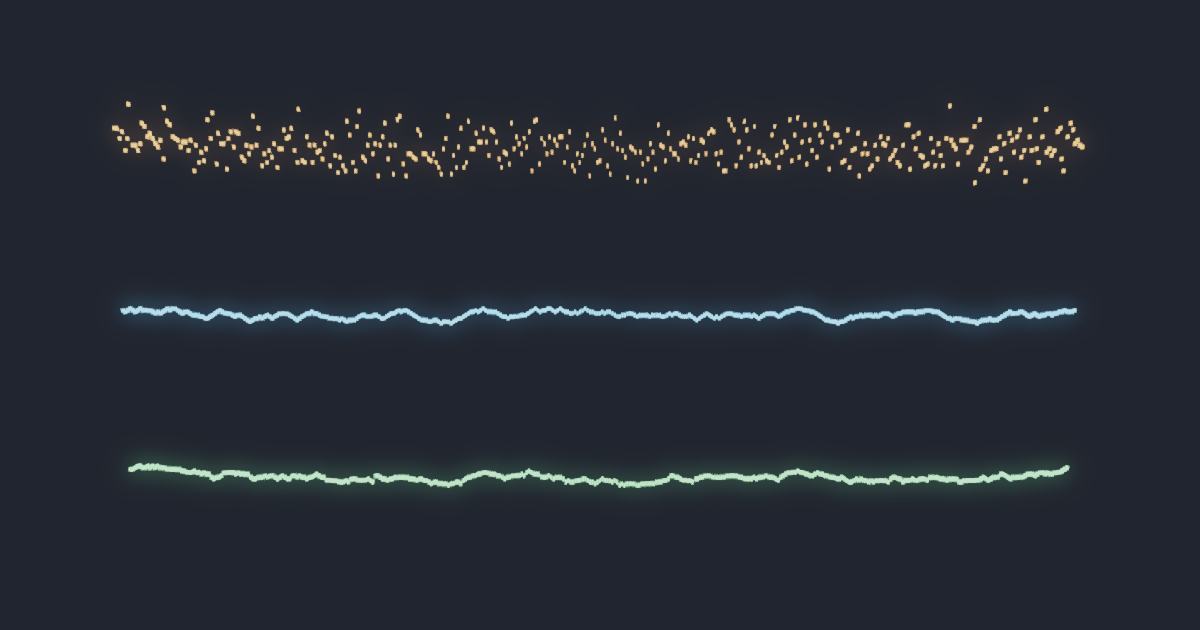
▶ Run the simulationSee the measured result
Units: dimensionless (KPZ/RSOS growth exponent β, W∝t^β in 1+1 D; secondary knowns: random deposition β = 1/2 exact, Edwards–Wilkinson relaxation β = 1/4)
Drop particles on a 1-D line of columns under three rules at once (land-on-top, KPZ/RSOS, and relax-to-lowest-neighbour) and measure each interface's roughening exponent β from the log-log slope of the width W(t) ∝ t^β, averaged over many regrown cycles.
three distinct universality classes selected by the rule alone: random deposition β = ½ (uncorrelated columns — exact by construction), KPZ/RSOS β ≈ ⅓ (the Kardar–Parisi–Zhang class), and Edwards–Wilkinson relaxation β = ¼ (diffusive smoothing). Measured ⟨β⟩ ≈ 0.50 / 0.30 / 0.24: RD nails ½; KPZ sits a few % below ⅓ — a stable corrections-to-scaling bias of this RSOS estimator that does NOT shrink as the lattice grows, not a textbook mismatch; EW is consistent with ¼ at this size (it carries log corrections in 1+1 D)
How fast a growing surface gets rough, and which of three universality classes a measured exponent belongs to. The whole content of this world is that the answer is set by the LOCAL RULE and not by the noise: the simulation above drives all three deposition rules from one shared column-selection stream and still gets three different exponents, 0.4972 / 0.3353 / 0.2396, with the adjacent pairs 17σ and 6.8σ apart. Nothing this calculator is about is typed into it — no 1/3, no 1/4, no 3/2 appears anywhere in its code. Two primitives are declared instead, a random walk's ln√2/ln2 and a diffusive length's ln4/ln2, and every exponent on the page is assembled from those through β = α/z and, for KPZ alone, the Galilean relation α + z = 2; the same refusal to inject the answer is what makes the simulation non-circular, since its generator codes only the three local deposition rules and a variance sum, with no power law and no exponent anywhere in its recovery path. The measured-β box defaults to 0.29610 ± 0.00756, and that is deliberate: it is what the SHIPPED on-screen module actually reads for its RSOS rule at L = 384 over a fit window that reaches into the early intrinsic-width transient, not the clean 0.3353 the oracle recovers at L = 2048 — so the page classifies it at 4.93σ from 1/3 and refuses to call it KPZ, which is the −11.2 % window bias this world prices rather than hides. Four things this lab does NOT measure, so the calculator does not pretend to: dimensions above one, since every exponent here is the 1+1 D value — 2+1 D KPZ has no exact solution at all and EW roughens only logarithmically there, so none of these numbers carry over to a real film on a real substrate; the dynamic exponent itself, which is theory on this page and not a recovery — the world discriminates its classes by β, and the z box tells you what a crossover measurement WOULD say rather than what this lab measured; the height distribution, which is where modern KPZ actually lives (Tracy–Widom GOE/GUE fluctuations), while this world measures only the second moment, the width; and everything that makes deposition physical — no rate, no temperature, no desorption, no surface diffusion, no substrate, just integer columns on a line.
W(L,t) = L^α·f(t/L^z), f(u) → u^β for u ≪ 1 · β = α/z · KPZ: α = 1/2 and α + z = 2 ⇒ z = 3/2, β = 1/3 · EW: z = 2 ⇒ β = 1/4 · random deposition: W² = t ⇒ β = 1/2