Measured by the lab
3.7009
What phase of matter does an emergent Particle Life world form — a gas, a liquid, or a crystal?
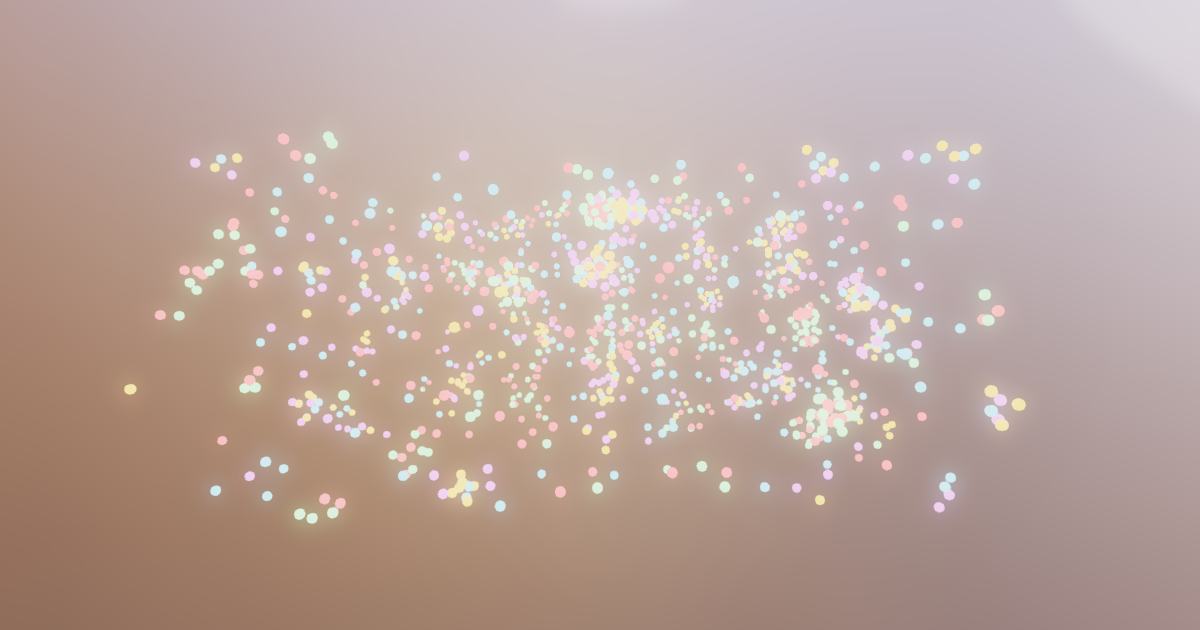
▶ Run the simulationSee the measured result
Units: dimensionless g(σ⁺) at η = 0.40 (ρσ³ = 0.7639437), Carnahan–Starling
Measure the pair-correlation function g(r) — the radial distribution function from statistical mechanics — by time-averaging a toroidal histogram of every pairwise separation over the live field, normalised so g = 1 means 'as likely as random'.
the g(r) shape: flat g ≈ 1 (gas), a first peak with damped oscillations (liquid, short-range order), or many sharp peaks (crystal). A first peak far above ~3 signals two-phase coexistence (dense droplets in gas), since g(r) is normalised by the global density
The whole pressure of a fluid, read off one number of its structure. Hard spheres do not attract, do not soften and have no energy scale at all — the only thing a pair of them can do is fail to overlap — and yet at η = 0.40 a second sphere is 3.70 times more likely to be found touching a given one than anywhere in an ideal gas. That number is not a curiosity: for a potential that is a wall, the virial pressure collapses onto the contact value, so Z = 1 + 4η·g(σ⁺) and the equation of state IS the structure. Nothing on this page assumes a pressure law. One function is declared — the contact value — and every pressure printed here comes out of the contact theorem applied to it, which is why the independently spelled Carnahan–Starling, Percus–Yevick-virial and Percus–Yevick-compressibility polynomials can be scored against it rather than trusted. That scoring is where the page earns its keep: the two Percus–Yevick routes are exact solutions of the same closure that disagree with each other, one 10.0% below the truth and one 5.0% above, and their 2:1 blend is Carnahan–Starling exactly — a fact this page computes, to the last bit, rather than quoting. The simulation above measures that bracket and lands inside it. The measured box holds 3.7009, this lab's own six-seed reading off raw overlap-rejection Monte Carlo, not the textbook 3.7037, so inverting it returns η = 0.39982688 and the page reports the −0.043% instead of rounding it away. One direction contains no equation of state whatsoever — η = (π/6)ρσ³ is geometry, and it is where the box edge, the freezing packing and the module's own 0.0692806σ histogram bin are assembled from a count of spheres. Five things the page refuses: any attraction, the crystal above η = 0.494, the metastable branch, the exact virial coefficients beyond B₃ (it carries B₄* and B₅* as numbers to score against, because nobody has a closed form for them), and correcting the simulation above.
g(σ⁺) = (1 − η/2)/(1 − η)³ · Z = 1 + 4η·g(σ⁺) = (1 + η + η² − η³)/(1 − η)³ · η = (π/6)ρσ³ · PY virial g = (1 + η/2)/(1 − η)², PY compressibility g = (4 − 2η + η²)/(4(1 − η)³) · g_CS = (2·g_PYc + g_PYv)/3