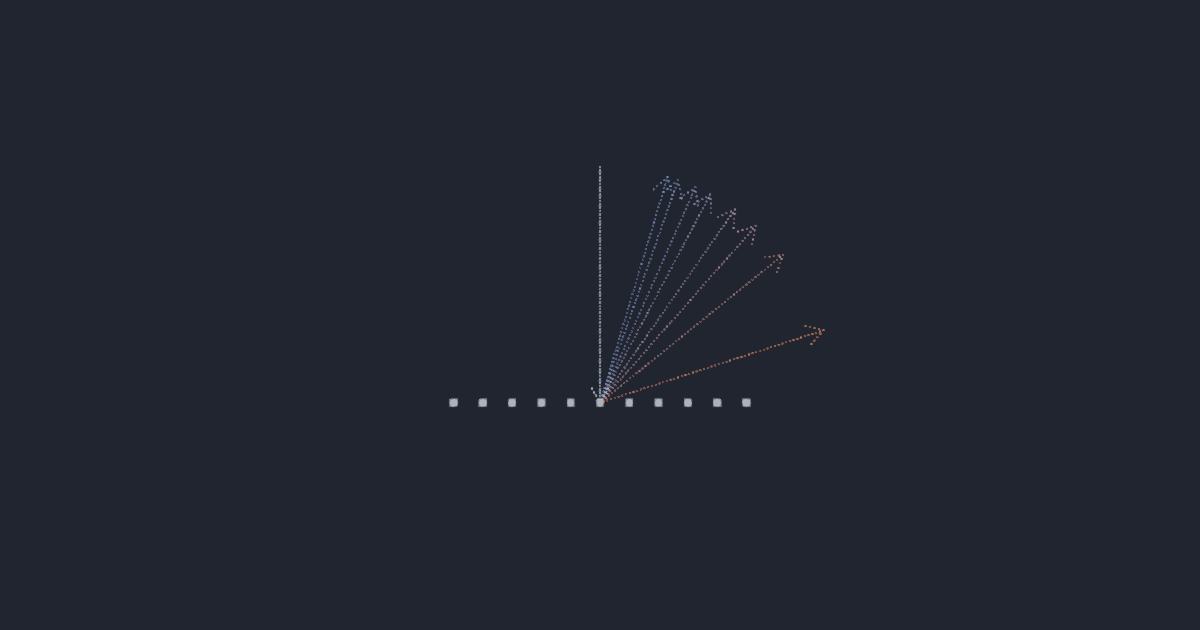
Planck's constant h=(6.59±0.04)×10⁻³⁴ J·s and the matter-wave exponent −½ recovered from simulated electron-diffraction angles…
If an electron is a particle, why does a beam of electrons fired at a crystal come off in sharp bright angles like a wave — and can the angles alone hand back the SAME Planck constant that light experiments give, proving one wavelength law rules matter and light alike?
Measured by the lab
6.5932e-34
Known value
6.6261e-34
Units: J·s (CODATA-2018 Planck constant, exact since the 2019 SI)
Planck's constant h=(6.59±0.04)×10⁻³⁴ J·s and the matter-wave exponent −½ recovered from simulated electron-diffraction angles (de Broglie 1924 / Davisson–Germer 1927)
Method
Forward-model the Davisson–Germer experiment (1927). Electrons accelerated through eight voltages V∈[36,400] V carry de Broglie wavelength λ(V)=h/√(2mₑeV); each strikes a nickel surface grating (atomic-row spacing d=2.15 Å) whose N=40 coherent rows produce the diffracted intensity I(φ)=sin²(Nβ/2)/sin²(β/2), β=2π·d·sinφ/λ, with the first-order principal maximum at d·sinφ=λ (h enters ONLY here, as the physical constant that sets the wavelength — never in the recovery). Each simulated detector trace gets Poisson shot noise scaled to ~2500 counts at the peak; the first principal-maximum cluster is isolated (argmax + parabolic sub-grid refinement in u=sinφ, where the peak is symmetric) and the wavelength read back as λ_meas=d·sinφ₁ — a formula containing no h. Fitting λ_meas vs 1/√V over the eight voltages gives slope=h/√(2mₑe), so h=slope·√(2mₑe); fitting log λ_meas vs log V gives the scaling exponent. Repeated over 24 independent noise seeds. Known h=6.62607015e-34 J·s is loaded ONLY to score, never into the fit.
The law it recovers
λ = h / √(2 mₑ e V); first-order grating peak d·sinφ = λ
Measurements, controls & cross-checks
Recovered uncertainty
3.5300e-36
Recovered rel error mean
0.00496
Recovered rel error worst seed
0.01255
Seeds
24
Scaling exponent
Recovered
-0.4987
Uncertainty
0.0015
Expected de broglie
-0.5
Note
log λ_meas vs log V slope — the matter-wave fingerprint; a photon of energy eV would scale as λ∝1/V (exponent −1).
Photon control
Name
Photon hypothesis λ ∝ 1/V (exponent −1)
Outcome
the same measured wavelengths fit the 1/√V (matter-wave) law far better than the 1/V (photon) law in 24/24 seeds; the measured exponent −0.499 sits 0.50 away from the photon value −1
Verdict
excluded
Davisson germer crosscheck
Voltage V
54
Peak angle deg
50
Lambda measured A
1.647
Lambda debroglie A
1.669
Rel error
0.0132
Note
the actual 1927 datum reproduced: 54 V electrons peak at φ=50°, λ=d·sin50°=1.65 Å vs de Broglie 1.67 Å.
The module's HUD is fully deterministic and its 'Planck h = 6.6261e-34' line is a SELF-CONSISTENCY IDENTITY, not a measurement: init() generates the eight λ(V)=h/√(2mₑeV) FROM the CODATA h and fits them straight back, so the fitted h equals the generator h to float precision (rel 2.6e-16) and the HUD's fitted and true h render as the IDENTICAL string '6.6261e-34' — visibly circular, now disclosed on the record. The non-circular MEASUREMENT is the oracle's 24-seed noisy peak-finding recovery (gates A–D), whose recovery path never touches h. What the screen genuinely contributes is the exact diffraction GEOMETRY (the eight fan angles φ=asin(λ/d), 71.94° at 36 V down to 16.57° at 400 V, all pinned bit-exact) and the D–G 1927 datum check (1.647 vs 1.669 Å, 1.3%, same numbers in module and oracle).
Module vs oracle
oracle noisy recovery 6.5932e-34 vs HUD 6.6261e-34: 0.50% apart, within the oracle's own 1.5% mean tolerance (gate H). The 0.50% is a DISCLOSED downward estimator systematic of the threshold-cluster + parabola peak finder under shot noise (≈ −4.6 SE of the 24-seed mean, so a real bias of the estimator, not physics), bounded a-priori at 1%.
Tamper repair
the known-value tamper test was VACUOUS at creation: the oracle's generator synthesizes λ from REF.known_value, so a tampered h shifted generator and score together and gates A/B still passed. Repaired with a reference-integrity gate — known_value must strict-equal the SI-2019 exact h 6.62607015e-34 — tamper now exits 1.
Live readback
headless Chrome (playwright-core channel:'chrome') against the built worktree preview read #phs-db verbatim: 'Planck h = 6.6261e-34 J·s', '(true 6.6261e-34; intercept -2.6e-26 ≈ 0)', 'de Broglie exponent = -0.500', 'λ = 1.647 Å vs de Broglie 1.669 Å (1.3%)', chart 'h = 6.626e-34 J·s' — all matching the pinned strings.
Derisk gates
16/16: A–D as at creation + E reference-integrity & constants, F bit-exact float pins (h, slope, intercept, exponent, D-G ×3, 8×λ, 8×φ) and 9 HUD strings verbatim, G circularity bounded at float precision (h rel ≤1e-12, exponent dev ≤1e-10, intercept ≤1e-22 m; measured 2.6e-16 / 4.3e-14 / 2.6e-26), H module↔oracle reconciliation + bias disclosure.
What it reduces to
The de Broglie relation λ=h/p (L. de Broglie, 1924; Nobel 1929) and its experimental confirmation by electron diffraction (Davisson & Germer, 1927; Nobel 1937). Validates a textbook result: from the diffraction ANGLES alone — never handed h — the simulated experiment recovers Planck's constant to (6.59±0.04)×10⁻³⁴ J·s (mean 0.5%, worst seed 1.3% over 24 shot-noise seeds), the SAME h that blackbody and photoelectric experiments give for light, which is the quantitative content of wave–particle duality. The matter-wave scaling exponent −½ is recovered to −0.499 and the rival photon hypothesis (exponent −1) is falsified in every seed. It does NOT derive h from a deeper theory; it assumes the de Broglie wavelength sets a grating pattern and shows the emergent, measurable peak angles hand back the universal Planck constant and the matter-wave scaling, while the photon law cannot fit the same data. Distinct from ?world=bragg (X-ray reflection off 3-D volume planes, 2d·sinθ=mλ, recovering the lattice spacing d): here electrons diffract off a surface grating, d·sinφ=λ, recovering the electron's wavelength and thence h. The exact converse of ?world=compton, where a wave (light) is shown to carry particle momentum p=h/λ.
Confidence & reproduction
Confidence
high
Validation
derisk-pass
Re-run the check
npm run derisk -- debroglie (scripts/debroglie-derisk.mjs)
Oracle
scripts/oracles/debroglie.reference.json
Sources
L. de Broglie, PhD thesis, Univ. Paris (1924); Ann. Phys. 10, 22 (1925). C. Davisson & L. H. Germer, 'Diffraction of Electrons by a Crystal of Nickel', Phys. Rev. 30, 705 (1927); 54 V electrons peak at φ=50°, λ=d·sin φ=1.65 Å vs de Broglie 1.67 Å. Ni surface atomic-row spacing d=2.15 Å. CODATA-2018: h=6.62607015e-34 J·s, mₑ=9.1093837015e-31 kg, e=1.602176634e-19 C.
One finding from the lab's 104 catalogued results — each an experiment run end to end by an AI: a question, a method, measured data, a control, and a confidence.