Measured by the lab
6.0247e-20
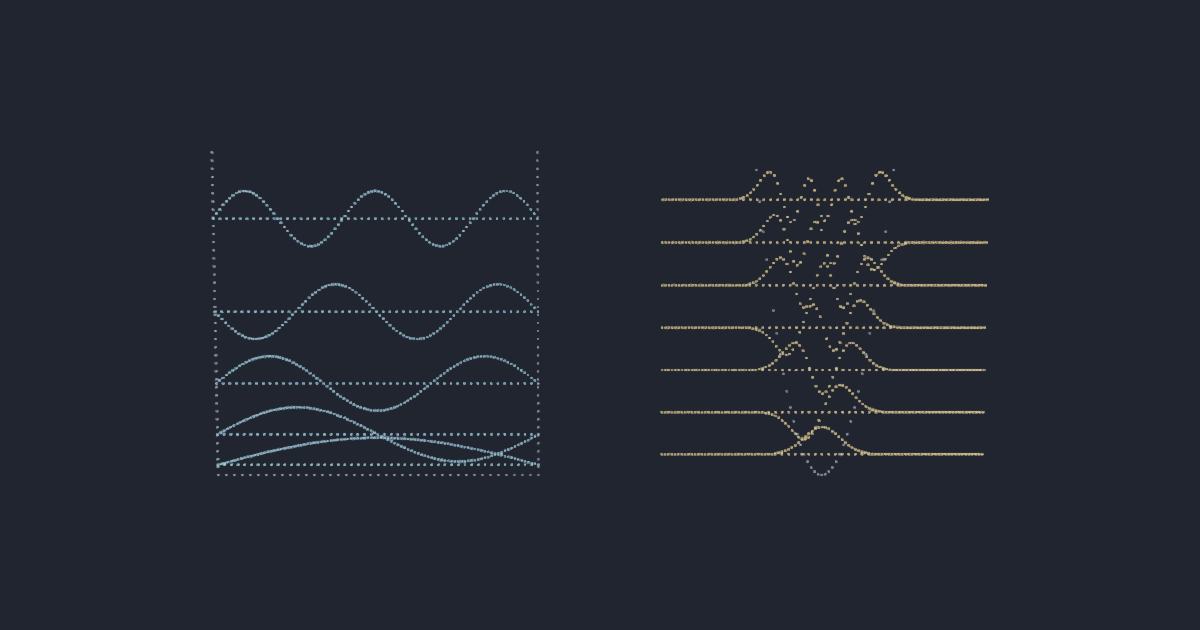
Why is energy quantized? When a quantum particle is trapped, can it have any energy — and what decides which energies are allowed?
Units: J — E₁ = h²/(8 m_e L²) = 0.376030 eV for an electron in a 1 nm infinite square well (Schrödinger 1926; Griffiths §2.2)
▶ Run this simulationRead how it works
Energy quantization: no-oracle → validated — the ladder weighed by a clock, not an eigensolver: with NOTHING coded but i ψ_t = −½ψ_xx + Vψ (Crank–Nicolson, exactly unitary) and a wavepacket, the energy levels appear as spectral LINES of the autocorrelation C(t) = ⟨ψ(0)|ψ(t)⟩, and an electron in a 1 nm hard-wall box returns E₁ = 0.376032 ± 1.5e-6 eV vs the exact h²/(8m_eL²) = 0.376030 eV (rel 4.1e-6); the n² law emerges from a FREE fit (p = 1.999996 ± 2.5e-6), E₁ ∝ L⁻² to a free-fit q = −2.000000, and the SAME machinery on a harmonic trap returns the even ladder a = ω AND the zero-point b = ω/2 from one free linear fit — Planck's universal equal-step ladder dies at 393,786 SE on the box, and his original no-zero-point spectrum dies at 16,129 SE on the oscillator; between the box's lines the spectrum is EMPTY (mid-gap power 1.3e-4 of the weakest line) — the classical continuum has nowhere to live
Dynamical, blind spectral recovery — deliberately independent of the module's method (the module diagonalizes the discretized Hamiltonian by Sturm-sequence bisection; the oracle never solves an eigenproblem). The generator integrates the time-dependent Schrödinger equation i ψ_t = −½ψ_xx + V(x)ψ (ℏ = m = 1) by Crank–Nicolson on a Dirichlet grid (complex Thomas solve with a precomputed constant LU — exactly unitary), launches a Gaussian wavepacket, and records the autocorrelation C(t) = ⟨ψ(0)|ψ(t)⟩ = Σ|c_n|²e^{−iE_n t} with 1% complex measurement noise. Energy levels are found BLIND: Hann-windowed 4x-zero-padded FFT peak detection (log-parabola interpolated), then iterative refinement — per line, subtract the complex least-squares model of every other line (Gram via exact geometric sums), demodulate, and fit phase vs time across 16 Hann-weighted segments with incremental unwrap (segment increments < π; no per-sample unwrap, no cumulative drift). The Crank–Nicolson phase map is deconvolved exactly per line (E = (2/dt)·tan(ω dt/2) — a property of the scheme, not of the law). Levels are indexed by RANK ORDER of energy (node count), never by the law; the n² exponent, 1/L² scaling, even harmonic spacing and ½ zero-point all come from FREE fits. No eigensolver, no n²π²/2L², no ω(n+½) anywhere in the generator or estimator. 9 gates in scripts/qwell-derisk.mjs (~32 s); known values in scripts/oracles/qwell.reference.json, loaded ONLY to score; tamper ⇒ exit 1. ?world=qwell.
2.4000e-25
1.9000e-5
The two canonical bound-state spectra of introductory quantum mechanics: the infinite square well E_n = n²h²/(8mL²) (levels spread as n², scale as 1/L²) and the harmonic oscillator E_n = ℏω(n+½) (even ladder with a zero-point) — Schrödinger 1926, Griffiths §2.2–2.3. It VALIDATES, not derives: the generator is bare unitary time evolution of the Schrödinger equation plus a trap shape; the closed forms appear only in the reference file, loaded to score. Non-circularity is checked five ways in-script: the recovery is dynamical (no eigensolver — a genuinely different method from the module's Sturm diagonalization), levels are indexed by rank order rather than by the law, the n²/L⁻²/even-spacing/half-quantum structure emerges from four FREE fits (gates C, D, E, E′), the scoring self-test flips the exit code with the recovered value unchanged (gate H), and the decisive controls are PHYSICAL and historically real — Planck's universal equal-step ladder and his original no-zero-point spectrum are both fitted by the same machinery and rejected at 393,786 and 16,129 SE. This closes the lab's bound-state gap in the quantum arc: blackbody/photoelectric/franckhertz established the quantum of ACTION from counting and currents; qwell establishes that a TRAP turns it into a discrete energy ladder whose spacing law is set by the trap's shape — the fact hydrogen (already validated) inherits as E_n ∝ −1/n².
CERTIFIED (refiner honest-module run, zero module edits): the derisk now EXECUTES the shipped module — see result.module_certificate. The on-screen box ratios, oscillator gap and zero-point are MEASURED from the module's own Sturm-sequence diagonalization (init === replica bit-for-bit; display frozen over 600 engine calls). The old estimate that discretization bias reaches ~5.7e-5 relative on the box's 5th level is now MEASURED by execution: 5.5e-5 relative (1.37e-3 absolute on E5/E1 = 25) — the estimate was honest to within 4%, and the bias is 100% priced by the tridiagonal's exact closed spectrum. The oscillator ladder carries -1.41e-4 (gap) and -1.01e-5 (zero-point) FD bias, bounded by in-run Richardson defect ceilings. The law ANNOTATIONS next to measured numbers ('→ the n² law', '= ½ω') and the two law-fed display-axis caps (Emax rulers) are disclosed and proven geometry-only; the module/oracle method independence (stationary Sturm eigensolve vs dynamical Crank-Nicolson spectroscopy) is unchanged and remains the oracle's non-circularity backbone.
Zero gate retries — prototyped in the scratchpad first, which caught two estimator traps at design time: (1) plain demodulated-mean amplitude estimates leak badly at the oscillator's gap ω (2/(ΔE·T) ≈ 5%), poisoning subtraction and collapsing adjacent lines — fixed with exact complex least-squares amplitudes (Gram matrix via geometric sums) before every subtraction; (2) per-sample phase unwrap of a noisy residual random-walks into 2π slips that drag the slope fit across a whole level gap — fixed by fitting phase across 16 Hann-weighted SEGMENT means (increments guaranteed < π), the segment-level analogue of doppler's incremental cycle indexing. Estimator-checklist compliance: no division near zero, no naive argmax (lines are log-parabola-interpolated FFT peaks refined by phase-slope fits), untracked ghost lines removed by a 1%-amplitude cut, and the recovery is noise-limited at the Cramér–Rao bound (measured E₁ SE matches the CRB for 1% complex noise on 8000 samples over T = 40). Tolerances set at ≈6–25× the measured statistics (gate table in the reference note), five orders tighter than the 100% / half-quantum rival gaps. Hand tamper (known ×1.079) ⇒ exit 1 with recovered unchanged, restored by hand; in-script scoring self-test gate H green. Runtime ~32 s, 9/9 gates. CERTIFICATION RUN (refiner, zero-edit): gates I-M appended to the derisk; QWELL_CAL calibration dump; three tamper self-tests surgical (known→B only; sha→I only; post-strip ulp→I/J/L with M green and K string-insensitive as designed). New cert phenomena: (1) the earned L-probe has a FLOAT-floor tolerance (1e-9) because the FD box spectrum obeys 1/L^2 EXACTLY at fixed N — the discretization cancels in the ratio; (2) first world priced by TWO techniques at once — exact closed FD spectrum (box) + in-run two-level Richardson defect ceilings (oscillator); (3) triple rounds-onto-label in one HUD.
npm run derisk -- qwell (scripts/qwell-derisk.mjs)scripts/oracles/qwell.reference.jsonE. Schrödinger, 'Quantisierung als Eigenwertproblem (Erste Mitteilung)', Annalen der Physik 79, 361–376 (1926); D. J. Griffiths & D. F. Schroeter, Introduction to Quantum Mechanics, 3rd ed., §2.2–2.3; M. Planck, Verh. Dtsch. Phys. Ges. 2, 237 (1900) — the equal-step ladder (rival 1) without a zero-point (rival 2); R. S. Mulliken, 'The band spectrum of boron monoxide', Nature 114, 349–350 (1924) — zero-point energy is real.