Measured by the lab
1.7239
Does the local sticking rule of diffusion-limited aggregation — a particle random-walks in and stops on first contact — grow a genuine self-similar fractal with the canonical 2-D mass dimension D ≈ 1.71, and is that non-integer dimension set by the diffusion (the harmonic-measure screening) rather than by aggregation per se?
Units: dimensionless (mass fractal dimension D of 2-D diffusion-limited aggregation; secondary knowns: solid disk D = 2 exact, radial line D = 1 exact, Eden compact growth D = 2)
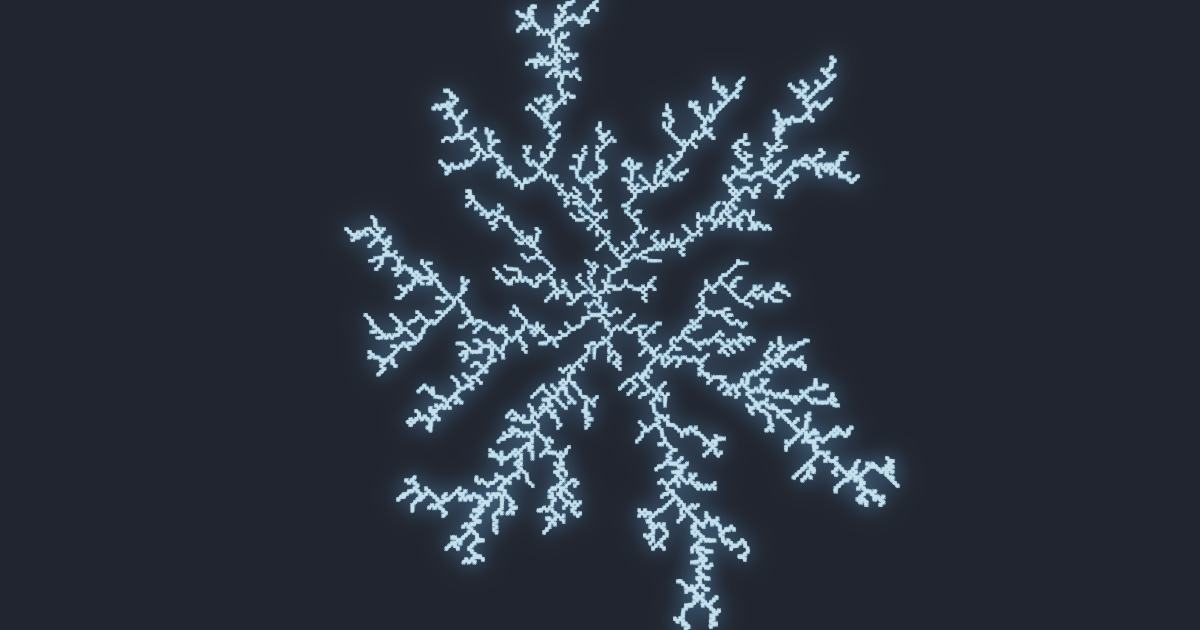
▶ Run this simulationRead how it works
The branch that weighs 1.72: diffusion-limited aggregation's local sticking rule — a particle random-walks in and stops on first contact — grows a self-similar fractal whose mass dimension, recovered from the ensemble radius-of-gyration scaling N ∝ R_g^D over 16 clusters, is D = 1.724 ± 0.015 vs the canonical 2-D value 1.71 (+0.8%, a disclosed finite-size bias: the local effective D falls from 1.727 over N 500–1650 to 1.705 over N 1650–4500, converging on 1.71 — no closed form coded); the SAME estimator returns D = 2.000 on a solid disk and 1.000 on a radial line, so 1 < D < 2 is a real property of the branched cluster, not the ruler; and it is the DIFFUSION that sets it — strip the random walk out (the Eden model, each particle at a random empty perimeter site) and the identical estimator returns a compact D = 2.09, 0.37 higher, because with no wanderer to screen the interior every surface site grows equally; the module's on-screen single-cluster cumulative-N(r) estimator under-reads — now CERTIFIED by executing the sha-pinned shipped module itself (gates H–L): 4200-call bit-exact lockstep at fl(1/120) against an independent replica across all 30.5M live RNG draws (Uint8/Int16/f64 science, zero f32 pricing), HUD byte-equal at all 840 writes, and the EXECUTED on-screen instrument measured at ⟨D⟩ = 1.6590 ± 0.0105 (−3.8% vs the oracle ensemble, −3.0% vs canonical) — consistent (~1σ) with the earlier near-replica estimate 1.672, a disclosure that this time survives execution
Generator = on-lattice DLA implementing DLAModule._growOne's rule: launch a walker at radius rMax+6 from a centre seed at a uniform random angle; far from the cluster (gap>5 cells) jump most of the empty distance (a harmonic-measure shortcut); near-field take unit 4-neighbour random steps; STICK on first 8-neighbour contact; relaunch past a kill circle; a rare walker that exhausts its step budget is relaunched (as the module does next tick) so every cluster reaches the target mass. Two disclosed generator idealizations vs the shipped module (corrected this run — the finding previously said 'verbatim'): the generator's kill circle is 2·rMax+60 on an unbounded 1400-cell grid, the module ships 2·rMax+40 on a walled 320-cell grid; gates H–L execute the shipped file itself and the 'rule' tamper (flipping the executable to the generator's +60) breaks lockstep on the first tick, so the cert provably distinguishes the two. Particle positions are recorded in growth order. The fractal dimension is recovered from the ensemble radius-of-gyration scaling N ∝ R_g^D — for each mass checkpoint N average R_g = sqrt(⟨|r−r_cm|²⟩) over 16 independent clusters, then OLS slope of ln N vs ln⟨R_g⟩ over an asymptotic window (smallest checkpoint 500 already clears the lattice-compact core). No 1.71, no R_g^D exponent, no dimension formula appears in the growth or the measurement; every known number (1.71, 2, 1) is loaded from the reference ONLY to score. Gates: (A) HEADLINE — ensemble-R_g D within 2% of canonical 1.71 and in [1.66,1.78]; (B) UNCERTAINTY — per-seed D over 16 clusters, mean ± SE with the ±0.06 single-cluster scatter and worst seed; (C) PERTURBATION — scale-band invariance: shallow (N 500..1650) and deep (N 1650..4500) bands both in the DLA range and agree to <0.04, a scale-free exponent with no crossover length; (D) RIVAL — the identical estimator on the Eden model (diffusion removed → random empty perimeter site) must return D → 2, separated from DLA by >0.25; (E) ESTIMATOR SELF-CHECK — the same R_g slope must return D = 2.000 on a solid disk and 1.000 on a radial line, proving the ruler unbiased and bracketing DLA strictly between; (F) MODULE SYSTEMATIC — reproduce DLAModule._measureD (single-cluster cumulative N(r)) and gate that it reads below the ensemble recovery, the disclosed on-screen bias; (G) SCORING SELF-TEST — hand-tampering known_value flips gates A/B to FAIL with the recovered D byte-unchanged. HONEST-MODULE CERT (H–L, added 2026-07-26): (H) sha-pin + mechanical type-strip of src/modules/DLAModule.ts + live-RNG accounting — exactly one Math.random site (no-seed fallback; executed: 0 draws seeded / 1 unseeded, fallback seed reproduced) and four rng() draw sites all in the fixedUpdate slice, stream at position 0 after init; (I) EXECUTED init bit-equal to an independent hand replica (statics, occupancy grid, cells, 96000-float render buffer, mesh/material/camera/env/DOM census); (J) 4200-call LOCKSTEP at the engine's fl(1/120) — occ+cells+rMax+D+ensemble-banks+buffer bit-exact at EVERY call, tick census {0:2100,1:2100} (2·fl(1/120)===fl(1/60): budget-3 and acc-overflow branches dead by execution), 3 regrows at pinned calls [1222,2220,3410], 30,509,881-draw stream fingerprint pinned; (K) DISPLAY — HUD textContent byte-equal to the replica template at all 840 %5 writes, final HUD byte-pinned; (L) CLOSURE — 6 fresh seeds × 3 banked clusters of the executed shipped module at fl(1/60), banked dSum/dSumSq bit-equal to replica and per-seed pins, executed instrument ⟨D⟩ = 1.6590 ± 0.0105 priced vs oracle/canonical. Tampers: sha ⇒ only H; kill-circle +40→+60 in the executable ⇒ J fails at call 2 + K + L, all else green; known_value ⇒ A/B with recovery byte-unchanged.
Diffusion-limited aggregation (Witten & Sander 1981): Brownian particles stick irreversibly on contact with a seed cluster, producing a statistically self-similar fractal with mass M(R) ∝ R^D, equivalently N ∝ R_g^D, D ≈ 1.71 in 2-D. The value is universal but not a simple rational — it is the nontrivial exponent of a kinetic critical phenomenon set by the harmonic measure (growth probability = first-landing probability of a diffusing particle), which screens interior sites and favours exposed tips. Remove the diffusion (Eden model) → compact blob, D = 2; a solid disk → D = 2, a radial line → D = 1.
12/12 pass in 18.2 s (deterministic), zero fix attempts; tampers: known_value → 1.4 ⇒ gates A/B FAIL, exit 1, recovered D byte-unchanged at 1.7239, restored by hand; DLA_TAMPER=sha ⇒ only H fails, exit 1; DLA_TAMPER=rule (kill circle +40→+60 in the executable — the oracle generator's own value) ⇒ J fails at call 2 (rMax, first tick), K and L fail, A–I green, exit 1
The canonical fractal mass dimension of two-dimensional diffusion-limited aggregation, D ≈ 1.71 (Witten & Sander, PRL 47, 1400 (1981), original square-lattice estimate D ≈ 1.70; off-lattice consensus D ≈ 1.71, Meakin PRA 27, 1495 (1983)), recovered through the standard radius-of-gyration mass scaling N ∝ R_g^D (Witten & Sander PRB 27, 5686 (1983)). Non-circular because the generator is the bare local rule — random walk in, stick on 8-neighbour contact — with no dimension, no 1.71, and no R_g^D exponent anywhere in the growth or the fit; D is a plain log–log slope of counted mass vs radius of gyration, and the known value lives only in the scorer (proven by the tamper self-test: change it and the recovered D is byte-identical while gates A/B flip). The recovery is sharper than 'the picture looks fractal' in three ways: it returns a number with a quantified ±0.015 SE over 16 seeds; it demonstrates the CAUSE by falsification — the identical estimator sends the Eden model (diffusion removed) to the compact integer dimension 2.09, isolating the harmonic-measure screening (not aggregation per se) as what fixes the non-integer value; and it self-checks the ruler on known geometries (solid disk → 2.000, radial line → 1.000), so 1 < D < 2 is a real property of the branched cluster. Limits: the recovered 1.7239 is +0.8% above the asymptotic 1.71 — a genuine finite-size and square-lattice-anisotropy bias at the reachable cluster masses (N ≤ 4500), disclosed and gated, and shown to converge (deep-band D = 1.705 < shallow-band 1.727). The canonical D itself is not a proven rational — it is the empirical/numerical exponent of a kinetic critical phenomenon, so this is validation against the accepted value within a stated finite-size band, not an exact identity like the rule-90 gasket.
CERTIFIED BY EXECUTION (2026-07-26, gates H–L; module untouched). The shipped DLAModule.ts is sha-pinned, mechanically type-stripped, and run headless in bit-exact lockstep with an independent hand replica — its science state is Uint8Array occupancy + Int16Array cells + f64 scalars, so module ≡ replica bit-for-bit with NO f32 gap to price (the lone Float32Array is the render matrix, itself bit-compared; lesson #135a — the cheapest cert class). The on-screen instrument, MEASURED by executing the shipped module (6 seeds × 3 banked clusters): ⟨D⟩ = 1.6590 ± 0.0105 SE (sd 0.0258) — −3.8% vs the oracle's ensemble R_g recovery 1.7239 and −3.0% vs canonical 1.71. The earlier near-replica estimate (gate F, 1.672 ± 0.038 sd over 12 clusters) is consistent to ~1σ — unlike kpz run #102, where an estimated disclosure understated the executed bias 3×, this disclosure SURVIVES execution. The gap remains an estimator systematic, not a physics discrepancy: a single-cluster cumulative N(r) with a narrow log-window under-reads DLA's dimension at reachable sizes, and the module's banner discloses it on screen ('canonical ≈ 1.71' beside its live ⟨D⟩). Corrected this run: the oracle generator is a near-replica, NOT verbatim — it uses kill circle 2·rMax+60 on an unbounded 1400-grid vs the module's 2·rMax+40 on a walled 320-grid (walkers clamped to [2,317]); the 'rule' tamper flips the executable to +60 and lockstep breaks at call 2, so the cert provably distinguishes the shipped walk statistics from the generator's. Executed-display facts now certified: HUD byte-equal at all 840 %5-cadence writes including the final pinned read; regrows fire on rMax≥150 (never the N=6000 cap) at pinned calls; the 2·fl(1/120)===fl(1/60) exact-doubling makes the accumulator alternate fl(1/120)/0 with the budget-3 and overflow branches dead by execution; every one of the 30,509,881 walker RNG draws is position-verified by lockstep (4 draw sites, all in _growOne ← fixedUpdate; init draws none; the single Math.random site is the no-seed fallback, executed both ways). The render path stays cosmetic — the measurement grid is independent, so the render never contaminates the number.
npm run derisk -- dla (scripts/dla-derisk.mjs)scripts/oracles/dla.reference.jsonT. A. Witten & L. M. Sander, 'Diffusion-Limited Aggregation, a Kinetic Critical Phenomenon', Phys. Rev. Lett. 47, 1400 (1981) — the model and the first 2-D dimension estimate D ≈ 1.70; T. A. Witten & L. M. Sander, 'Diffusion-limited aggregation', Phys. Rev. B 27, 5686 (1983) — radius-of-gyration scaling N ∝ R_g^D. P. Meakin, 'Diffusion-controlled cluster formation in 2—6-dimensional space', Phys. Rev. A 27, 1495 (1983) — off-lattice consensus D ≈ 1.71 and the harmonic-measure screening picture. M. Eden, 'A two-dimensional growth process', Proc. 4th Berkeley Symp. Math. Stat. Prob. 4, 223 (1961) — the compact Eden model (D = 2 rival). Review: T. Vicsek, 'Fractal Growth Phenomena' (World Scientific, 1992).