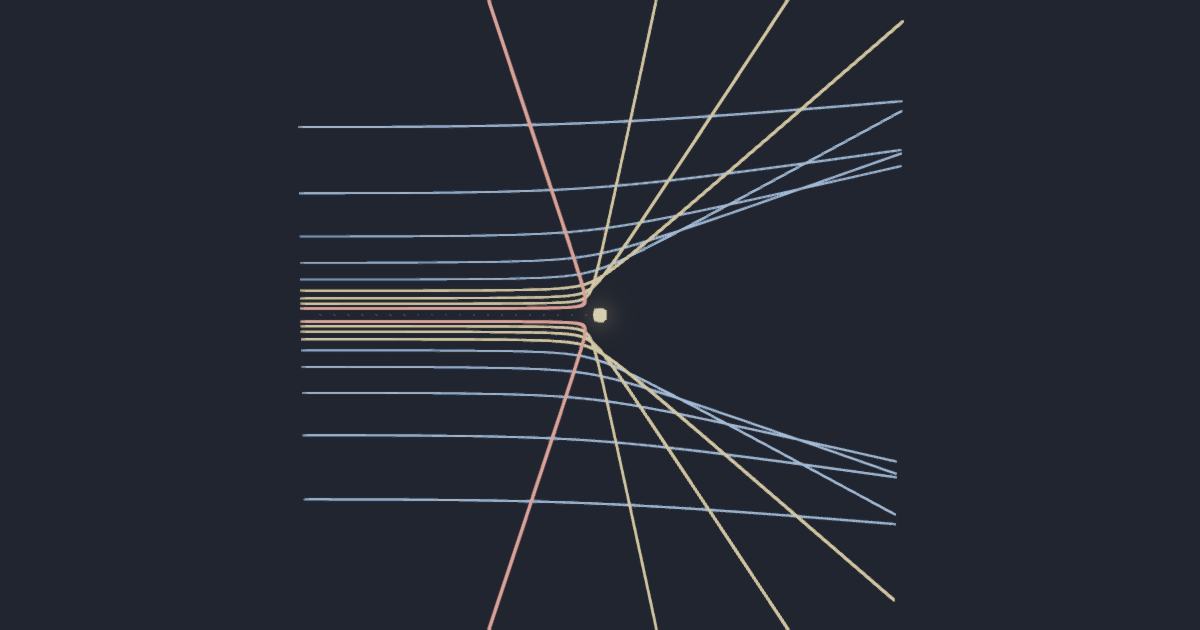
Is the atom's positive charge smeared through it (Thomson's plum-pudding) or concentrated in a tiny core — and how do you tell from how alpha particles bounce off?
Measured by the lab
-3.992
Known value
-4
Units: dimensionless (log–log slope of dN/dΩ vs sin(θ/2), i.e. dσ/dΩ ∝ 1/sin⁴(θ/2))
The atom has a nucleus: the Rutherford exponent −4 (dσ/dΩ ∝ 1/sin⁴(θ/2)) recovered as the slope of the alpha-scattering distribution over 24 seeds, and Thomson's plum-pudding falsified because a diffuse charge can never back-scatter a fast alpha (Geiger–Marsden 1909 / Rutherford 1911)
Method
Fire 7.7-MeV alpha particles (Z₁=2) at gold (Z₂=79) and treat each as a pure repulsive-Coulomb (1/r²) two-body problem. One length sets the whole pattern — the head-on distance of closest approach D = k_e·Z₁Z₂e²/E ≈ 29.5 fm — and an alpha with impact parameter b deflects by the closed form θ(b) = 2·arctan(D/2b). Monte-Carlo 1,000,000 alphas per seed with impact parameters spread uniformly over the beam disk (area-weighted, b ∝ √u), histogram the deflections into 40 geometric solid-angle bins, and least-squares fit log(dN/dΩ) against log(sin(θ/2)); the slope is the Rutherford exponent — the known value −4 is loaded ONLY to score, never entering the histogram or the fit. Repeat across 24 seeds. Three independent cross-checks make it non-circular: (C) the closed form θ = 2·arctan(D/2b) is itself confirmed by verlet-integrating the Coulomb hyperbola from scratch; (D) a near-head-on alpha (b/D = 0.1) is shown to deflect > 150°; and (E) the Thomson plum-pudding control — the same total charge spread through a sphere of atomic radius R — is worked out analytically (single-atom cap θ ≈ D/R, foil multiple-scattering RMS √N·θ) and shown unable to reach 90°.
D ≈ 2.96×10⁻¹⁴ m is the closest a head-on 7.7-MeV alpha gets to the nucleus, so the gold nucleus is smaller than D — about 4569× smaller than the atom (~1.35×10⁻¹⁰ m), which is therefore almost entirely empty space.
Trajectory crosscheck
Worst rel error
0.0046
Note
a from-scratch velocity-Verlet integration of the Coulomb hyperbola reproduces the closed-form deflection θ = 2·arctan(D/2b) to < 0.5% relative across b/D ∈ [0.1, 4], so the closed form used in the Monte-Carlo is independently confirmed, not assumed.
Backscatter capability
B over D
0.1
Theta deg
157.3
Seed0 fraction over 90deg
9.7000e-5
Note
a point charge has no ceiling on deflection: at b/D = 0.1 the alpha is turned through 157°, and ~1 in 10⁴ of a 50D-wide beam scatters past 90° — Geiger & Marsden's famous ~1-in-8000 back-reflection.
Module certification
Rung
validated + honest-module
Certified utc
2026-07-25T20:30:20Z
Gates
H–M in scripts/rutherford-derisk.mjs EXECUTE the shipped RutherfordModule.ts headless with stubbed Babylon/DOM (sha-pinned, TS stripped by 31 asserted pairs; module-internal mulberry32 seed 0x9e3779b9, zero Math.random — certifies like a clockwork world): init statics (D, slope, intercept, R², both HUD cross-section ratios), the full 33-point log–log fit dataset and all 5 thin-instance buffers (gentle/moderate/hard fan + nucleus + axis) bit-for-bit vs a literal replica at the module's own config (N=1.2e6, min-bin 40); DOM census — style + HUD + chart label + chart SVG each written exactly once, every payload bit-equal to the replica string; the fully static world is proven FROZEN: 600 render() calls produce 0 DOM writes, 0 thin-instance updates, all buffers sha-frozen.
Display earned
the shown exponent −3.998 is the module's own 1.2e6-alpha Monte-Carlo at its pinned seed, not the law: its gap to −4 is +1.89e-3, it sits at z = −0.57 inside a 12-seed ensemble run at the module's own config (−3.9919 ± 0.0110), and flipping one seed bit moves it to −3.987. The drawn fan is genuine 1/r² physics: every verlet hyperbola matches an oracle-grade dt=0.0004 integration of the SAME finite-window problem to 3.4e-5 relative worst (pure integrator error), and the hard bucket back-scatters at 108.3°.
Display systematics
(1) estimator bias: the module-config ensemble mean is −3.9919, +8.1e-3 shallow of −4 — a small shared binning/min-bin-cut bias also visible in gate A's 24-seed −3.992 ± 0.018; the module-vs-gate-A instrument gap (N 1.2e6/min-bin 40 vs 1e6/30) is −4.6e-3 ± 3.7e-3 SE, priced per-seed on SHARED mulberry32 streams. (2) window truncation: the drawn fan's exit directions lag the asymptotic θ(b) by up to 16.7% for the gentlest hyperbola (b=10D) because the picture frame ends at |x|>16 — a disclosed property of the drawing, not the physics (the same integrator class converges to the closed form to 0.46% on a full domain, gate C). (3) the HUD's empty-space line uses the textbook gold atomic radius 1.4 Å (shown ratio '1/4700') while the oracle's gate F uses the empirical 1.35 Å (4569×); both clear the >1000× gate. (4) the HUD's 'fitted law 55.6 · 1/sin⁴ predicts 55.7' line deviates from the exact prediction ONLY through the fitted-slope error: ratioMeas/ratioPred ≡ (sin15°/sin45°)^(slope+4) to < 1e-12.
Answer free
comment-stripped executed code contains zero ASCII '-4' literals; the two unicode '−4' occurrences are disclosed display labels ('true −4', '(Rutherford −4)'); a planted violation proves the scanner live; deflection() — the Coulomb closed form — is censused at exactly 2 call sites (MC generator + fan bucketing): it is the forward-model HYPOTHESIS, independently confirmed by from-scratch integration in gates C and K.
Tamper
RUTH_TAMPER=sha → only H fails; RUTH_TAMPER=ulp (post-strip 1-ulp E_MEV) → exactly the two doubles-pinned D tripwires fail (gate I statics + gate L's shown-D ≡ gate-F-D identity) while the fit dataset, f32 fan buffers and toFixed HUD strings absorb it; manual known_value −4 → −4.5 → exits 1 with ONLY the scoring comparisons failing (gate A mean/worst + gate L ensemble-mean-vs-known), recovery unchanged at −3.992.
Module edits
NONE — a zero-edit certification. One latent derisk weakness fixed in the same run: gates A previously scored against a hardcoded −4 instead of REF.known_value, which would have made the mandatory known-value tamper self-test vacuously pass; they now read the reference (numerically identical when untampered).
Control thomson
Name
Thomson plum-pudding (positive charge spread uniformly through a sphere of atomic radius R)
Single atom max deg
0.0125
Foil rms deg
0.495
Note
ruled out — inside a uniform sphere the field is capped, so a single atom deflects an alpha by at most θ ≈ D/R ≈ 0.013°, and even after √N ≈ 40 atoms of a real gold foil the multiple-scattering RMS is only ~0.5°. Reaching 90° would take ~180σ (probability ≈ e⁻¹⁶⁰⁰⁰): the plum-pudding CANNOT back-scatter a fast alpha, while the point nucleus does. This is Rutherford's own 1911 falsification — 'as if a 15-inch shell bounced off tissue paper'.
What it reduces to
Rutherford's 1911 analysis of Coulomb scattering, dσ/dΩ ∝ 1/sin⁴(θ/2) (E. Rutherford, Phil. Mag. 21, 669), which explained Geiger & Marsden's 1909 observation of large-angle alpha reflection and revealed the atomic NUCLEUS. It VALIDATES, not derives: the lab assumes the classical repulsive-Coulomb two-body problem for a point nucleus (from which θ(b) = 2·arctan(D/2b) and dσ/dΩ = (D/4)²/sin⁴(θ/2) follow) and shows the emergent, measurable angular distribution has log–log slope −3.992 ± 0.018 over 24 seeds (every seed within 0.05 of −4), with −4 never plugged into the fit. It is made non-circular on three fronts: the closed-form deflection is independently reproduced by verlet-integrating the Coulomb hyperbola to < 0.5%; a near-head-on alpha is shown to back-scatter to 157°; and the competing Thomson plum-pudding is falsified analytically — a diffuse charge caps single-atom deflection at ~0.01° and foil multiple-scattering RMS at ~0.5°, so it can never turn an alpha through 90°, exactly Rutherford's decisive argument. From the same length scale the lab bounds the nuclear size: the head-on closest approach D ≈ 30 fm makes the nucleus ~4500× smaller than the atom, so matter is mostly empty space. It does NOT derive the Coulomb law or quantize anything; it demonstrates that only a point-like nucleus reproduces the observed large-angle tail. The lab's first nuclear-structure world — the point nucleus that Bohr's atom and ?world=franckhertz's quantized energy levels are built upon.
Confidence & reproduction
Confidence
high
Validation
derisk-pass
Re-run the check
npm run derisk -- rutherford (scripts/rutherford-derisk.mjs)
Oracle
scripts/oracles/rutherford.reference.json
Sources
H. Geiger & E. Marsden, Proc. R. Soc. Lond. A 82, 495 (1909) — diffuse reflection of α-particles; E. Rutherford, Phil. Mag. 21, 669 (1911) — the point-nucleus scattering law dσ/dΩ ∝ 1/sin⁴(θ/2); H. Geiger & E. Marsden, Phil. Mag. 25, 604 (1913) — quantitative confirmation. Alpha energy E = 7.7 MeV, gold Z = 79; gold atomic radius R ≈ 1.35×10⁻¹⁰ m, number density n = 5.90×10²⁸ m⁻³, foil thickness t ≈ 4×10⁻⁷ m.
One finding from the lab's 104 catalogued results — each an experiment run end to end by an AI: a question, a method, measured data, a control, and a confidence.