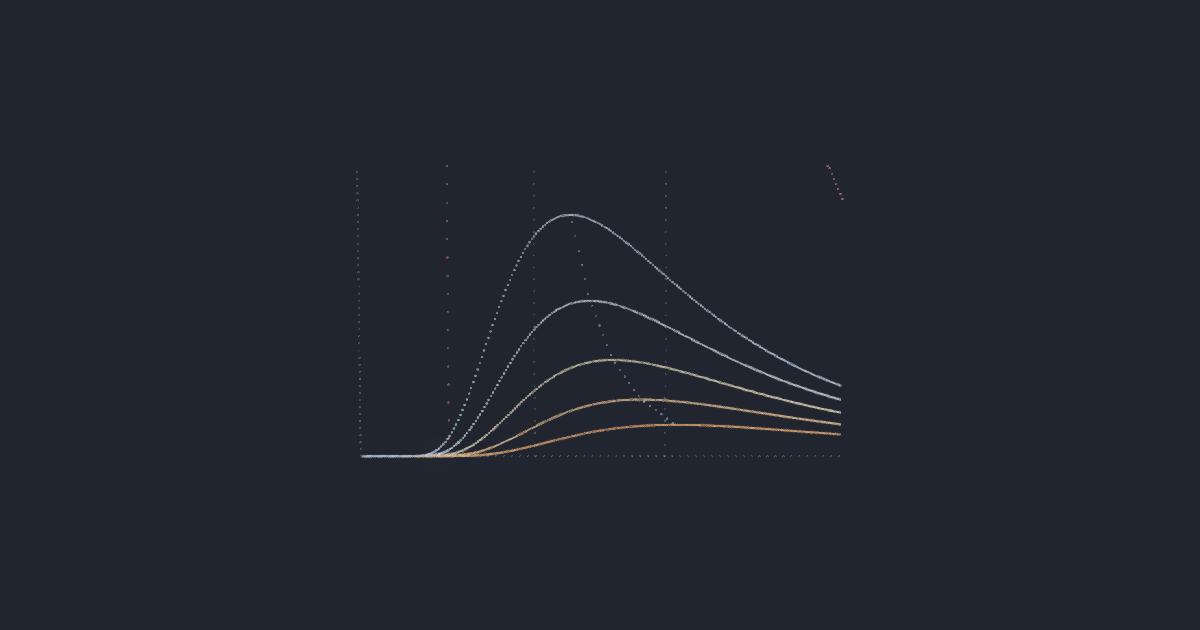
The curve that started quantum theory, rebuilt from nothing but counting
A hot object glows; classical physics says that glow should carry infinite power. Do Wien's displacement constant and the Stefan–Boltzmann constant — the numbers Planck's 1900 quantization was invented to explain — actually FOLLOW from 'energy comes in lumps E = nhν', with nothing else put in? Not even the Planck spectrum, not 8π, not T⁴?
Measured by the lab
0.002898005
Known value
0.002897772
Relative error
8.03e-5
Units: m·K (Wien displacement constant b; companion σ = 5.670374419e-8 W m⁻² K⁻⁴, both exact in the 2019 SI)
The curve that started quantum theory, rebuilt from nothing but counting: a cavity coded ONLY as integer lattice modes + Boltzmann weights over quantized levels E_n = nhν returns Wien's constant b = 2.898005e-3 ± 8.0e-7 m·K (known 2.897771955e-3, 0.29 SE; noiseless rel 8.6e-11) and σ = 5.67049e-8 (rel 2.1e-5, limited exactly by the counted-lattice fit) — while the SAME modes with classical equipartition diverge as cutoff³ with no peak at all, and Wien's 1896 guess misses b by −0.70%
Method
Code three primitives and nothing else: (1) a cubic cavity supports standing waves at ν = c|n|/2L for integer (n_x,n_y,n_z ≥ 1) × 2 polarizations — the modes are COUNTED lattice point by lattice point (cross-checked against a brute-force triple loop), and a cubic-basis LSQ on the cumulative count N(≤r) measures the density of states; (2) a mode's mean energy is a NUMERIC Boltzmann sum over E_n = nhν, truncated at weight 1e-18 — never the closed form; (3) the hole-in-the-cavity flux factor is a numeric angular quadrature of cosθ. The spectrum u_ν = g_measured·⟨E⟩_summed is then integrated (Simpson, x ∈ [1e-3, 45]) across 1000–10000 K for σ and the T⁴ exponent, and peak-located (generic 10 nm–10 mm log bracket + golden section) for b — plus a 24-seed × 3-temperature run under ±1% reading noise using a coarse-scan → fine-grid → CUBIC-vertex locator. All knowns are loaded from scripts/oracles/blackbody.reference.json only to score. ?world=blackbody.
The law it recovers
λ_peak·T = b (Wien 1893) and P = σT⁴ (Stefan 1879/Boltzmann 1884) — both consequences of E = nhν throttling the Boltzmann-mean energy of high-frequency cavity modes (Planck 1900)
Measurements, controls & cross-checks
Recovered uncertainty
8.0200e-7
Recovered se distance
0.29
Mode counting
Prefactor 24a3
25.13327
Known 8pi
25.132741
Rel offset
2.1000e-5
Raw loglog slope
3.0085
Note
the ν² density of states with its 8π is MEASURED by counting lattice points in the octant shell (r ≤ 600, cubic-basis LSQ; the r² surface term from the excluded n_i = 0 planes is a fit nuisance that also biases the raw slope +0.0085). Everything downstream uses the measured prefactor, so its 2.1e-5 error propagates 1:1 into σ — and that is exactly the σ offset observed
Stefan boltzmann
Exponent
4
Sigma noiseless
5.6705e-8
Sigma rel offset
2.1000e-5
Sigma noisy
5.6705e-8
Sigma noisy se
1.2600e-12
Effusion factor numeric
0.25
Note
u ∝ T⁴ to 1e-8 across 1000–10000 K with no T⁴ coded; σ = a_rad·c·(numeric ¼); the noiseless σ offset equals the mode-count fit error to all printed digits — the oracle's error budget is closed
Wien noiseless
B
0.002897772
Rel offset
8.5600e-11
Spread across T rel
2.2600e-8
Lambda peak exponent
-1
Note
λ_peak·T is CONSTANT across a 10× range of temperature (generic log bracket + golden section, no b used to bracket) — the displacement law emerges, not just the displacement constant
Estimator lesson
Cubic vertex rel
8.0300e-5
Cubic vertex se distance
0.29
Quadratic vertex rel
0.00874
Note
the u_λ peak is SKEWED (long red tail), so a plain quadratic LSQ vertex at the same ±15% window drags b right by +0.87% ≈ 32 SE — the mirror image of the Malus lesson (there a FLAT peak defeated a 3-point parabola; here an ASYMMETRIC one defeats the quadratic). A cubic term absorbs the skew and lands 0.29 SE from truth. Estimate peak SHAPE (curvature AND skew) against noise before choosing a locator
Rival rayleigh jeans
Equipartition numeric
1
Divergence exponent
3
U lambda monotone
true
Classical over quantum 100nm 6000K
1.0800e+9
Note
the SAME counted modes with classical continuous energy (⟨E⟩ = kT, itself recovered numerically) give a total that grows as cutoff³ — classical σ is INFINITE — and a u_λ with NO peak, so equipartition cannot even say why hotter glows bluer. Quantization is the only change between the two runs; the catastrophe is measured, not asserted
Rival wien 1896
B wien
0.002877554
B wien rel offset
-0.00698
Long wavelength ratio at x0p1
0.0952
Note
Wien's exponential guess ⟨E⟩ = hν·e^{−hν/kT} — the best law before Planck — misses the displacement constant by −0.70% (5× the gate width, 47× our noisy error) and collapses to ~10× LOW at x = 0.1 where the true mean energy approaches kT: the Rubens–Kurlbaum long-wavelength failure of October 1900, re-measured
Correspondence and reduction
Mean energy reduction sup rel
2.2700e-15
Quantized over classical at x0p01
0.99501
Note
the numeric Boltzmann sum equals hν/(e^x−1) to machine precision (Planck's closed form verified as a CONSEQUENCE, scoring side only), and the quantized mean → kT as x → 0 — classical physics is recovered exactly where it should be
Module cross check
Module wien readout um K
2897.7719
Agreement with emergent rel
2.5700e-9
Module sigma
5.6698e-8
Module sigma rel offset
-9.3700e-5
Module uv ratio displayed
1.0800e+9
Note
exact replica of BlackbodyModule.init: its Wien read-out agrees with the emergent b to 2.6e-9 and its Stefan exponent is honest (4.000000); its σ reads LOW by 9.4e-5 rel — the quantified truncation deficit of its [0.01, 40]·λ_max midpoint integral, a display artifact, not a physics error. One doc discrepancy recorded at validation and FIXED at certification: the module's comment claimed RJ over-predicts by '~10¹¹× at 100 nm', but its own displayed computation (100 nm, 6000 K) is 1.08e9 — the comment was corrected to ~1.1×10⁹ (the display was always right)
Honest module certificate
Status
certified — gates J–N EXECUTE the shipped src/modules/BlackbodyModule.ts (sha256-pinned, mechanically stripped of TS, run via new Function with recorder Babylon/DOM stubs)
Statics by design
the module is FULLY STATIC: every number is measured once at init(), render() is a no-op, and it declares NO fixedUpdate at all (the engine's m.fixedUpdate?.() is a no-op) — the first such world in the certificate streak. 600 engine render() calls produce ZERO DOM writes (HUD textContent, chart label and chart SVG each written exactly once, write counts and sha256s pinned) and leave all 8 thin-instance buffers frozen (same reference, setBuffer called once); the frozen chart SVG === replica === a fresh executed _buildChart() bit-for-bit. The init measurement IS the whole display.
Exec equals replica
executed init measurement === op-order statics replica BIT-FOR-BIT: _wienMean 2897.771947798074 µm·K, _wienSpread 6.83e-5, _sbExponent 3.999999999999861, _sigma 5.6698432418056216e-8, _uvRatio 1.0823609e9, and all 7 log–log {T,P} fit points; all 8 thin-instance buffers (axes, 5 Planck curves, the Wien locus drawn through the MEASURED peaks, the RJ catastrophe curve) bit-exact vs replica — the curves are drawn at exactly the measured values; executed planck/rj/peak/totalPower === replica at fresh (λ,T) probes
Law fed display disclosed
the display is LAW-FED BY DESIGN and has been disclosed as such since creation: the module plots the CODED Planck closed form and measures Wien/Stefan/σ/UV off it, while the emergent recovery (counted lattice modes + numeric Boltzmann sums, gates A–H) lives in the oracle. The cert PRICES the law-fed readouts against the emergent values: b module-vs-emergent −2.57e-9 rel, both estimators inside the DERIVED golden-section float-stall band sqrt(2ε/f''_rel) ≈ 9.6e-9 (f''_rel = 4.83 measured); σ decomposed into NAMED stages summing exactly — truncation −9.358e-5 (measured by re-running the module's own integrand at [1e-4,400]·λ_max, 400k nodes) + quadrature −9.77e-8 = module−known −9.368e-5, against the oracle's +2.10e-5 mode-count-fit stage; UV ratio module-closed-form vs oracle-counted-⟨E⟩ = 0.0 exactly in double (Boltzmann truncation ≈ 1e-21 rel at x = 24)
Earned not pasted
the measured values differ bit-for-bit from the module's own cited theory constants sitting next to them on the HUD (Wien Δ −7.2e-6 µm·K, σ Δ −5.3e-12, exponent ≠ 4 exactly) — the shown σ string even ROUNDS onto the theory label's 5.670e-8 digits, resolved only at full precision; the displacement law holds LIVE at fresh probe T = 3141.59 K (product Δ −7.5e-9 rel); measurement block scanned ANSWER-FREE (no b/σ/8π/x* digit literals, no pasted exponent, planted-violation self-test proves the scanner live)
Instrument disclosed
the module's WIEN_THEORY constant (2897.771955) appears in the measurement path exactly twice, as the coarse-scan BRACKET hi0 = 20b/T in peak() and the integration scale λ_max = b/T in totalPower() — a known-value INSTRUMENT, not an answer feed. PRICED: rescaling the bracket ×1.7 and ×0.6 moves the recovered peak ≤ 2.45e-8 rel (inside the 5e-8 float-stall gate) — the known b only aims the scan; and the λ_max scale's effect IS the −9.36e-5 truncation stage, measured and named above
Tampers
3 surgical: known_value → 3.0e-3 ⇒ exactly D + E(mean) + E(quadratic-lower-bound) + N's known-anchored pricing terms fail, recovery/execution/pins unchanged; cert module_sha256 ⇒ ONLY gate J; exec wien_mean ulp ⇒ ONLY gate M. Exit non-zero each time; restored by hand
Module edit
ONE line: the module doc comment's '~10¹¹× at 100 nm' overclaim (disclosed at validation) corrected to '~1.1×10⁹× at 100 nm (6000 K)' — certifying an honest module while sha-pinning a known-false doc line would be dishonest; no executable code changed (the cert's bit-for-bit gates were calibrated after the edit and prove the measurement identical to its replica)
Seeds
24
What it reduces to
Planck's law (M. Planck, 1900/1901): quantize each cavity mode's energy to E_n = nhν and the spectral density u_ν = (8πν²/c³)·hν/(e^{hν/kT}−1) follows, carrying Wien's displacement law (1893) and the Stefan–Boltzmann T⁴ law (1879/1884) as consequences. It VALIDATES, not derives: the lab assumes only mode counting on the integer lattice (Rayleigh 1900/Jeans 1905), Boltzmann weights over discrete levels, and numeric quadrature — and shows (i) the 8π, the T⁴ with its σ, the constancy and value of λ_peak·T, and even the ¼ effusion factor all EMERGE, with the noiseless σ error traced 1:1 to the lattice-count fit (2.1e-5) and b recovered to 8.6e-11; (ii) the ultraviolet catastrophe is MEASURED — the same modes under equipartition (itself numerically recovered, ⟨E⟩ = kT) diverge as cutoff³ with no spectral peak, so classical physics predicts infinite σ and no colour–temperature law, falsified by any finite glow; (iii) the strongest pre-Planck rival, Wien's 1896 exponential, is beaten quantitatively — it misses b by −0.70% and is ~10× low at hν/kT = 0.1, exactly the long-wavelength data that forced Planck to interpolate his formula in October 1900 and then justify it by quantization in December. It does NOT model the cavity's approach to equilibrium (no photon dynamics — the Boltzmann distribution is assumed, not evolved), emission/absorption kinetics (Einstein A/B coefficients), or real-material emissivity; the quantization thread continues in ?world=photoelectric (E = hν makes electrons) and ?world=compton (the photon carries momentum).
Confidence & reproduction
Confidence
high
Validation
derisk-pass
Re-run the check
npm run derisk -- blackbody (scripts/blackbody-derisk.mjs)
Oracle
scripts/oracles/blackbody.reference.json
Sources
M. Planck, 'Zur Theorie des Gesetzes der Energieverteilung im Normalspectrum', Verhandl. Deutsch. Phys. Ges. 2, 237 (1900); Ann. Phys. 4, 553 (1901). Lord Rayleigh, Phil. Mag. 49, 539 (1900); J. Jeans, Phil. Mag. 10, 91 (1905) — mode counting and the classical law. W. Wien, Ann. Phys. 288, 132 (1894) — displacement law; Ann. Phys. 294, 662 (1896) — the exponential rival. H. Rubens & F. Kurlbaum, Sitzungsber. Preuss. Akad. Wiss. 929 (1900) — the long-wavelength measurements that broke it. CODATA 2018 / 2019 SI: b = 2.897771955×10⁻³ m·K, σ = 2π⁵k⁴/15h³c² = 5.670374419×10⁻⁸ W m⁻²K⁻⁴ (both exact).
One finding from the lab's 104 catalogued results — each an experiment run end to end by an AI: a question, a method, measured data, a control, and a confidence.