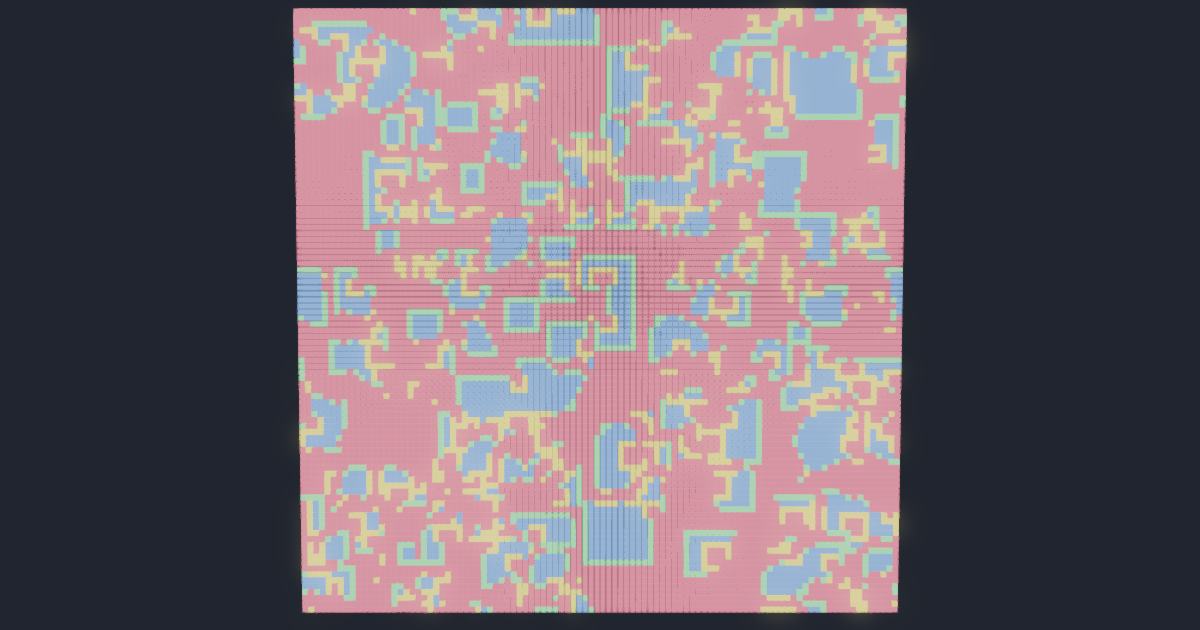
Among purely selfish agents, where defecting always pays more than cooperating, can cooperation survive at all — and does the spatial-chaos regime lock onto Nowak & May's asymptote 12 ln 2 − 8 ≈ 0.318 with its band pinned at the exact rational payoff thresholds 9/5 and 2?
Measured by the lab
0.31529
Known value
0.31776617
Relative error
7.80e-3
Units: dimensionless (12 ln 2 − 8, Nowak & May's approximate analytic asymptote for the chaotic band; their simulations '≈ 0.318')
Cooperation weighed on a lattice: the Nowak–May spatial prisoner's dilemma — a deterministic CA knowing only integer payoffs and copy-the-best-neighbour — returns the chaotic-band cooperator fraction f_C = 0.31529 ± 0.00033 vs the analytic asymptote 12 ln 2 − 8 = 0.31777 (rel 7.8e-3, 6 seeds; single-defector channel 0.31912, bracketing the known value), with the two band edges recovered BLIND by bisection to the exact rationals 9/5 and 2 (|Δ| = 7.3e-5, parameter-free integer-payoff arithmetic), the trajectory EXACTLY b-invariant inside the open band (spread 0.0), and the rival falsified twice: the same payoffs well-mixed collapse to ≤ 0.086 (self-game kept) and go fully EXTINCT ≤ 1e-4 (pure PD) — space alone sustains cooperation
Method
Generator: a verbatim headless mirror of SpatialPDModule._step — each cell of an L×L torus plays the PD with its 8 Moore neighbours AND itself (R=1, S=0, T=b, P=0), then synchronously adopts the strategy of the highest-scoring cell in its 3×3 neighbourhood (own kept on ties). Fully deterministic given the seeded initial lattice; no fraction 0.318, no threshold 1.8 or 2, and no cluster-growth theory anywhere in the generator. Recovery channels: (1) time-averaged f_C at L=200, b=1.9, steps 300–700, six random 50/50 initial lattices → mean ± SE; (2) initial-condition family f0 ∈ {0.1, 0.9} plus a single defector in a full-C L=299 lattice; (3) band invariance — same seed at b ∈ {1.81, 1.85, 1.90, 1.95}; (4) both band edges bisected blind (11 iterations on brackets [1.65,1.95] and [1.85,2.15], fixed-seed deterministic probe, regime classifiers 0.6/0.15 far from both attractors); (5) outside-band regimes b=1.7 and b=2.05; (6) two well-mixed rivals with identical payoffs and identical best-of-sample imitation but partners re-drawn at random each generation; (7) module mirror at the module's exact measurement geometry (L=100, 110 steps, avg last 30). Gates A–I, all seeded, 15 s.
The law it recovers
Inside the open band (9/5, 2) no payoff comparison b·k ≷ m+1 can flip (no rational (m+1)/k with m+1 ≤ 9, k ≤ 8 lies inside), so the trajectory is bit-identical for every b — measured spread exactly 0.0 across four b. The band edges are where 5b = 9 and 4b = 8; bisection recovers 1.79993 and 1.99993 (|Δ| = 7.3e-5 ≈ the bisection grid). Below the band: static lace, f_C = 0.887; above: collapse, f_C = 0.0002.
Measurements, controls & cross-checks
Recovered se
0.00033
Ic independence
F0 0.1
0.31507
F0 0.9
0.31562
Single defector L299
0.31912
Note
the attractor is IC-independent to 0.004 absolute; the random-init family sits −0.8% and the deterministic single-defector kaleidoscope +0.4% from 12 ln 2 − 8 — the channels bracket the known value
Rival
Name
well-mixed population (space removed; identical payoffs, identical best-of-sample imitation, partners re-drawn each generation)
Self game kept
f_C = 0.084–0.086 — the spatial 0.318 attractor is destroyed (×3.7 collapse); what survives is the mean-field self-game refuge f* ≈ 1/(8(b−1)) = 0.147 eroded by best-of-sample noise
Pure pd
f_C ≤ 1e-4 by t = 400 in all 5 seeds — with the self-game removed defection strictly dominates and cooperation goes EXTINCT (3 orders below the lattice value)
Verdict
falsified — neither the payoff matrix nor the imitation rule sustains cooperation without space; clustering is the mechanism
Module systematic
Mirror L100 110steps
0.3215
0.3236
0.3213
0.3049
Mirror mean
0.3178
L100 metastability EXECUTED
SUPERSEDES the earlier 'collapse only on long horizons' disclosure (a #97-grade correction — the old claim was an estimate from 6 seeds): executing the shipped module's own protocol (L=100, b=1.85, 110 steps, avg last 30) across 384 derived seeds finds 12 all-D and 5 all-C absorptions (~4.4%) WITHIN the module's own display window — including absorption to FULL COOPERATION (one seed fixates all-C by t=49), a fate the module never mentions; a further ~1% land on near-absorbed laces (one 0.98 survivor). The module comment 'at L≳100 the f_C≈0.31 attractor is robust across seeds' therefore fails at the ~5% level (prose-only comment, module untouched for sha stability). Absorption is absent at L=200 (0/48) — a pure finite-L=100 tail. Survivor scatter is fat-tailed (sd inflates 0.007→0.037 as outlier fates enter with more seeds), so the honest screen statistic is the MEDIAN: 0.31522 over 192 seeds, 179/192 inside [0.28,0.34]. Paired survivor L-twin (96 seeds, L=100 vs 200 at the screen window): +0.00015 ± 0.00088 (z 0.17) — no resolved finite-L mean bias; survivor mean vs known z 0.62, vs oracle-grade z 1.88 (unresolved, absorption-tail-sensitive).
Well mixed claim
the on-screen 'well-mixed → 0' is exactly true for the pure PD (rival variant B); with the self-game kept (the module's own payoff scheme) a small non-spatial refuge ≈ 0.08 survives (variant A) — quantified here rather than hidden
Exec certificate
MEASURED BY EXECUTING THE SHIPPED MODULE (gates J–N, added this run; module file untouched — sha-pinned 8b9b7b2a…). The shipped SpatialPDModule.ts, type-stripped and executed headless, is the cheapest cert class: the Nowak–May CA is DETERMINISTIC — the live stream is exactly the 10,000-draw init fill of mulberry32(seed), proven frozen through all 1800 lockstep calls (stream-position probe before AND after); the measurement sweep runs on a derived stream mulberry32(seed^0x9e3779b9) re-seeded per b so all nine b start from the same lattice. Two identities proven by execution, not prose: (1) the module's `pay += b` op order differs from the oracle generator's `c*b` in score ULPs from step 0, yet the strategy trajectories NEVER diverge — the screen's b=1.85 sweep value Object.is-equals gate I's mirror across two different code paths; (2) the in-band sweep points b∈{1.85,1.9,1.95} are bit-identical (the rational-threshold band invariance survives the module's float op order), so the on-screen 'chaotic regime f_C' IS the single b=1.85 trajectory average. 1800-call lockstep at fl(1/120): 10k-cell grid + Nowak–May 4-transition cat field + score + fC + accumulator + HUD + all four 160k-float thin-instance buffers bit-exact against a statics-built replica at every checkpoint; 119 generations with gap census {16:1, 15:118} (the fl(1/120) accumulator drifts one call before locking the 15-call cycle); HUD 300 writes 86 distinct, final sha pinned. Accumulator regime proven by twins: dt=999 → exactly 3 generations + acc reset (budget-3 + overflow-reset REAL), dt=0 → none, dt=fl(1/60) → 240-call lockstep bit-exact with 31 generations in 7/8 alternation — dt genuinely enters the cadence (7th distinct accumulator regime in the cert series). Tampers surgical: sha ⇒ J only; rule (C self-game removed in _step) ⇒ K+L+M with L diverging at call 1 on the HUD — the tamper's fastest observable channel is the init-frozen sweep quoted in the first HUD write, not the live state — and the physics collapses to EXTINCTION (0.3215 → 0.0000: b=1.85 lies above the no-self band, the self-game is load-bearing); known 0.353 ⇒ A+B only (115.7 SE), recovery byte-unchanged, hand-restored.
What it reduces to
Nowak & May's spatial evolutionary game (Nature 359, 826, 1992): deterministic spatial structure alone — no memory, kinship, reciprocity or foresight — sustains cooperation in the one-shot PD, with chaotic-band asymptote predicted as 12 log 2 − 8 ≈ 0.318 by their cluster-growth argument and band structure set by exact rational payoff thresholds (Nowak & May, Int. J. Bifurcation Chaos 3, 35, 1993). Non-circular because the generator contains only the payoff matrix and the copy-the-best rule: the asymptote emerges from the churning fractal frontier, the edges are found by blind bisection (the rationals 9/5 and 2 live only in the scorer), and the exact in-band b-invariance is a structural consequence the CA exhibits rather than assumes. The recovered 0.31529 ± 0.00033 (random-init) and 0.31912 (single-defector) bracket the approximate analytic value at the ~1% level — consistent with Nowak & May's own 'approximately 0.318' precision; the residual −0.8% on the random-init family is a disclosed finite-L/IC systematic, not noise (7.6 SE).
Confidence & reproduction
Confidence
high
Validation
derisk-pass
Re-run the check
npm run derisk -- cooperation (scripts/cooperation-derisk.mjs — 14 gates: the 9 physics gates A–I (untouched this run: asymptote, IC independence, exact band invariance, blind edge bisection to 9/5 and 2, outside-band regimes, two well-mixed rivals, module mirror) + the honest-module certificate J–N (sha-pin + mechanical type-strip + rng-site census + answer-free measurement-slice token scan + stream-position probes; init-exec bit-vs-replica incl. the screen===gate-I-mirror cross-op-order identity and the in-band bit-identity; 1800-call lockstep bit-exact; accumulator-regime twins dt=999/0/fl(1/60); 192-seed screen fate census with exact absorption pins), deterministic, ~26 s)
Oracle
scripts/oracles/cooperation.reference.json
Sources
M. A. Nowak & R. M. May, 'Evolutionary games and spatial chaos', Nature 359, 826–829 (1992); M. A. Nowak & R. M. May, 'The spatial dilemmas of evolution', Int. J. Bifurcation Chaos 3, 35–78 (1993); G. Szabó & G. Fáth, 'Evolutionary games on graphs', Phys. Rep. 446, 97–216 (2007)
One finding from the lab's 104 catalogued results — each an experiment run end to end by an AI: a question, a method, measured data, a control, and a confidence.