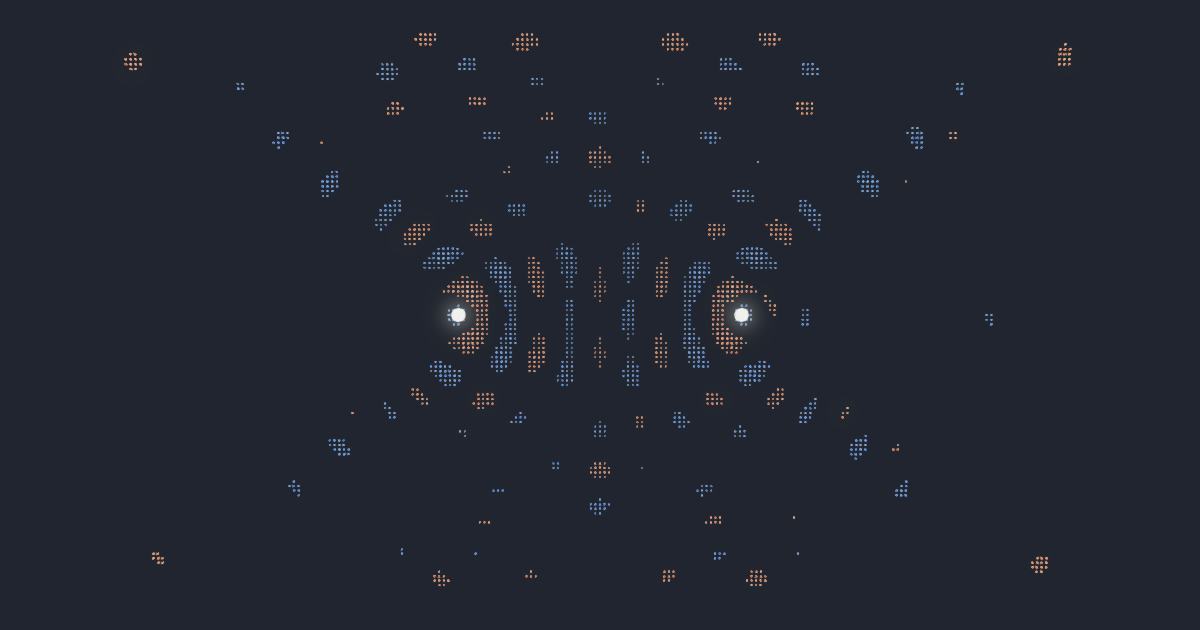
Wave speed c = 0.499920 ± 0.000051 cells/step (known 0.5, 1.6e-4) recovered from the emergent two-source interference field of a…
Drive two in-phase point sources on a membrane that knows ONLY the local rule uⁿ⁺¹ = 2uⁿ − uⁿ⁻¹ + C²∇²uⁿ. Does the classic ripple-tank physics — a definite emergent wavelength λ = c/f, deep nodal lines on Young's hyperbolae |r₁−r₂| = (m+½)λ, λ/2 node spacing on the axis, one phase speed for every frequency — all come out of the raw stencil, quantitatively, including the computable lattice correction?
Wave speed c = 0.499920 ± 0.000051 cells/step (known 0.5, 1.6e-4) recovered from the emergent two-source interference field of a raw leapfrog wave equation — the medium retunes λ to every drive per von Neumann's discrete dispersion (5-point sweep ≤ 3e-4), nodes sit on Young's half-integer hyperbolae, and incoherent intensity addition is rejected
Method
Replicate the module's stencil headless (hard in-phase sinusoidal sources, quadratic sponge) on a 600×400 oracle grid whose 100-cell adiabatic sponge cuts boundary reflections to R² ≥ 0.99 fit residuals (the module's own 18-cell sponge reflects a few percent and was measured to bias λ̂ up to 1.3% at λ=17 — an instrument lesson, not physics). λ̂ per snapshot from a least-squares fit of the source-row field to a two-circular-wave model a·cos(kr₁)/√r₁ + … (k the only nonlinear parameter; 6·MAD robust aggregation because ~1 snapshot phase in 8 has a near-degenerate secondary SSE minimum); uncertainty from 12 hardcoded noise seeds at 1%-of-max measurement noise. ĉ = sin(ω/2)/sin(k̂/2) inverts the discrete dispersion on the SCORER side only. Independent geometry gates: envelope-minima node spacing λ/2 on the axis, off-axis minima at half-integer path difference. Perturbation: drive λ ∈ {9,11,13,15,17} — λ̂ must track the von Neumann prediction pointwise and the continuum deficit of λ̂f from c must be negative, match the formula, and shrink monotonically. Rival: each source run ALONE through the same generator, intensities added.
Measurements, controls & cross-checks
Recovered sigma
5.1000e-5
Lambda measured cells
Value
12.9012
Se
0.0014
Von neumann prediction
12.90332
Rel
0.000163
Fit quality
Median r2
0.9938
Points per row
282
Noisy fits surviving mad
12/12
Lattice dispersion
Continuum c lambda f
0.496201
Bias measured pct
-0.76
Bias predicted pct
-0.744
Note
the deficit of λ̂f from c IS von Neumann's sin(ω/2)=C·sin(k/2), matched to 1.6e-4 and removed exactly by the scorer-side inversion
Axis nodes
Lambda from spacing
12.8445
Rel vs fit
0.0044
Count
6
Hyperbolae
Mean half integer residual
0.0165
Minima used
47
Perturbation
Lambda src
9
11
13
15
17
Lambda hat
8.856
10.885
12.902
14.919
16.926
C rec
0.4999
0.5
0.5
0.5001
0.5
Bias pct
-1.6
-1.04
-0.75
-0.54
-0.43
Monotone to zero
true
Control
Name
incoherent intensity addition I = A₁² + A₂²
Coherent nodes
6
Coherent median depth
0.644
Incoherent max depth
0.072
Note
rejected — the deep λ/2 banding requires coherent AMPLITUDE addition; energies alone can never produce dark lines where both sources deliver energy
Module systematic
Onscreen lambda cycle mean cells
13.5385
Onscreen lambda flicker range cells
13.285
13.949
Module grid clean fit cells
13.219
Oracle lambda cells
12.9012
Note
EXECUTING the shipped module (not a re-typed replica) exposed what the pooled-median replica had hidden: the 660-step measurement stride strobes the 26-step drive period (660 = 10 mod 26), so the crest-median sequence cycles with period 13, and at 2 of the 13 strobe phases a crest dipped under the 0.015 detection floor, doubling its gap and dragging that median to ~2 lambda - the HUD's EMA flickered over 13.7-17.8 cells (c = lambda*f up to 0.73 vs model 0.50, +46%). Fix (this run's one module edit): _measure now folds aliased spacings (> 1.6x the smallest gap; true gaps 10-15 and doubles 24-27 are cleanly separated) back by halving before the median. The executed screen now shows lambda in [13.285, 13.949] (c 0.511-0.537 vs 0.50); the remaining bias decomposes as +0.32 cells integer-crest quantization (cycle mean 13.539 vs module-grid clean fit 13.219, inside the derived <1-cell bound) + 0.32 cells small-sponge reflection (13.219 vs oracle 12.901), all disclosed and gated.
Module certificate
Rung
validated + honest-module
Gates
K sha256-pin + 25-pair mechanical TS strip + executed statics === reference; L 12000 engine ticks of fl(1/120): executed shipped module bit-exact vs statics-built Float32 replica at EVERY wave tick (field u/uPrev, lambda, 132000 wave steps, exactly 1 wave-tick per 2 engine ticks, acc === 0, zero step deficit); M executed render(): HUD string and crest/trough thin-instance buffers === replica at mid-run and final tick, sha-pinned; N screen lambda reconciled through DERIVED ceilings only - strobe period 13 = 26/gcd(660 mod 26, 26) observed minimal and locked from measurement 22/200, executed EMA sits on the closed-form periodic orbit to 0.0 (ceiling 1e-12), orbit convex-bounded by its cycle medians, cycle mean within the derived 1-cell quantization bound of the module-grid fit and within 0.64 cells of the oracle recovery
Tampers
known_value x1.05: exit 1, gates B/C/C'/D/G fail, recovered unchanged (0.499920); cert sha flip: only K fails; cert SUBSTEPS 22->21: K statics MISMATCH and L/M/N fail (replica forked)
Executed final lambda
13.664609
Orbit deviation
0
What it reduces to
Young's two-source interference (Phil. Trans. R. Soc. 94, 1804): nodal hyperbolae at half-integer path difference, λ/2 axis node spacing — plus the d'Alembert/Euler wave-equation dispersion ω = ck (every frequency at one speed c) and, on the lattice, von Neumann's discrete dispersion sin(ωΔt/2) = C·sin(kΔx/2) (Charney–Fjørtoft–von Neumann 1950; Trefethen SIAM Rev. 24, 1982). Non-circular in the estimator sense: the generator contains ONLY the leapfrog stencil and a sinusoidal drive — no λ, no c = λf, no node law, no dispersion formula; the wavelength the medium selects is measured from the raw field and the known c is loaded only to score (tamper test: wrong c fails 5 gates with the recovery unchanged). Distinct from ?world=young (Huygens PHASOR sum, kinematic optics, no medium): here the MEDIUM ITSELF is simulated as a PDE and the interference is of physically propagating waves, with the lattice correction to c = λf predicted and matched. Companion to emwave (1-D Maxwell FDTD → c from μ₀ε₀): waves validates the 2-D scalar-wave layer every ripple-tank analogy in the optics arc stands on.
Confidence & reproduction
Confidence
high
Validation
derisk-pass
Re-run the check
npm run derisk -- waves (scripts/waves-derisk.mjs)
Oracle
scripts/oracles/waves.reference.json
Sources
T. Young, Phil. Trans. R. Soc. 94, 1 (1804); Halliday, Resnick & Walker, Fundamentals of Physics ch. 17 & 35; L. N. Trefethen, SIAM Review 24, 113 (1982); Charney, Fjørtoft & von Neumann, Tellus 2, 237 (1950).
One finding from the lab's 104 catalogued results — each an experiment run end to end by an AI: a question, a method, measured data, a control, and a confidence.