Measured by the lab
2.4263e-12
When X-rays scatter off electrons, does the scattered light keep its wavelength (as a classical wave should) or does it redden — and what would a shift mean?
▶ Run the simulationSee the measured result
Units: m (electron Compton wavelength λ_C = h/(m_e c), CODATA 2018)
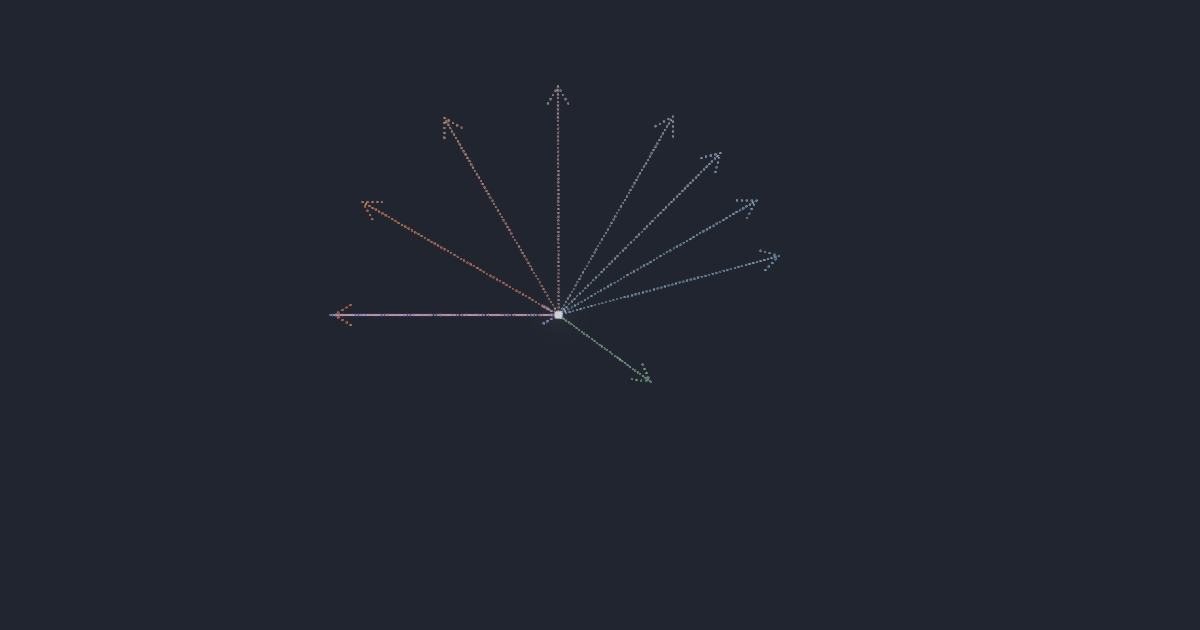
From two conservation laws — relativistic energy and momentum for a photon (E = pc, p = h/λ) elastically striking a stationary electron — derive the wavelength shift Δλ = (h/mₑc)(1−cos θ) = λ_C(1−cos θ). Generate the scattered wavelength at eight angles for an incident Mo Kα line and least-squares fit Δλ against (1−cos θ).
the Compton wavelength λ_C = 2.426×10⁻¹² m — recovered as the SLOPE of a single straight line through the origin (intercept ≈ 0); the shift is INDEPENDENT of the incident wavelength (a softer Cu Kα line gives the identical Δλ(θ) — the classical wave theory has no parameter that could do this, and in fact predicts Δλ = 0 at every angle); and energy conservation — the photon's lost energy equals the recoil electron's kinetic energy at each angle. Compton's 1923 result, the one that made the photon a particle carrying momentum p = h/λ and the fourth pillar of early quantum theory
What a photon loses to a free electron. The wavelength shift is set only by the scattering angle — never by the incident energy — and that angle-only dependence is what made light a particle; the energy the electron carries away, however, depends on both, and its maximum at θ = 180° is the Compton edge that terminates every gamma-ray spectrum. λ_C is not typed in: h/(mₑc) = 2.426310 pm is assembled here from CODATA 2018 h, mₑ and c, the same refusal to inject the answer that makes the simulation above non-circular (it root-finds energy–momentum conservation and reads λ_C off as the SLOPE of Δλ vs 1−cos θ). Two things this lab does NOT measure, so the calculator does not pretend to: the Klein–Nishina cross-section — how MUCH light scatters into each angle, as opposed to how far it shifts — and electron binding, since the target here is a free electron at rest (a good approximation for outer-shell electrons well below the incident energy, and a poor one for K-shell electrons in heavy elements).
Δλ = (h/mₑc)(1 − cos θ) · E′ = E₀/(1 + α(1−cos θ)), α = E₀/mₑc² · T_max = E₀·2α/(1+2α)