Measured by the lab
1103
Can a grid of cells with two trivial birth/death rules produce moving creatures, oscillators, and even universal computation?
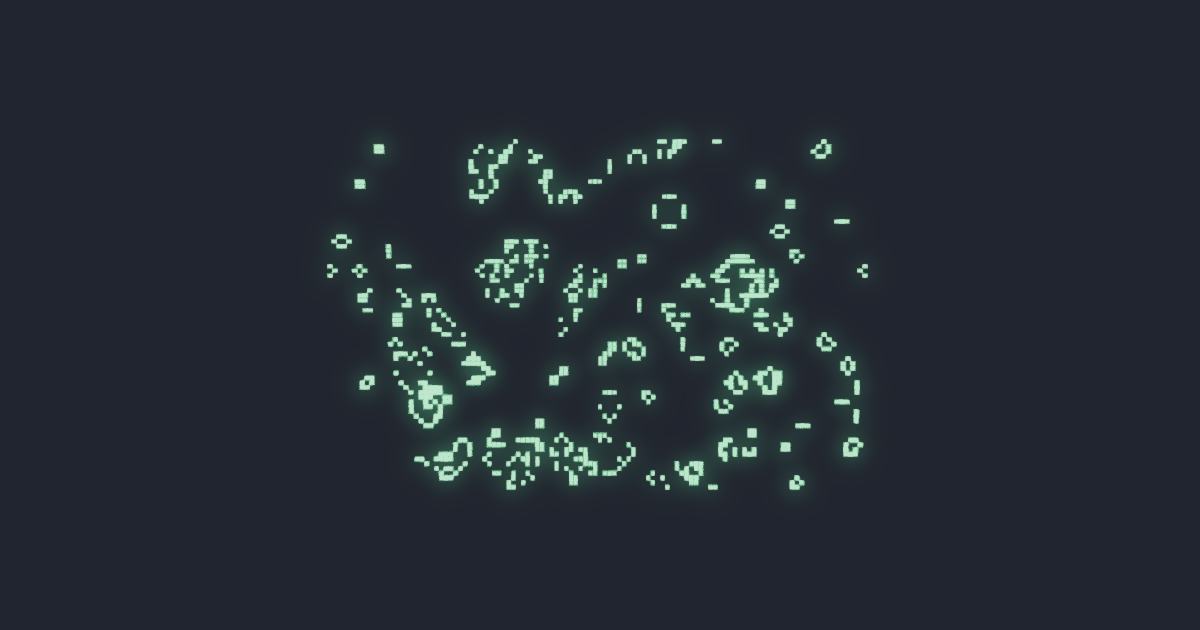
▶ Run the simulationSee the measured result
Units: generations to stabilization of the R-pentomino (secondary knowns: population 116 = 86 ash + 6 gliders, glider c/4, LWSS c/2, diehard 130, acorn 5206/633/13)
Each cell lives or dies by its eight neighbours (B3/S23): a live cell survives with 2 or 3 live neighbours, a dead cell is born with exactly 3. Seed the grid and watch what persists, moves, and self-reproduces.
open-ended emergence from two lines of rule — still lifes, blinking oscillators, gliders that travel across the grid, and guns that emit them. The Game of Life is Turing-complete (logic gates and a universal computer can be built from gliders), so its long-term fate is formally undecidable.
Life's three computable questions, in the conventions the simulation above measures. A spaceship's speed is an exact rational — displacement over period, in the Chebyshev metric, because the Moore neighbourhood's light cone is a square — so the glider's c/4 and the LWSS's c/2 are recovered by exact integer translation matching with no fit anywhere: the world's own gate demands (±100, ±100) at +400 generations and (200, 0) at +400. The rule is typed here as its digits (B3/S23 is b = 3, s = 23), never stored, and c is not stored either — it IS the neighbourhood, since one application of the rule moves information exactly one cell. Enter HighLife's B36/S23 or the survival-starved B3/S2 and the page reports what this lab measured when it ran those two rivals through the identical machinery: the same R-pentomino extinct at generation 9 and at generation 3, against 1103 generations under Conway's rule. Four things the lab does not measure, so the calculator does not pretend to: the fate of a rule it has not run — a fate table is the whole rule, but Life is Turing-complete, so what a seed does under it is formally undecidable and has to be simulated rather than looked up; oblique spaceships, which exist (Gemini, 2010) but appear here only as arithmetic; population growth rates, since nothing in Life bounds how many cells a light cone actually contains; and anything past the wrap, because the shipped module runs a 110 x 72 torus whose gliders re-enter and collide while the headline constants live on the unbounded plane.
Bb/Ss — a dead cell is born on b live neighbours, a live one survives on s · v = max(|Δx|, |Δy|)/p · c, c = 1 cell/generation · after g generations a w-wide seed lies inside w + 2g