Measured by the lab
1.2196699
A circular lens can't focus a point to a point — so how close can two stars (or two letters) be and still be seen as two, and why does 20/20 vision stop where it does?
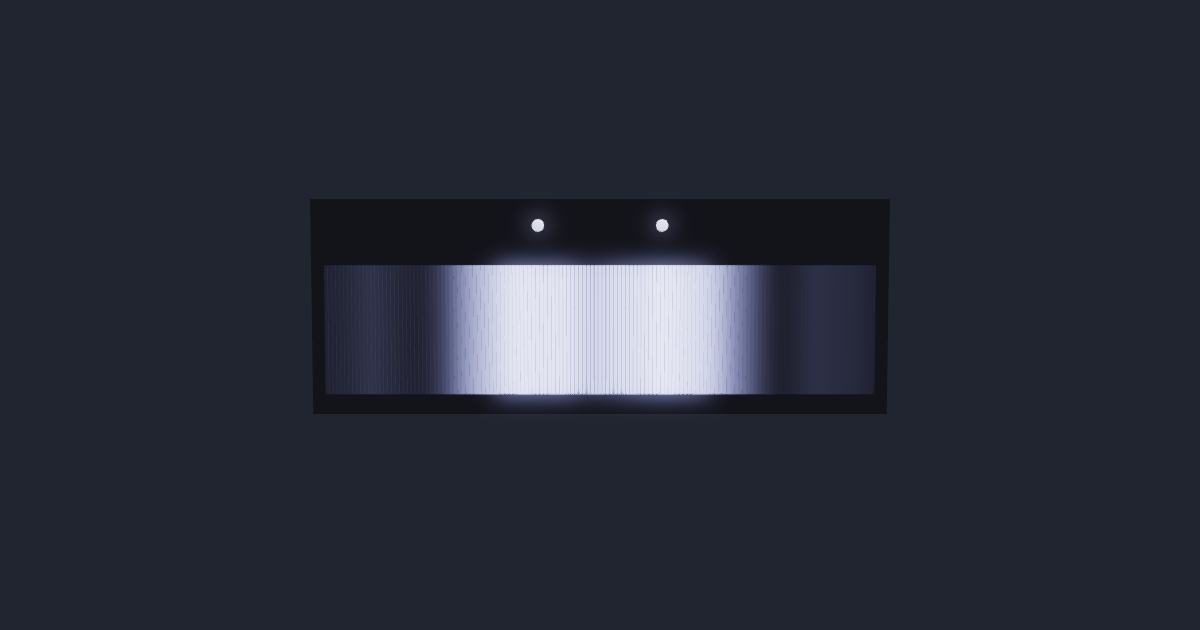
▶ Run the simulationSee the measured result
Units: dimensionless sinθ₁·D/λ (= j₁,₁/π, first zero of J₁ over π)
Model the Airy pattern A(x)=[2J₁(x)/x]² of a circular aperture; bisect the Bessel function J₁ for its first zero x₁; form the incoherent sum of two equal point sources, scan a noisy combined profile at the Rayleigh separation to count peaks and read the central saddle dip, and locate the Sparrow limit from where the central curvature flips sign.
the central disk's angular radius is θ_min = (x₁/π)·λ/D = 1.22·λ/D — the celebrated 1.22 is NOT a fudge but x₁/π, the first zero of J₁ (≈3.8317) divided by π, recovered here from scratch. At Rayleigh separation the two Airy disks merge into a profile that dips to ≈0.735 of the peaks (the 'just resolved' signature); squeeze below the Sparrow limit ≈0.78 θ_min (≈0.95 λ/D) and the dip vanishes into one blob. Made concrete: a 2.3 mm daylight pupil at 550 nm gives θ_min≈1 arcminute — exactly the stroke width on the 20/20 eye-chart line, so 'perfect' vision is set by diffraction, not biology, and bigger apertures (telescopes) see finer. The imaging sequel to the diffraction grating: from resolving two colours to resolving two points.
The wall every circular instrument hits. A telescope, a microscope objective, a camera lens and the pupil of your eye all stop resolving at the same place — θ_min = 1.2197 λ/D — and no amount of magnification, coating or exposure moves it, because the limit is the hole, not the glass. The 1.22 is not stored here: J₀ and J₁ are evaluated from their own power series on this page and the first zeros of J₁ are bisected out of them, so 1.2196698913 = j₁,₁/π is assembled at runtime rather than injected, the same refusal that makes the simulation above non-circular (it sums raw phasors e^{ikx·sinθ} over an open disk and reads the dark rings off sign changes, with no Bessel function in the recovery path at all). Three numbers this page computes are the world's own gate values, reached independently: 83.7785% of the light inside the first dark ring, the Sparrow limit at 0.947155 λ/D, and the Rayleigh saddle at 0.735032 — where the dip between two just-resolved peaks falls to, which needs no search, since at Rayleigh separation each peak sits exactly on the other's first dark ring and the peaks are therefore 1 by construction. Five things this lab does NOT measure, so the calculator does not pretend to: aberration and figure error, since the wavefront here is perfect and a real lens is diffraction-limited only once its optical errors fall below this scale; central obstruction, which in a reflector pulls light out of the disk and into the rings without moving the rings; atmospheric seeing, which blurs ground-level images to roughly an arcsecond no matter how big the aperture, so the formula stops being the binding constraint past ~140 mm; partial coherence and polychromatic or extended sources, since every number here is one wavelength from two incoherent points; and the detector — Rayleigh's criterion is a convention about a 26% dip, not a law about what an eye or a sensor can actually pick out, which is why Dawes' empirical double-star limit sits slightly inside it. The near field is out of scope too: this is Fraunhofer diffraction, the pattern at infinity or at a focus.
θ_min = 1.2197 λ/D · D = 1.2197 λ/θ · d_Airy = 2.4393 λN · Sparrow = 0.9472 λ/D · 83.78% inside the first dark ring