Known value
1.4142136
How far does a molecule travel between collisions? Clausius (1858) imagined ONE molecule threading a field of frozen targets and got λ=1/(n·σ). But the targets move too — by how much does that shorten the free path?
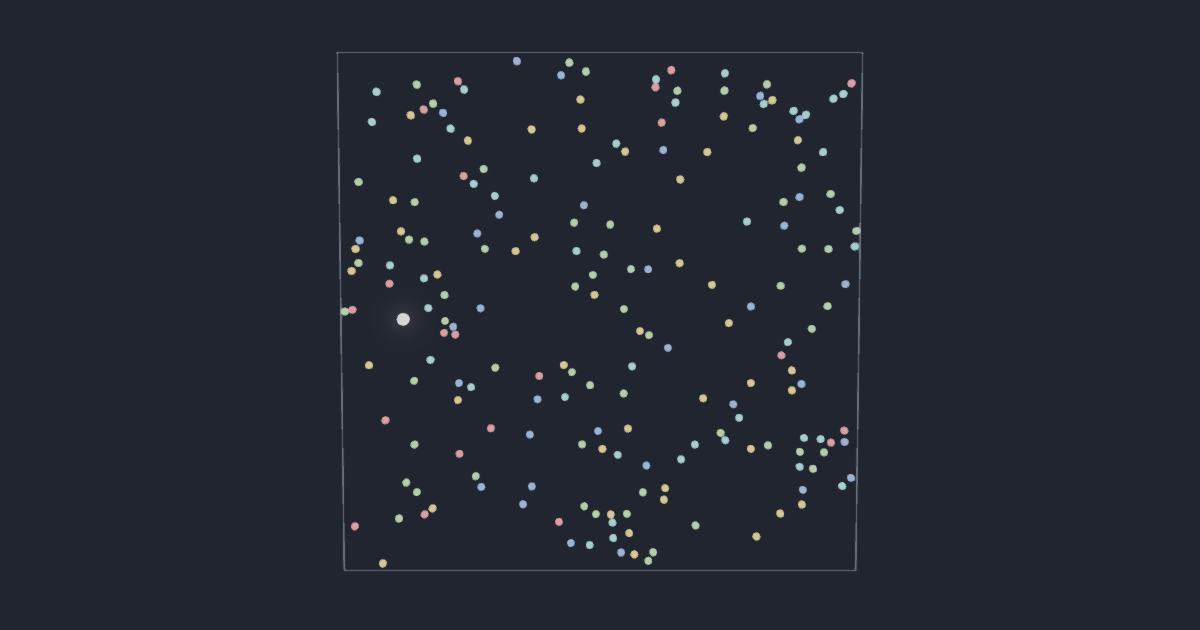
▶ Run the simulationSee the measured result
Units: dimensionless (√2 = ⟨v_rel⟩/⟨v⟩ for two independent Maxwell–Boltzmann velocities of equal mass; equivalently λ_stationary-target / λ_true)
Run a from-scratch event-driven hard-disk gas (equal masses, elastic line-of-centres collisions, energy conserved to machine precision), started OFF equilibrium — every disk at the same speed, random direction — and let it thermalize to Maxwell–Boltzmann. Recover Maxwell's √2 TWO independent ways without ever plugging it in: kinematically as ⟨v_rel⟩/⟨v⟩ (mean relative ÷ mean speed, sampled over pairs) and dynamically as λ_naive/λ_measured (measured λ = total path travelled ÷ 2·collisions), across three densities extrapolated to the dilute limit. Decisive control: FREEZE the targets (a Poisson Lorentz gas) and re-measure. ?world=meanfreepath.
Maxwell's √2 correction (1860). The true mean free path is λ = 1/(√2·n·σ) — a factor √2 SHORTER than Clausius's stationary-target estimate — because the collision rate is set by the mean RELATIVE speed, and for a thermalized gas ⟨v_rel⟩=√2·⟨v⟩ EXACTLY (the difference of two Maxwell–Boltzmann velocities is Maxwellian with half the mass). The gas STARTS at the non-Maxwellian fixed-speed ratio 4/π=1.273 and the collisions drive it UP to √2: recovered as ⟨v_rel⟩/⟨v⟩=1.42 (0.6%) and as a density-extrapolated λ_naive/λ_measured intercept of 1.409 (0.35%). The FROZEN control collapses to ≈1 (Clausius's estimate, no √2), decisively below the moving gas's 1.43 — so the √2 exists ONLY because the targets are themselves in motion. Mean free path is temperature-INDEPENDENT (heating speeds up collisions but never lengthens the gaps) and scales as 1/(n·σ). The transport companion to ?world=maxwell (the speed distribution) and the kinetic-theory root of viscosity and diffusion.
How far a molecule gets before it hits something. Clausius wrote down 1/(n·σ) in 1858 by walking one molecule through a field of targets that hold still; Maxwell noticed in 1860 that the targets are moving too, and since the collision rate is set by the mean RELATIVE speed rather than the mean speed, every free path in the universe is a factor √2 shorter than Clausius thought. That √2 is not typed into this page. It is assembled from the reduced mass — for two Maxwellian gases at one temperature the relative velocity is Maxwellian with μ = m·M_t/(m+M_t), so the ratio is √(1+1/Rm) — and the target/projectile mass ratio Rm is a box you can turn: at Rm = 1 it returns √2 and Maxwell's answer, and as Rm grows the targets get too heavy to move, the ratio falls to 1, and Clausius's estimate comes back. That is the same frozen-target control the simulation above runs as its falsification, here as one field. The defaults are nitrogen at one atmosphere and 15 °C, where λ = 64.55 nm — about 175 molecular diameters, which is why a gas can be treated as a continuum at all until the container gets small, and the Knudsen direction is where that stops being true. The inverse direction is the historically important one: Loschmidt had no way to see a molecule in 1865, so he measured a free path and inverted it, which is how anyone first knew how big an atom is. Two things this page does not do, because this lab does not measure them: the Chapman–Enskog transport integrals behind viscosity and thermal conductivity, and any correction beyond hard spheres.
λ = kT/(f·πd²·P), f = ⟨v_rel⟩/⟨v⟩ = √(1+1/Rm) = √2 for a pure gas · ν = f·n·σ·⟨v⟩ = ⟨v⟩/λ · ⟨v⟩ = √(8RT/πM) · Kn = λ/L · 2-D: σ = 2d = 4r, λ = 1/(f·n·σ)