Measured by the lab
1006590.3
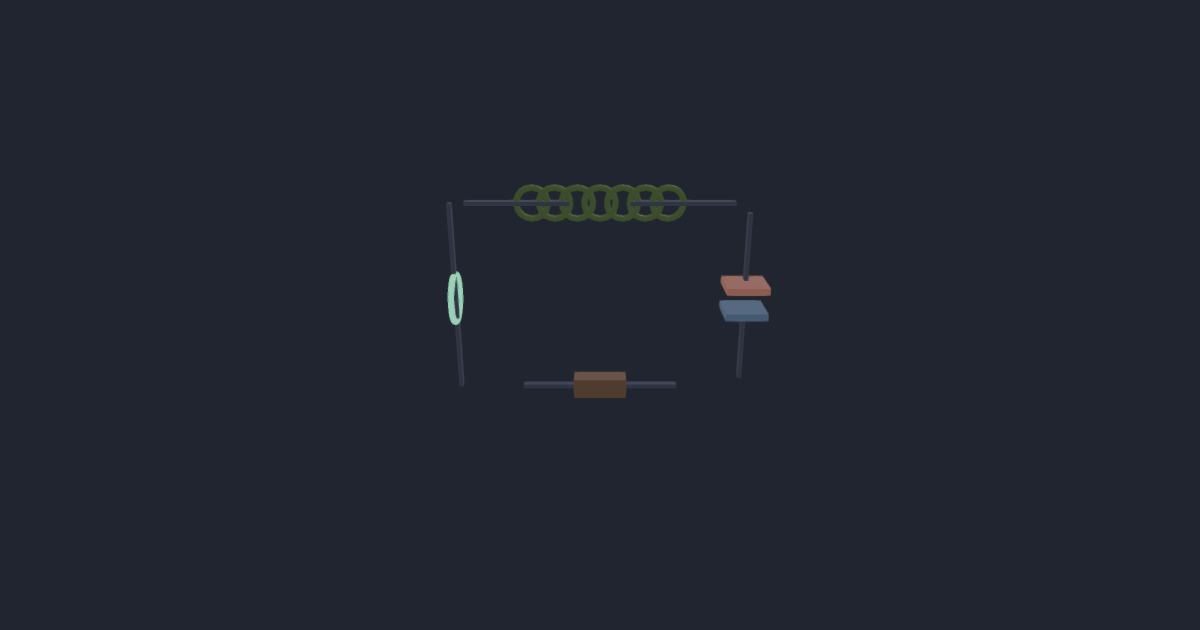
A coil, a capacitor and a resistor wired in a loop and driven by an AC source. Sweep the drive frequency: does the circuit respond the same at every frequency, or does it 'prefer' one — and if so, what sets it?
▶ Run the simulationSee the measured result
Units: Hz — f₀ = 1/(2π√(LC)) of the real tank (250 µH · 100 pF), Thomson's 1853 oscillation formula, in the AM broadcast band
Drive a series RLC loop with V₀cos ωt, so the charge obeys L q̈ + R q̇ + q/C = V₀cos ωt — the driven damped oscillator with L↔mass, 1/C↔stiffness, R↔friction. The lab sweeps the drive frequency through ω₀ and traces the steady current amplitude |I|(ω), shading the half-power band, while the live coil (½LI²) and capacitor (q²/2C) hand the energy back and forth. A real AM-radio tank — L=250 µH, C=100 pF, R=10 Ω — is swept with ±1.5% reading noise on the peak.
There IS a preferred frequency: the current amplitude |I| = V₀/√(R²+(ωL−1/ωC)²) peaks SHARPLY at the natural frequency ω₀ = 1/√(LC), where the inductive and capacitive reactances cancel and the loop looks like a bare resistor (|I| = V₀/R). The sharpness is the quality factor Q = (1/R)√(L/C) = ω₀/Δω, and the current's phase flips from leading (below ω₀) to lagging (above) through resonance. Reading a real tank recovers f₀ ≈ 1.01 MHz, Q ≈ 158 and (with C known) L ≈ 250 µH; its 6 kHz bandwidth is narrower than the 10 kHz station spacing — which is exactly how a radio dial picks one station out of the air
A radio dial, written as one square root. Three parts in a loop — a coil, a capacitor, a resistor — fix everything a tuned circuit does: the frequency it picks out, how sharply it picks it, and how far down the station next door arrives. None of that is stored here. f₀ is ASSEMBLED as 1/(2π√(LC)) out of the two parts you type and Q as √(L/C)/R, and every other frequency on the page is one of those two multiplied by a square root of a Q-ratio — zero the lab's own readings and not one computed number moves. The defaults are this world's bench, an AM tank of 250 µH and 100 pF: f₀ = 1006584.2421 Hz, 44.0733% of the way across the 535–1605 kHz broadcast band, Q = 158.113883, half-power width 6.366198 kHz. The simulation above reaches that same frequency down a completely different road — it integrates Kirchhoff's loop L·q̈ + R·q̇ + q/C = V₀cos ωt and bisects the drive frequency at which the current comes into phase, with no 1/√(LC) and no Lorentzian anywhere in its recovery — and its 24-seed noisy read of 1006590.3 ± 3.4 Hz lands 1.781738 bars from the closed form, which is the only reason the agreement is worth anything. Two things here are not restatements of the finding but second routes to it. Its claim that Δf = 6.4 kHz beating the 10 kHz AM channel spacing is WHY one station comes in alone is never quantified there; the answer is 10.3233 dB of rejection, because 2Q·δf/f₀ = 3.141593 is that spacing measured in half-widths. And the rival it falsified — the pre-1842 view that a driven loop is just Ohm's law, the same current at every frequency — dies here with no simulation at all: its selectivity is identically 1.000000 at every detuning, where these parts give 15.467287 at 5% off resonance, which is the 15.47 the lab measured by integrating the ODE at two frequencies, recovered here by closed form and landing -1.753836e-4 away. Four things this page will NOT do. It will not re-run the simulation above. It will not model a real coil or a real capacitor — no winding resistance, core loss, self-capacitance or skin effect, no ESR or dielectric loss — all of which drag a real tank's Q below √(L/C)/R, so the width below is a floor on sharpness rather than a promise. It is the SERIES loop this world integrates and not the parallel tank, whose peak is a maximum of impedance rather than of current. And it will not correct a single number the finding recovered: it prices closed forms, and the measured values belong to the oracle.
f₀ = 1/(2π√(LC)) · Q = (1/R)√(L/C) = 2πf₀L/R · Δf = f₀/Q · |Z| = √(R²+(2πfL−1/2πfC)²) · f_ring = f₀√(1−1/(4Q²)) · f_charge = f₀√(1−1/(2Q²))