Measured by the lab
-7.3413e-11
Run a current down a strip across a magnetic field and a voltage appears ACROSS it. Resistance can't tell whether a current is positive charges going one way or negative charges going the other — can this transverse voltage?
▶ Run the simulationSee the measured result
Units: m³/C — free-electron Hall coefficient R_H = −1/(ne) of copper at the world's input density n = 8.5e28 m⁻³ (Ashcroft & Mermin Table 1.4: 8.47e28; the module rounds to 8.5)
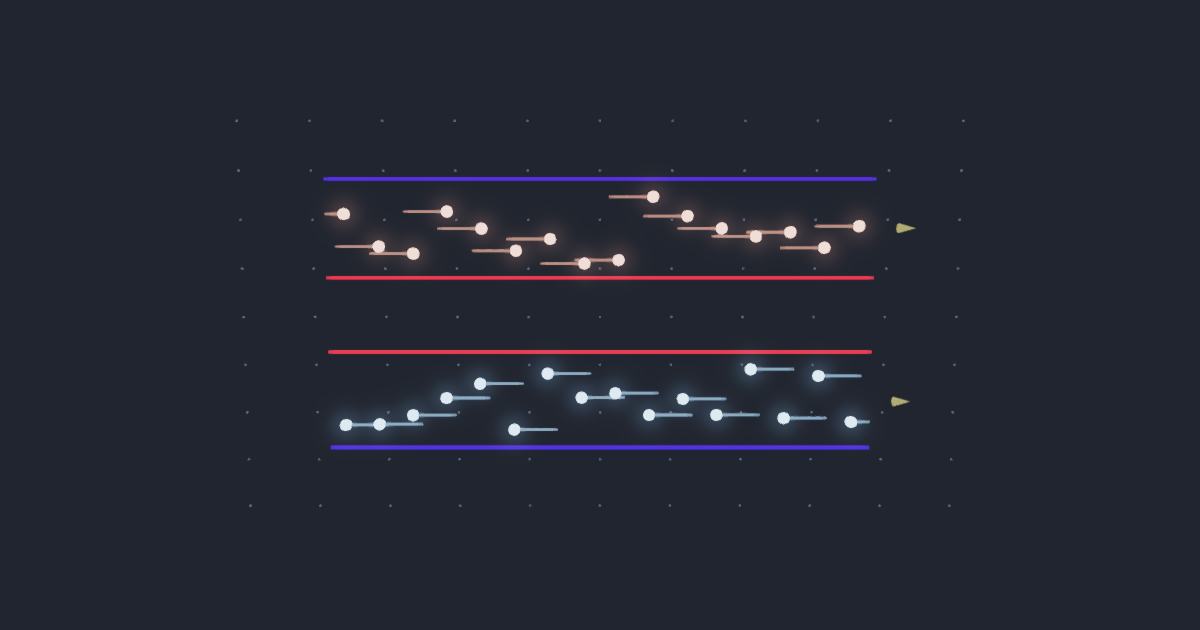
Drive two strips with the SAME conventional current (left→right) in the SAME field B (out of the page): one conducts by positive carriers (holes, drifting +x), the other by negative carriers (electrons, drifting −x). Each is a swarm of Drude carriers under F = q(E_H − v×B) whose transverse field E_H is itself dynamical — dE_H/dt ∝ −⟨q·v_y⟩, the sideways current charging the edges. The carriers bend to an edge, charge it up, and the growing Hall field straightens the flow; the lab reads the steady E_H and, separately, forward-models a real copper foil's V_H = IB/(net) with noise and inverts it.
the Hall law E_H = v_d·B and R_H = E_H/(J·B) = 1/(n·q): both species deflect to the SAME edge yet charge it with OPPOSITE sign, so V_H flips sign — sign(R_H) = sign(q) reads the carrier charge straight off (no resistance measurement can), and |R_H| = 1/(ne) recovers copper's free-electron density n ≈ 8.5×10²⁸ m⁻³ with R_H < 0 confirming electron conduction
The one measurement that can tell you the SIGN of the charge carriers. Push a current down a strip in a magnetic field and the carriers are shoved sideways until the field they pile up on the edges cancels the push — leaving a transverse voltage of a few microvolts whose sign says whether the current is positive charge going forwards or negative charge going backwards. No resistance measurement can tell those apart, because every transport coefficient in Drude's theory carries the charge SQUARED; the Hall voltage carries it once. The carrier density is never typed into this page: it is WEIGHED, n = Z·ρ_m·N_A/M, a mass density and a molar mass with no electricity in the chain anywhere, and it comes out 8.491232e28 m⁻³ for copper against the 8.5e28 the simulation above was handed and the 8.47e28 in the table — a 0.25% spread that is four figures in a density, not a disagreement about physics. Everything else is built from that: the coefficient, the voltage, the drift speed of 1.47 mm/s, the 0.44% tilt of the current that is the entire effect, and a Fermi velocity a billion times the drift. The measured-voltage box holds −14.6860 µV, this lab's own microscopic reading rather than a textbook number, so inverting it returns 8.499944e28 and the page prints the +1.03e-3 instead of rounding it away. One field carries the rival: f is the fraction of the magnetic force that reaches the carriers, 1 for Hall and 0 for the sentence in Maxwell's Treatise §501 — 'the mechanical force… acts, not on the electric current, but on the conductor which carries it' — which predicts a voltmeter reading of exactly nothing and is rejected here at 2771σ, and by the simulation above at 2.75e3 by integrating a swarm instead. The last direction RE-EXECUTES the shipped module: its mulberry32 stream, its 32 carrier jitters, its 24 voltmeter readings and 2400 Euler steps of both strips, landing on the same V̂_H = 1.4739963360365639e-5 V the screen rounds to 14.74 µV and the same 6.66e-16 force balance the world's own gate measures. Four things this page will not do: magnetoresistance, more than one carrier species at a time, the quantum Hall regime where the coefficient goes in steps of h/e², and any claim that the 0.37% the screen calls an error is a defect — it is priced here, exactly, as the mean of the module's own 24 noise draws.
V_H = R_H·I·B/t, R_H = 1/(nq) · n̂ = I·B/(q·t·V_H), n_s = I·B/(q·V_H) · n = Z·ρ_m·N_A/M · µ = |R_H|/ρ = eτ/m, tan θ_H = ω_c·τ · V_H = f·R_H·I·B/t, f = 0 is Maxwell's Treatise §501