Measured by the lab
0.8948
Can a 2-D system have a phase transition with NO long-range order to switch on — and what drives it if not a broken symmetry?
▶ Run the simulationSee the measured result
Units: J/k_B (Hasenbusch 2005, T_KT = 0.89294(8))
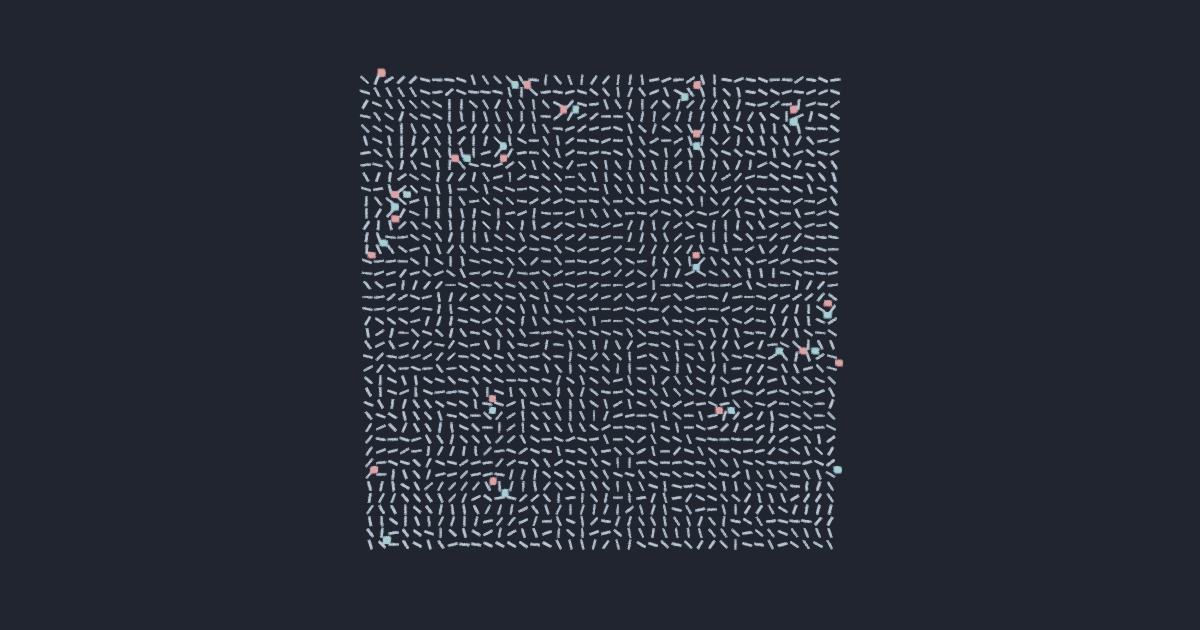
Planar spins on a lattice, neighbours aligning (E=−Σcos Δθ), evolved by Metropolis Monte-Carlo. Across a temperature sweep, measure the helicity modulus ϒ(T) (the spin stiffness) and the vortex density ρ_v(T). The Nelson–Kosterlitz criterion says ϒ jumps to zero across the universal line ϒ=(2/π)T — the crossing locates T_KT. Live, a lattice oscillates its temperature through T_KT with vortices flagged ± (red/cyan).
a TOPOLOGICAL transition driven by vortex unbinding, not symmetry breaking. In 2-D the continuous symmetry forbids true long-range order at any T>0 (Mermin–Wagner), so the magnetisation never sharply switches on; instead the order is quasi-long-range (power-law) and is destroyed when vortices, bound in ± pairs below T_KT, UNBIND into a free plasma above it. ϒ(T) crosses 2T/π at T_KT (≈0.95 from the naive crossing on this finite lattice; the ∞-limit 0.893 is recovered only by finite-size scaling with logarithmic corrections, not by a larger lattice alone) and ρ_v rises sharply there. A phase transition with no local order parameter
A two-dimensional magnet that cannot magnetise, and yet has a phase transition. Mermin and Wagner proved in 1966 that a continuous symmetry cannot break in two dimensions at any temperature above zero, which was taken to mean there was nothing to find; Berezinskii, Kosterlitz and Thouless found something anyway, and it earned a Nobel prize fifty years later. What changes at T_KT is not order but TOPOLOGY: below it the vortices — the points where the spin direction winds once around — are bound in pairs, and above it they come apart into a plasma. This page computes the two universal numbers that transition is made of, and it computes them from one line of counting rather than quoting them. Put a single vortex in a box of side L/a. Its energy is πw²J·ln(L/a), because the winding integral runs over shells whose area grows like the radius while the gradient falls like one over it; its entropy is D·ln(L/a), because the core can sit in any of (L/a)^D places. Both are the same function of L — that coincidence happens only in two dimensions — so the free energy is a single logarithm with a coefficient that changes sign, and the sign change is the transition: πw²K = D, which for a single vortex in the plane is the Nelson–Kosterlitz universal jump K_c = ϒ/T = 2/π. Feed that root into Berezinskii's spin-wave exponent η = T/(2πϒ) and the temperature cancels out of both sides, leaving η_c = w²/2D — the exact universal exponent, one quarter, a number that belongs to no particular magnet. Neither of those decimals is written anywhere in the code below; the title carries one of them, because that is what people search for, but the calculator never reads it, and the gate checks both halves of that claim. The transition temperature ITSELF is a different kind of number and is treated differently. T_KT = 0.89294(8) is a Monte-Carlo determination — Hasenbusch's, in 2005 — with no closed form to derive, so it arrives here as an editable field, loaded only to score, exactly as the third onset does on the logistic page. What this page can do with it is show you the estimator that finds it: the Weber–Minnhagen finite-size form ϒ(L) = ϒ_∞(1 + 1/(2 ln L + c)), which on two lattice sizes is a QUADRATIC and solves in closed form for both the infinite-size stiffness and the correction constant, with the physical root selected by ϒ_∞ < min(ϒ₁, ϒ₂) rather than by convention. The one-dimensional control is exact and needs no fitting at all: on a ring the bonds are independent, the stiffness is [I₁ − β(I₀−I₂)/2]/I₀ in modified Bessel functions, and the identity I₀ − I₂ = 2I₁/β kills it to the last bit at every temperature — no stiffness, no transition, no vortices, in the dimension where the counting argument above has nothing to count. Four things this page will not do. It will not extrapolate this lab's own on-screen reading to infinite size, because the module runs ONE 40×40 lattice and a size series is the one thing an extrapolation needs. It will not divide out the oracle's 0.21% miss against Hasenbusch as though it were a disclosed bias: that miss is defined as the distance to the number being scored, and dividing by it would hand back the answer by construction, which is the definition of circular. It will not give the correlation length above the transition, whose essential singularity this lab never measured. And it will not read the module's rounded ϒ = 2T/π crossing as a measurement of T_KT — it is high by a disclosed amount, and the whole of this audit is spending that disclosure rather than hiding it.
F/T = (πw²K − D)·ln(L/a) ⇒ K_c = ϒ/T = D/(πw²) · η(T) = T/(2πϒ) ⇒ η_c = w²/2D · ϒ(L) = ϒ_∞(1 + 1/(2 ln L + c)) · ϒ_1D = [I₁ − β(I₀−I₂)/2]/I₀ ≡ 0