Measured by the lab
2.7992e+10
A magnetic force does no work — it only bends a moving charge into a circle. Does a faster charge take LONGER to go around, or does the time stay the same?
▶ Run the simulationSee the measured result
Units: Hz — electron cyclotron frequency at B = 1 T, f_c = eB/(2πm_e), from SI-exact e and CODATA-2018 m_e (the '28 GHz per tesla' of ECR physics)
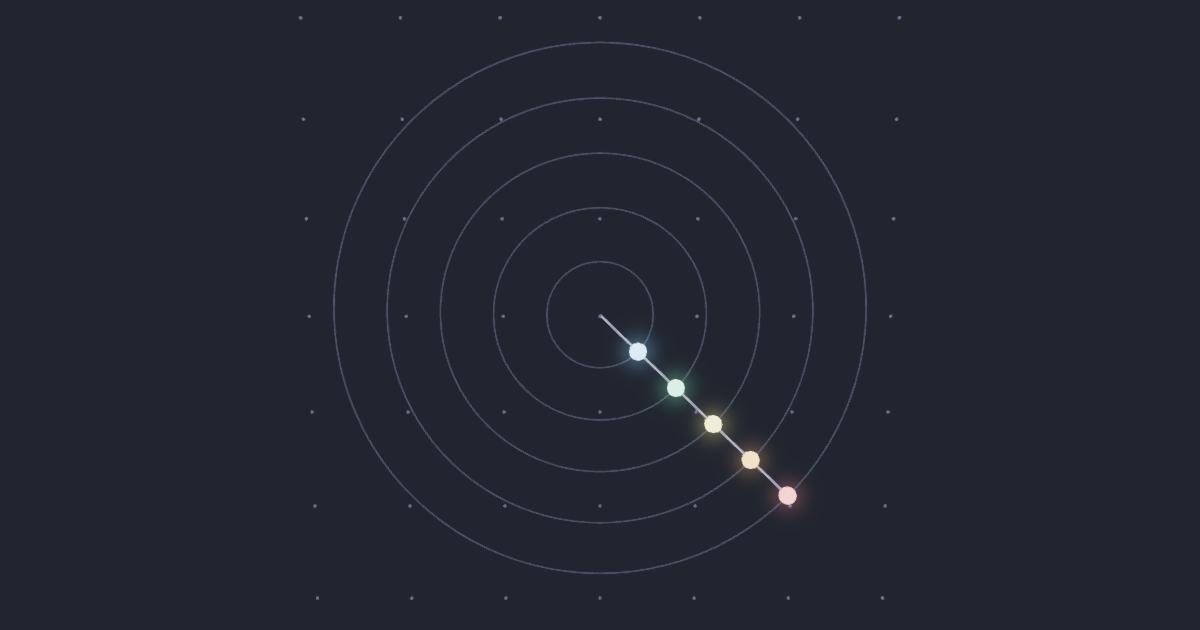
Put a uniform magnetic field B out of the plane and launch several particles of the same charge and mass but different speeds, all sharing one guiding centre. Each feels only F = qv×B (Boris push, exact rotation, |v| conserved); the lab measures every particle's period from its swept velocity angle and plots T against speed.
the cyclotron period T = 2πm/(qB) — INDEPENDENT of speed: a faster charge just traces a bigger circle (radius r = mv/(qB) ∝ v) and covers it in the same time, so every particle stays collinear on one spoke sweeping at the constant ω_c = qB/m, and the measured T(v) is a flat line