Measured by the lab
5.8930e-7
Press a curved lens onto flat glass — why does a bullseye of dark and bright rings appear, with a DARK centre, and what can the rings measure?
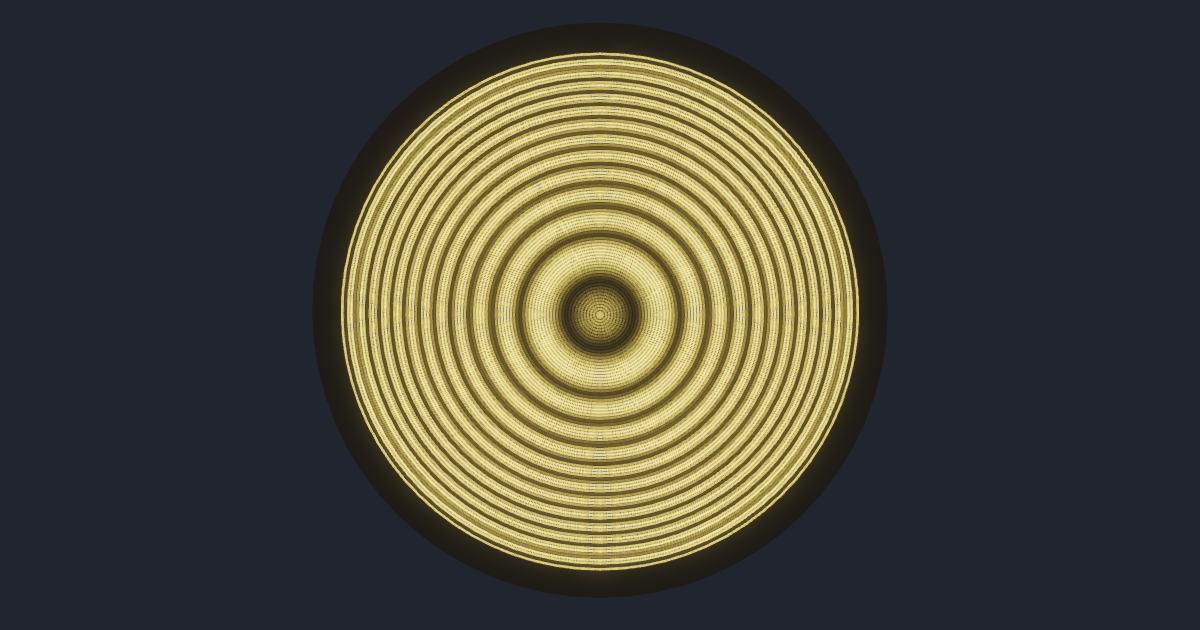
▶ Run the simulationSee the measured result
Units: m (sodium D-line mean: D2 588.9950 nm + D1 589.5924 nm ⇒ 589.29 nm; module and oracle use 589.3 nm)
Model the thin air wedge t(r)=t₀+r²/2R between a plano-convex lens (R=1 m) and a flat plate; combine the top and bottom reflections (with the π half-wave flip at the bottom surface) into the reflected intensity I=sin²(2πt/λ), locate the dark-ring radii from a noisy radial scan, and fit r_m² against the ring index m.
thin-film interference — dark rings at r_m²=mλR (a straight line of slope λR, rings crowding outward as √m) and, decisively, a DARK centre: with zero path difference the lone π flip at the bottom reflection makes r=0 destructive — the direct fingerprint of the half-wave shift. The slope weighs the wavelength of light with a ruler (recover λ≈589 nm given R), and lifting the lens by λ/2 slides one whole fringe past any point — counting fringes counts half-wavelengths of motion (interferometric metrology). The interference branch of the optics arc, after Brewster and Malus.
Ring radii, a ruler, and the wavelength of light. Press a plano-convex lens onto a flat plate and the trapped wedge of air throws concentric dark rings whose radii obey r_m² = mλR — a straight line in the ring index, of slope λR. Two things fall out of that line and both are on this page. Read it one way and the rings WEIGH LIGHT: Young did exactly this in 1802 with Newton's own published ring measurements and got about 570 nm, the first wavelength anyone ever computed. Read it the other way and the rings measure the LENS, which is what the undergraduate lab actually does, and the form it uses is the DIFFERENCE of two rings, (r_n² − r_m²)/((n − m)λ), because that cancels the one error nobody can avoid — a speck of dust holding the lens off the plate. Nothing about sodium light is typed into this page: λ is assembled from the two NIST D lines, 588.9950 nm and 589.5924 nm, and the 589.3 nm the simulation above codes is that mean rounded to four figures, a 1.07e-5 the page prints rather than hides. The measured boxes hold the simulation's OWN ring radii, so inverting the twelfth ring returns 588.6446 nm and −0.11% instead of the answer. The dark CENTRE is the part worth staying for: zero path difference, and yet black. Two dials run the rivals through the same Fresnel sum — g, the fraction of the two reflections that add as amplitudes instead of intensities, and fl, the sign of the bottom coefficient — and their endpoints test themselves: at g = 1 with the flip the centre is EXACTLY zero and the visibility EXACTLY one; at g = 0, Newton's own corpuscular picture, the visibility is EXACTLY zero and there are no rings at all to measure; and with the flip removed the centre goes bright and every dark ring slides out half an order. Four things this page will not do: transmitted rings, which are the complement of these and reverse the centre; rings in a film of index n, where the optical thickness carries an n and the wedge is not air; the dispersion of glass, since R is one number here and a real lens has a different focus for every one of these wavelengths; and any claim about the module's own on-screen reading beyond the one the last direction re-executes.
r_m² = mλR − m²λ²/4 (exact sag) · r_m ≈ √(mλR) (paraxial) · λ = 2(R − √(R² − r²))/m · R = (r_n² − r_m²)/((n − m)λ) — the difference form, immune to the contact gap · one fringe per λ/2 of lift · I(δ) = r_top² + r_bot² + 2g·r_top·r_bot·cos δ, r_bot = fl·(n_g − n_a)/(n_g + n_a)