Measured by the lab
6.3284e-7
Pass light through two slits — why a striped comb instead of two bright lines, what sets the stripe spacing, and why is one stripe missing?
▶ Run the simulationSee the measured result
Units: metres (helium–neon laser line, 632.8 nm)
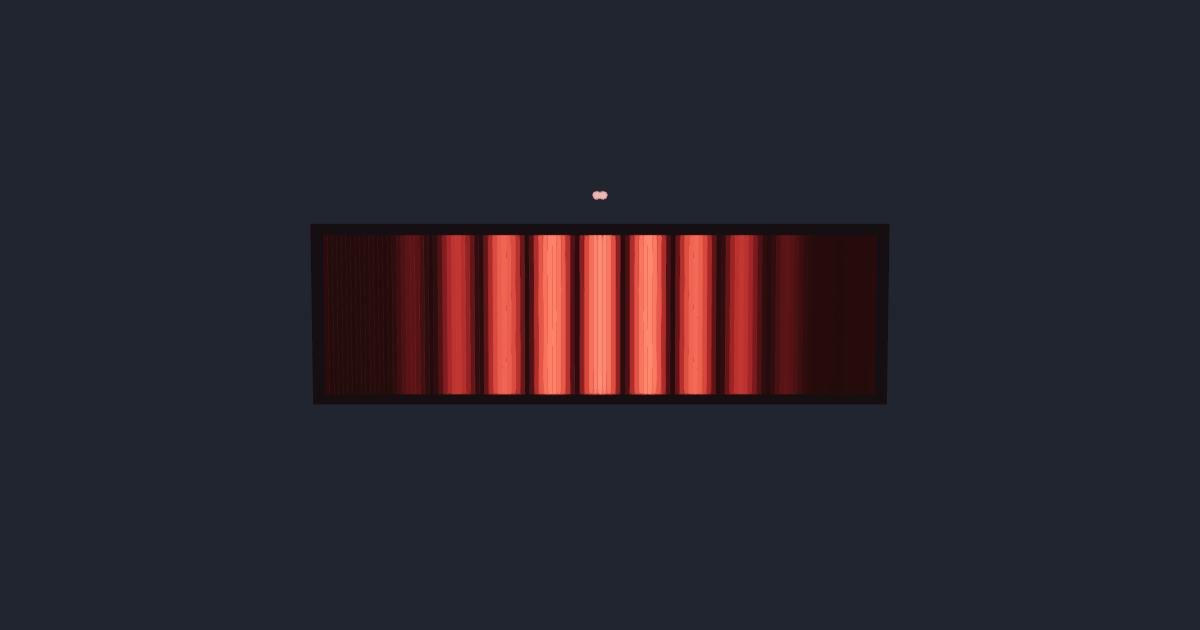
Model the far-field intensity I=cos²(πdy/λL)·[sinβ/β]² (β=πay/λL) on a screen distance L from two slits of separation d and width a; scan a noisy intensity profile, locate the bright-fringe peaks with a hysteresis finder, fit y_m=(λL/d)·m, and read λ off the fringe spacing Δy=λL/d.
two-beam interference — the bright fringes form an EVEN comb at y_m=m·λL/d, so the fringe spacing Δy=λL/d is a ruler for the wavelength (recover λ≈633 nm given L and d). The comb is not a property of either slit: block one and it collapses to a single broad blob. The cos² fringes ride under the single-slit (width a) diffraction envelope [sinβ/β]², whose zero at y=λL/a KILLS every (d/a)-th fringe — here d/a=5, so the 5th order is MISSING: a gap that fingerprints the slit WIDTH a as distinct from the slit SPACING d. The wavefront-division sibling of Newton's amplitude-division rings.
Two slits, one screen, and the experiment that decided what light is. The spacing between bright fringes is Δy = λL/d — three lengths a ruler can reach — so the pattern is not a picture of light, it is a SCALE for weighing it: measure the pitch with the slit separation and the screen distance known, and the wavelength falls out. That is Young’s 1804 move and it is the second direction on this page. It is worth saying what the second box holds, because it is not the tidy number: it holds the shipped simulation’s OWN fitted pitch, 5.205357 mm, noise and envelope pull and all, so this page hands back 624.64 nm and prints the −1.29% rather than echoing the 632.8 nm sitting one box above it. A page with the answer stored in it could not do that. The third direction drops the small-angle approximation for the exact d·sinθ = mλ and prices the difference, and tells you where the comb simply stops — no pair of slits can throw more than floor(d/λ) orders, because the path difference cannot exceed d. The fourth is where orders go to die: the finite slit WIDTH rides on top as a diffraction envelope whose zeros land on comb maxima whenever d/a is a whole number, deleting them, and here d/a = 5 deletes the fifth fringe outright — a gap in an even comb that measures the slit width using a pattern set by the slit spacing. The fifth carries the rival, and it needs no trigonometry at all: add AMPLITUDES and square after and the centre is 4× one slit; add intensities, as independent corpuscles would, and it is 2×, with no comb anywhere. Set the amplitude ratio to zero and you have blocked a slit, which is the other half of the argument — the fringes belong to the pair, not to either slit. The last direction re-executes the simulation’s own init measurement, grid step for grid step, and then derives from the envelope alone why the number on its screen reads low. Four things this page will not do: single-photon build-up, partial coherence, polarization, and which-way detection (that is ?world=bell).
Δy = λL/d · λ̂ = Δy·d/L · d·sinθ = mλ, m_max = floor(d/λ) · envelope [sinβ/β]², β = πma/d — order m = d/a deleted · centre 4× one slit (waves) vs 2× (corpuscles)