Measured by the lab
3.99989
Why is the daytime sky blue and the setting sun red — and can that colour be derived from scratch, without ever assuming the answer?
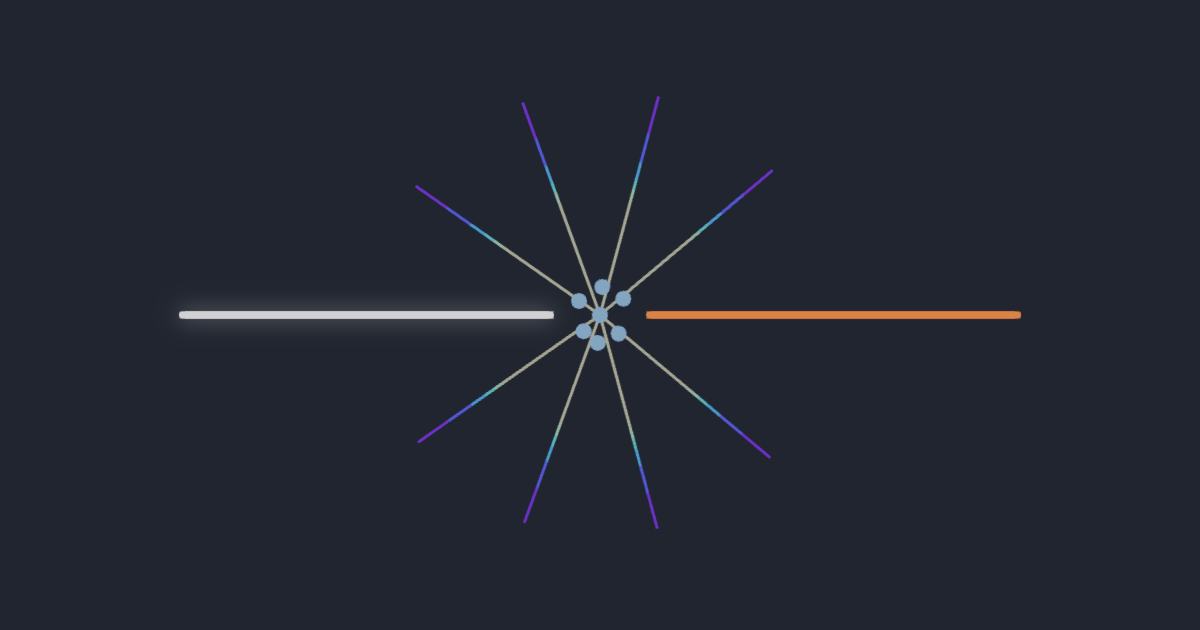
▶ Run the simulationSee the measured result
Units: dimensionless power-law exponent (⟨P⟩ ∝ λ^−4 ∝ ω^+4)
Model an electron bound in an air molecule (natural frequency ω₀ in the deep UV) as a driven damped oscillator ẍ+γẋ+ω₀²x=(e/mₑ)E₀cos(ωt); its steady amplitude x₀(ω)=(eE₀/mₑ)/√((ω₀²−ω²)²+(γω)²) contains NO exponent. The wiggling charge radiates by the Larmor formula ⟨P⟩=e²ω⁴x₀²/(12πε₀c³). Generate the scattered-power curve ⟨P⟩(ω), measure its local log–log slope by finite difference, and extrapolate to ω→0 to read off the exponent p in ⟨P⟩∝λ⁻ᵖ — a recovery in which the number 4 never appears. Repeat across binding stiffness ω₀, damping γ and intensity E₀ (universality), and unbind the electron (ω₀=0, Thomson) as a falsification control. An RK4 lock-in of the actual equation of motion confirms the generator's amplitude. ?world=rayleigh.
Rayleigh's law ⟨P⟩∝ω⁴∝λ⁻⁴ — the exponent p=4.000 recovered (to ~1e-4) as the ω→0 limit of the scattered-power slope, and shown to be UNIVERSAL: independent of the binding stiffness ω₀, the damping γ and the intensity E₀, exactly as the law demands. Blue (450 nm) therefore scatters (700/450)⁴≈5.9× more than red — the sky's blue, and the reddened setting sun whose long air path scatters the blue away. The result is decisive because binding is what makes it happen: unbinding the electron (ω₀=0, Thomson scattering) collapses the slope to 0 — a free electron scatters every colour equally (grey), which is why a free-electron plasma does not blue the sky. The same machinery hands back a second textbook constant, the wavelength-independent Thomson cross-section σ_T=(8π/3)r_e²=6.6525e-29 m² (and r_e=2.818e-15 m), to ~1e-11. Distinct from ?world=compton (the inelastic photon–electron energy shift): Rayleigh is elastic dipole re-radiation whose wavelength SCALING makes colour. The scattering branch of the optics arc, after Snell, Brewster and the rainbow.
Why the sky is blue, worked out rather than asserted. The exponent is never typed on this page: it is MEASURED, as the ω→0 limit of the log–log slope of the power a driven bound electron radiates — and the formula that generates that power, x₀ = (eE₀/mₑ)/√((ω₀²−ω²)²+(γω)²), has no exponent anywhere in it. What comes back is 3.999886296, and the 1.1e-4 it misses 4 by is not error but the curvature of a ladder that never quite reaches zero. The inverse direction is the one worth keeping: fed nothing but an observed intensity ratio and two wavelengths, ln R / ln(λ_red/λ_blue) hands back the same exponent with no oscillator, no fit and no physical constant in it at all. The cross-section is ASSEMBLED the same way — r_e = e²/(4πε₀mₑc²) rather than 2.818e-15 typed in, so moving any one of those four constants moves everything downstream — and it is where this page gets its cleanest number: σ(450)/σ(700) is a ratio of two polynomials in ω, no logarithm, no power, bit-identical in every browser ever written, while the exponent it encodes is not. That gap is stated rather than hidden: p is printed to ten significant figures against an engine floor of ±1.951e-11 derived on the page from the ulp of ln⟨P⟩, because a world whose answer is a difference of logarithms has no business printing sixteen. The binding dial is the falsification, and it is one number rather than a second formula: b multiplies ω₀ and γ together, b = 1 is the shipped simulation reproduced line for line, and b = 0 is a free electron, whose slope is exactly zero — grey, colour-blind, no sky at all. Binding is what makes the sky blue. The optical-depth direction turns the exponent into the sunset: at one air mass the surviving beam reddens by 1.20×, at the ≈38 of a sun on the horizon by 936×, and nothing about the air changed between them. Two things this page will not do: fix the ABSOLUTE size of the cross-section, which one oscillator cannot (it fixes the scaling, and real air is a sum of them), and derive τ_ref, which is an input measured from a real atmosphere.
⟨P⟩ ∝ ω⁴x₀², x₀ = (eE₀/mₑ)/√((ω₀²−ω²)²+(γω)²) · p = lim(x→0) d ln⟨P⟩/d ln ω · I_blue/I_red = (λ_red/λ_blue)^p · p = ln R / ln(λ_red/λ_blue) · r_e = e²/(4πε₀mₑc²), σ_T = (8π/3)r_e² · τ(λ) = τ_ref·(λ_ref/λ)^p, T = exp(−m·τ)