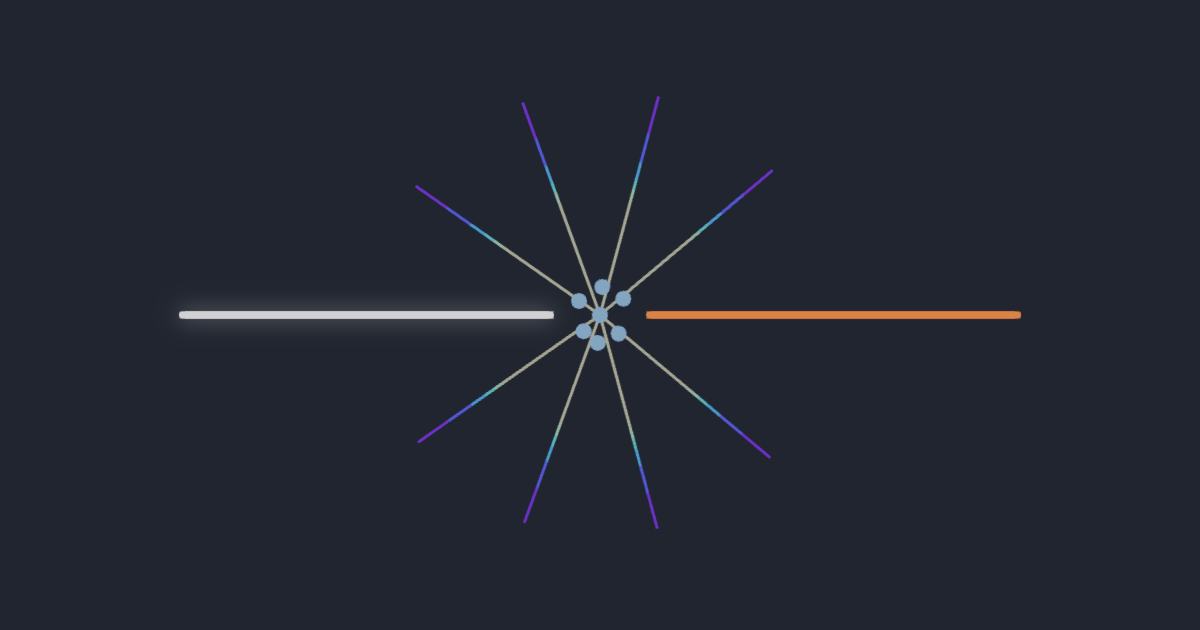
Rayleigh's λ⁻⁴ law (exponent 4.000) recovered from a driven bound electron — why the sky is blue and the sunset red (Rayleigh 1871)
Method
Model an electron bound in an air molecule (natural frequency ω₀ in the deep UV, λ₀≈90 nm) as a driven damped oscillator ẍ+γẋ+ω₀²x=(e/mₑ)E₀cos(ωt); its steady amplitude x₀(ω)=(eE₀/mₑ)/√((ω₀²−ω²)²+(γω)²) contains NO exponent. The oscillating charge radiates by the Larmor formula ⟨P⟩=e²ω⁴x₀²/(12πε₀c³). Generate the scattered-power curve ⟨P⟩(ω), measure its local log–log slope s(x)=d ln⟨P⟩/d ln ω by central finite difference at a ladder of x=ω/ω₀, and least-squares-fit s against x² to read the x→0 intercept — the exponent p in ⟨P⟩∝λ⁻ᵖ, a recovery in which the number 4 never appears. Repeat across binding stiffness ω₀, damping γ and drive amplitude E₀ (universality); unbind the electron (ω₀=0, Thomson) as a falsification control; and RK4-integrate the actual equation of motion with a lock-in to confirm the analytic generator's amplitude.
The law it recovers
P ∝ omega^4 ∝ lambda^-4 (Rayleigh scattering)
Measurements, controls & cross-checks
Recovered abs error
0.000114
Asymptotic recovery
exponent = x→0 intercept of measured log–log slope s(x) vs x²; s(x) increases monotonically with x (scattering steepens toward blue — the leading resonance correction)
Universality
Note
the recovered exponent is 4.000 (worst |Δ|=1.14e-4) independent of ω₀ (λ₀∈{40,90,200} nm), damping γ (0.005–0.05·ω₀) and intensity E₀ (0.5–2 V/m)
Blue red ratio
Expected
5.85
Recovered
5.86
Note
blue (450 nm) scatters (700/450)^4 ≈ 5.86× more than red (700 nm) — the blue sky, and (in transmission) the reddened setting sun
Control
Name
Free electron (Thomson scattering), ω₀=0
Recovered slope
0
Note
ruled out as the sky's cause — with no binding a=eE₀/mₑ is frequency-independent, so the log–log slope is 0 (colour-blind, grey). Binding is what makes the sky blue.
Thomson crosscheck
Known value
6.6525e-29
Known value unit
m² (Thomson cross-section σ_T=(8π/3)r_e²)
Recovered value
6.6525e-29
Rel error
1.1100e-11
Classical electron radius m
2.8179e-15
Note
the free electron's σ=⟨P⟩/I_inc equals the CODATA Thomson cross-section to ~1e-11 — a second textbook constant out of the same machinery
Ode lockin crosscheck
Note
RK4 integration of ẍ+γẋ+ω₀²x=Fcosωt with a cos/sin lock-in reproduces the analytic steady amplitude to <1e-3 at x=ω/ω₀∈{0.05,0.5,0.9}, proving the analytic generator IS the simulated oscillator
Module honesty
Status
validated + honest module
Module is oracle
RayleighModule is fully deterministic (no RNG; the recovery runs once at init, HUD and chart are static). Its numeric path is arithmetically identical to the oracle's — same CODATA constants, same x-ladder/dlnw, operand orderings equal up to a·b = b·a which IEEE-754 preserves bit-exactly — so the on-screen exponent === the oracle intercept strict-=== (3.999886295883877, gate M2): the module IS the oracle recovery, not a copy of its answer.
Onscreen systematic decomposed
the HUD's p = 3.9999 (|Δ| = 1.137e-4 below 4) is NOT numerical error: fitting the EXACT closed-form slope s(x) = 4 + (4x²(1−x²) − 2g²x²)/((1−x²)² + g²x²) on the module's own ladder gives intercept 3.999886296192615 (the ladder-curvature bias of the leading resonance correction s ≈ 4 + 4x² + 4x⁴), and adding the predicted central-difference correction (d²/6)·s''(lnω) reproduces the module's value to 1.4e-12 — 1.3e-8 of the miss left unexplained (gate M5). The same steepening-toward-blue correction is real atmospheric physics (measured exponent ~4.05–4.09).
Display pins
five scalars bit-pinned strict-=== (p, σ_T, r_e, free-slope, blue/red); all 10 HUD lines + chart label + chart SVG (sha256 + axes/flat/ticks/open pieces + 86 curve points + 6 swatches) pinned verbatim (gates M3/M6/M7); live read-back of the BUILT worktree (npx vite preview + playwright-core channel chrome) — HUD textContent 10/10 lines, path d bit-identical, 6 circles + 6 texts + 3 lines by DOM-attribute reads (serializer-proof), label innerHTML verbatim.
Discretization disclosures
module measures the free-electron slope over 400–700 nm (oracle: 380–700 nm) — BOTH are exactly 0 in floats via a quantization mechanism gated as M4: P(400) and P(700) differ by ~2 ulps but ln⟨P⟩ ≈ −71.5 where one output ulp is ~1.4e-14 ≈ 70× that change, so Math.log returns the same double and the slope numerator is exactly 0. Module probes σ_T at 500 nm (oracle: 380 nm): relΔ = 1.7e-16 (1 ulp; a-priori few-ulp bound 1e-15). HUD shows blue/red '5.85×' from the MEASURED p while the oracle narrative prints 5.86 from the KNOWN 4 — the 7.1e-4 closed-form factor (700/450)^(4−p) straddles the two-decimal rounding boundary; the module honestly displays its own measurement (gate M8).
Rival through module
the free-electron (Thomson) rival runs through the module's own transcribed machinery and returns slope exactly 0 vs the bound electron's 4 — infinite separation at the 0.02 control tolerance; binding is what makes the sky blue.
What it reduces to
Rayleigh's λ⁻⁴ scattering law (Lord Rayleigh / J. W. Strutt, Phil. Mag. 1871). Validates a textbook result: the exponent 4 is recovered to ~1e-4 as the low-frequency limit of a driven Lorentz-oscillator's Larmor radiation — with the number 4 nowhere in the recovery path — and is shown universal across binding stiffness, damping and intensity. It does NOT derive the atomic resonance ω₀ from a deeper theory; it assumes the classical bound-electron (Lorentz) model and the Larmor radiation formula, and shows the emergent, measurable wavelength SCALING is λ⁻⁴. The free-electron (Thomson) control falsifies the alternative that scattering is intrinsically blue-weighted — a free electron is colour-blind (slope 0) and its cross-section is the constant σ_T=(8π/3)r_e²=6.6525e-29 m², recovered here to ~1e-11. Distinct from ?world=compton (Compton 1923, the INELASTIC photon–electron collision that shifts a photon's wavelength by the electron mass): Rayleigh scattering is elastic dipole re-radiation whose λ⁻⁴ scaling makes colour. The scattering branch of the optics arc (after ?world=snell, ?world=brewster, ?world=rainbow); the physics of why the sky is blue.
Confidence & reproduction
Confidence
high
Validation
derisk-pass
Re-run the check
npm run derisk -- rayleigh (scripts/rayleigh-derisk.mjs)
Oracle
scripts/oracles/rayleigh.reference.json
Sources
Lord Rayleigh (J. W. Strutt), Phil. Mag. 41, 107, 274 & 447 (1871). CODATA-2018 e, mₑ, ε₀, c; classical electron radius r_e=2.8179403262e-15 m; Thomson cross-section σ_T=(8π/3)r_e²=6.6524587321e-29 m². Air's effective UV electronic resonance λ₀≈90 nm.
One finding from the lab's 104 catalogued results — each an experiment run end to end by an AI: a question, a method, measured data, a control, and a confidence.