Measured by the lab
15.0597
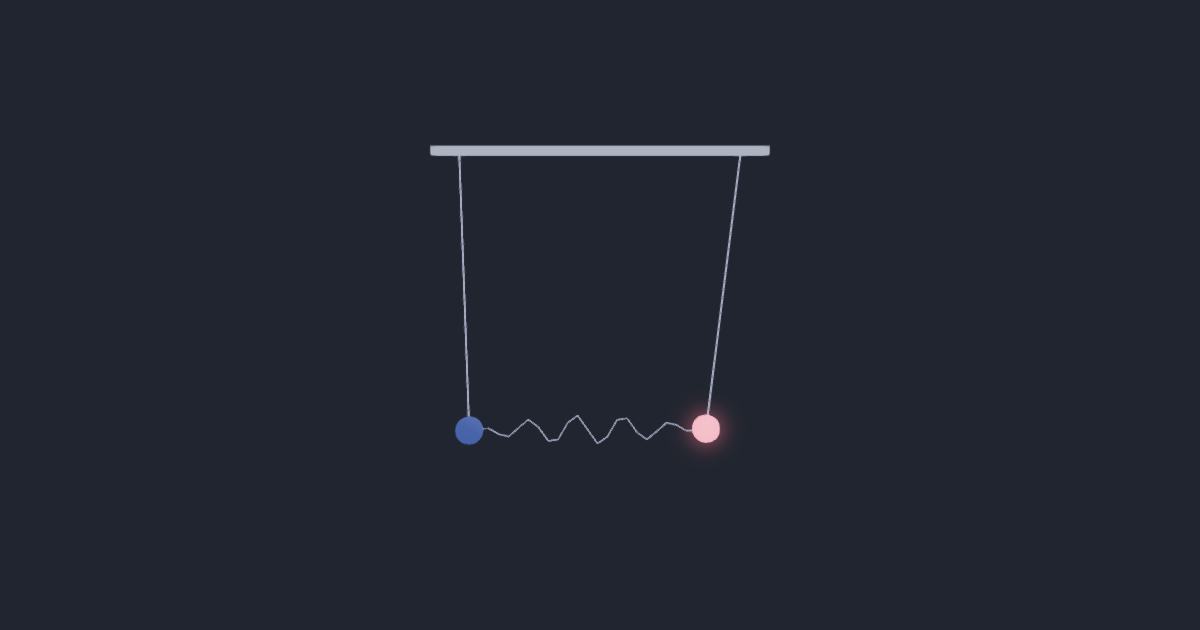
Hang two IDENTICAL pendulums and join them with a light spring; start one swinging and the other still — what does the energy do?
▶ Run the simulationSee the measured result
Units: seconds per beat (T_beat = 2π/(ω_a − ω_s); secondary knowns ω_s = √(g/L) = 2.4996815, ω_a = √(g/L+2c) = 2.9169175 rad/s)
Integrate the small-angle coupled system θ¨ = −(g/L)θ − c·Δθ (velocity-Verlet), released from one pendulum at amplitude and the other at rest. Recover the slow beat envelope by low-passing pendulum 1's energy over one carrier period and timing the interval between its troughs (T_beat); read the fast carrier frequency ω̄ off pendulum 1's zero-crossings; reconstruct both normal-mode frequencies ω_s = ω̄ − Δω/2 and ω_a = ω̄ + Δω/2 and compare to theory.
the two NORMAL MODES — in-phase ω_s = √(g/L) (the spring never stretches) and out-of-phase ω_a = √(g/L + 2c) (it does) — and the beat T_beat = 2π/(ω_a − ω_s): releasing one pendulum excites an equal mix of both, so the energy drains ENTIRELY into the second pendulum and slowly returns. Because the pendulums are identical (resonant) the transfer is 100% — the left one momentarily stops dead; detune them and the swap would be incomplete. The measured beat and reconstructed mode frequencies match the closed forms to ~0.1–1%
Two pendulums, one light spring, and the moment every physics student remembers: let one swing and within a quarter of a minute it is hanging still while its neighbour swings for it. Nothing about that exchange is stored here. The two normal modes are ASSEMBLED from the three numbers you type — the in-phase mode is √(g/L) with the coupling nowhere in the expression, because when both bobs move together the spring never changes length, and the anti-phase mode is √(g/L + 2c), stiffened because both ends of the spring are working. Everything else is those two: the beat period is 2π over their difference, the carrier is their mean, the coupling is the product of the two rates, and the detuned transfer is the avoided-crossing Lorentzian. Zero the lab's own readings and not one computed number moves. The defaults are this world's bench, a 1.57 m pair coupled at c = 1.13 rad/s²: modes at 2.49968150838 and 2.91691748997 rad/s, a beat of 15.0590686908 s and 6.49104971436 carrier swings inside it. THE SUBTRACTION IS THE POINT OF THIS PAGE. Δω = ω_a − ω_s is how every textbook prints the splitting and it is the one spelling you should not use: the two modes agree in their leading digits and every digit they share is a digit the subtraction throws away. Written cancellation-free as 2c/(ω_a + ω_s) it is the same algebra and a different double — 8 ulps apart at this stiff bench, 3.9e-5 RELATIVE at c = 1e-11, where the weak-coupling limit every treatment calls the easy case is exactly where the easy spelling fails. This page derives the ceiling on that loss, 2·ulp(ω_s)/Δω, rather than choosing one. Three things here are consequences the finding never computes. The coupling is weighable with nothing but a stopwatch: c = Δω·ω̄ = 4π²/(T_beat·T_carrier), no mass, no spring constant, no anchor geometry. Timing the AMPLITUDE rather than the energy reads exactly twice the beat, and that factor of two is exact to the last bit rather than approximately two. And the gap between the 15.07 s on the simulation's own screen and the 15.0591 s of theory decomposes with no fitted parameter at all: velocity-Verlet runs each mode at (2/h)·arcsin(ωh/2) rather than ω, which shortens the beat by 3.4586e-4 s, and the trough detector reports a whole number of substeps, which lengthens it by 1.1277e-2 s — and those two plus the theory ARE the displayed number. That arcsine is computed here out of a cancellation-free half-angle step and its own Maclaurin recursion, so this page reaches for Math.sqrt, Math.abs and the Math.PI constant and no implementation-approximated function at all, and every figure above is the same double in every browser. Four things this page will NOT do. It is the SMALL-ANGLE pair, so the finite-amplitude correction the single-pendulum page prices is absent and a wide release needs that page first. It has no damping, so the exchange repeats forever where a real pair loses a little on every handover. It refuses to print the mixing angle in degrees — that needs an arctangent, and one call would cost every full-precision figure here its cross-engine guarantee, so sin 2φ and cos 2φ are printed instead. And it will not correct a single number the finding recovered: it prices closed forms, and the measured values belong to the oracle.
ω_s = √(g/L) · ω_a = √(g/L + 2c) · Δω = ω_a − ω_s = 2c/(ω_a + ω_s) · T_beat = 2π/Δω, ω̄ = (ω_s+ω_a)/2 · c = Δω·ω̄ = 4π²/(T_beat·T_carrier) · (max θ₂/A₀)² = sin²2φ = 4c²/(4c² + Δ²) · ω_d = (2/h)·arcsin(ωh/2)