Measured by the lab
2.0070899
Of all the ramps between a high point and a lower one, which lets a frictionless bead slide between them fastest — and is it the straight line?
▶ Run the simulationSee the measured result
Units: s (least descent time A→B for B at the cycloid arch bottom; π√(R/g), Bernoulli 1697)
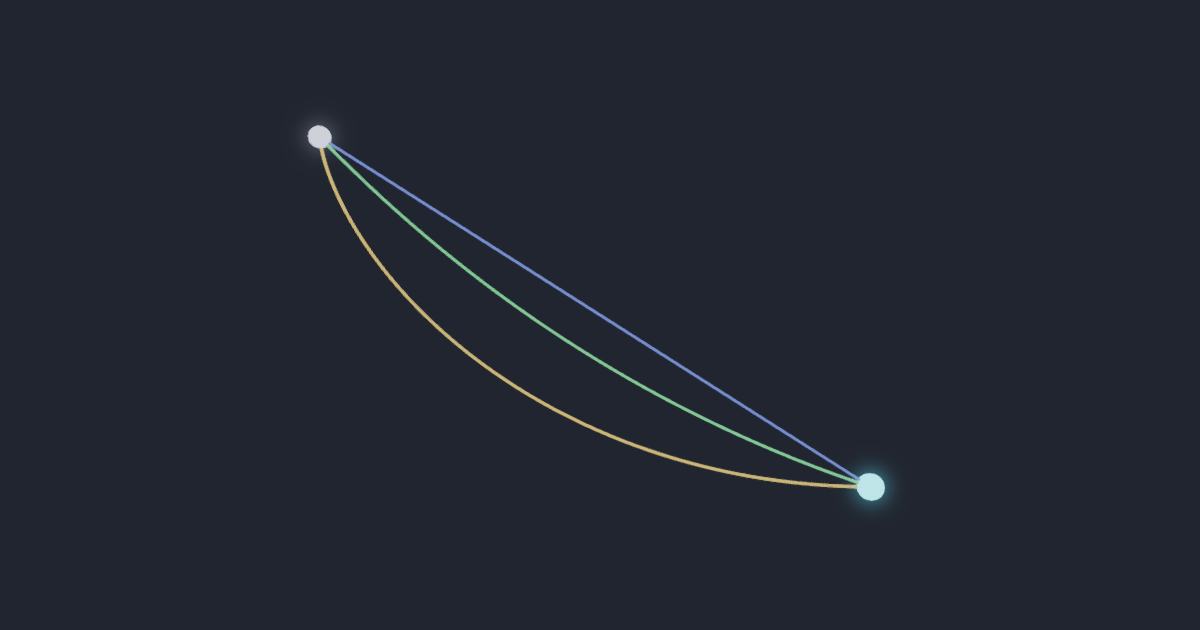
Race beads from the same A to the same B down a straight line, a circular arc, and a cycloid, stepping each by the exact tangential gravity (conserved energy ½v²+gy is the check), and time the arrivals; then drop beads from different heights on the cycloid.
the BRACHISTOCHRONE: the cycloid is fastest (not the straight line) — and not just here: it is the optimum over ALL curves, proven by Johann Bernoulli in 1696 — reaching the minimum time π√(R/g) to the cycloid's bottom; and the TAUTOCHRONE: beads released from any height on that same cycloid reach the bottom simultaneously (Huygens' isochronism, 1659)
A ramp between two points, and the 1696 challenge that invented the calculus of variations. Nothing about the curve is stored here. You type a horizontal run and a drop; the wheel angle θ₁ is SOLVED out of them by inverting (θ − sinθ)/(1 − cosθ) = X/Y, a function monotone on (0, 2π) and therefore invertible exactly once; the radius follows as Y/(1 − cosθ₁) and the least time as θ₁√(R/g). No π is used as a target, no 2R is pasted, and the 2.0070899 the lab above recovered is read by nothing that computes. The defaults are that lab's own bench — a run of 4π metres over a drop of 8, which is X/Y = π/2 exactly, the one aspect ratio where B lands on the arch bottom itself: θ₁ = π to the last bit, R = 4 m, T = 2.0070899231544930 s, ramp length 16 m against a 14.8967671 m chord. The simulation above reaches that same number down a road this page does not take — it minimises the raw descent-time functional over free polylines with no cycloid, no Euler–Lagrange equation and no π coded anywhere — and lands 8e-12 from it, which is the only reason the agreement is worth anything. Three things here are second routes rather than restatements. Galileo's 1638 circular arc, which the lab falsifies by racing polylines, has a CLOSED FORM: a bead on a circle is a pendulum, so its descent time is an incomplete elliptic integral of the first kind, and minimising that over the whole circle family through the same two points gives 0.490247599% slower — Galileo's entire error, and never worse than two thirds of one percent at any aspect, which is why it took fifty-eight years to catch. The straight line's 18.5% penalty is exactly √(π²+4)/π = 1.1854470610572836, a pure number with neither the size nor the gravity in it. And Huygens' tautochrone, which the lab measures to a few parts in ten thousand, is here an arccosine of a ratio of cosines that returns the same time from every release to the last bit — because a bead on a cycloid is a harmonic oscillator in its own arc length, with ω = √(g/4R). Four things this page will NOT do. It will not re-run the minimiser above. It will not model friction, rolling, a finite bead or air — the curve is the frictionless brachistochrone and a real ramp's fastest shape is not quite this one. It will not recompute the circular pendulum's amplitude correction, which belongs to this lab's pendulum page. And it will not correct a single number the finding recovered: it prices closed forms against them, and where a printed number and a closed form part company it reports the gap and the printing quantum and stops there.
(θ − sinθ)/(1 − cosθ) = X/Y · R = Y/(1 − cosθ₁) · T = θ₁√(R/g) · arc = 8R sin²(θ₁/4) · y(1 + y′²) = 2R · sinα/v = 1/(2√(gR)) · time to the arch bottom = π√(R/g) from ANY release · T_line/T_cyc = √((θ₁−sinθ₁)² + 4sin⁴(θ₁/2)) / (θ₁ sin(θ₁/2)) · T_circle = √(ρ/g)·(K(k) − F(ψ_B, k))