Measured by the lab
39.47187
Does a planet's orbital period really go as the 3/2 power of its orbit size?
▶ Run the simulationSee the measured result
Units: dimensionless (μT²/a³ = 4π²; companion known exponent p = 3/2; secondary knowns: sidereal year 365.25636 d, AU 1.495978707e11 m)
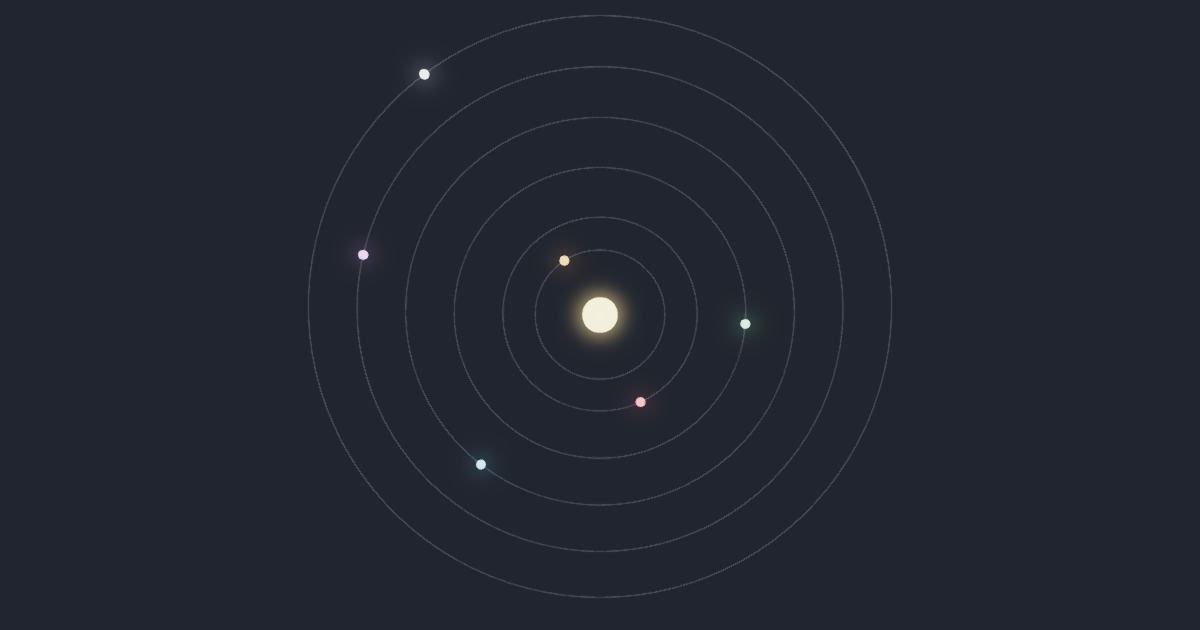
Place planets on circular orbits at several radii, time each period, and plot T² against a³.
Kepler's third law — a shared constant T²/a³ = 4π²/μ
How fast a body is going, and how big its orbit is, from one observed state and nothing else. The vis-viva equation is the whole of two-body motion compressed into one line: v² = μ(2/r − 1/a), speed against radius with the semi-major axis standing in for the energy. Read forwards it gives the speed anywhere on the orbit; read backwards — 1/a = 2/r − v²/μ — it turns a single position-and-speed measurement into the orbit itself, which is how a tracking station converts a radar return into an ephemeris. This page never types a semi-major axis: it either measures one out of the state you enter or bisects one out of the cubic a³ = μT²/4π², because Math.cbrt and Math.pow are left implementation-approximated by the language and a root-found cube is not — which is why every digit on this page is the same in every browser. Feed it the NASA fact-sheet numbers for Earth's perihelion and the chain runs: a = 1.0001879 AU, e = 0.0169154, other apsis 1.0171065 AU, year 365.35986 d. That year is 2.8e-4 long, and the page shows where the error is rather than hiding it: the simulation above INTEGRATED the same state and timed 365.3599 d, so the closed form and the leapfrog agree to one part in ten million, and the whole of the miss is the four significant figures the observed speed is published to — bisect the axis the sidereal year demands and the entered state is 1.9e-4 larger, which dT/T = (3/2)da/a carries to exactly the 2.8e-4 seen. The rival is carried as a DIAL rather than as a second formula: for a force falling as 1/r^p the period scales as a^((p+1)/2), so p = 2 returns three halves exactly and p = −1 — Hooke's spring — returns zero exactly, which is what isochronous means and what this lab measured for its Hooke rival. Inverting that dial on the measurement is this world's best sentence: the timed orbits fix the force-law exponent at 2.000228 ± 0.000149, inverse-square to one and a half standard errors, and Kepler's own Mysterium guess of T ∝ a² — an inverse-cube universe — is dead by six thousand of them. A fourth direction prices the harmonic law's strangest claim, that the period cannot see the eccentricity at all, against the coupled rival that says it can. The last one audits the screen: the module's displayed T²/a³ sits 5.7e-5 above theory, and this page recomputes the leapfrog half of that from the module's own six radii and substep rate — (ωh)²/3, no fitted parameter — rather than quoting it. What this page will not do: compute a period from a size (the three-body world here owns that scaling, including the figure-of-eight's prefactor), add the relativistic precession (the Schwarzschild world owns it), or price anything a two-body conic cannot carry — no perturbations, no transfer burns, no drag.
v² = μ(2/r − 1/a) · 1/a = 2/r − v²/μ · e = |1 − r/a|, other apsis = 2a − r · T = 2π√(a³/μ), a³ = μT²/4π² bisected · v_esc = √(2μ/r) = √2·v_circ · rival as a dial: F ∝ 1/r^p ⇒ T ∝ a^((p+1)/2) · leapfrog bias: T(h)/T∞ − 1 = (ωh)²/3