Measured by the lab
42.9806
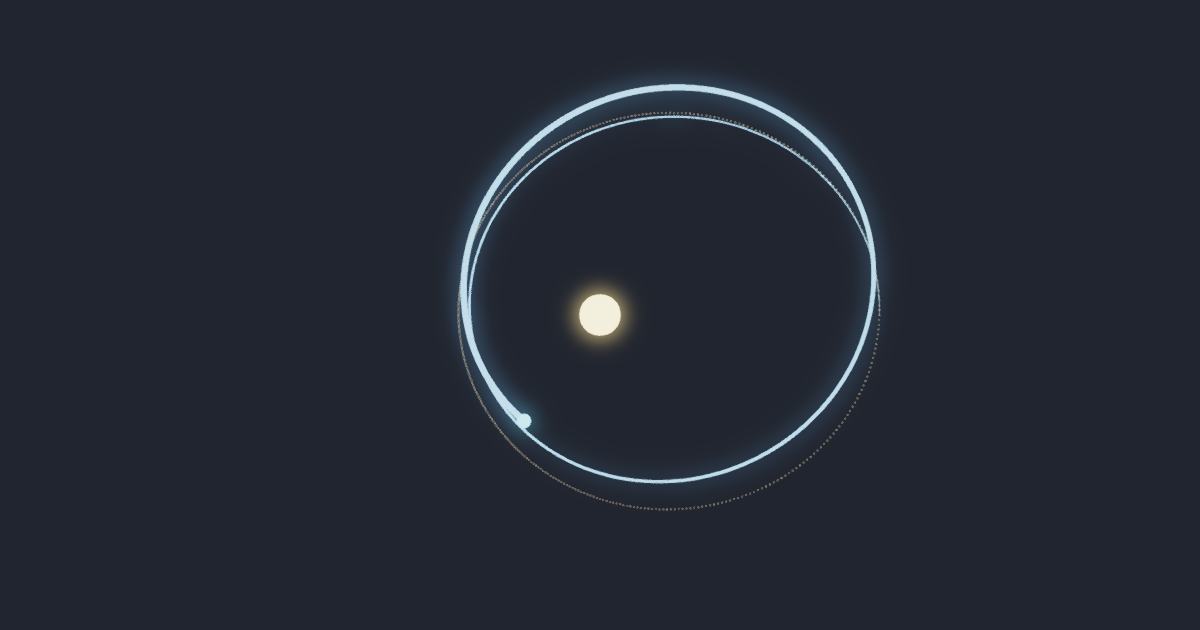
Newton makes every orbit a closed ellipse — but Mercury's perihelion creeps forward 43 arc-seconds per century, which Newton cannot explain. Does General Relativity produce exactly that, with no fudge factor?
▶ Run the simulationSee the measured result
Units: arcsec/Julian century (GR's predicted anomalous perihelion advance of Mercury; observed excess 42.56±0.94 in Clemence 1947, modern ranging consistent with GR)
The Schwarzschild metric reduces (in the orbital plane) to Newton's orbit equation plus one relativistic term: u'' + u = GM/h² + (3GM/c²)u², i.e. a central force a = −[GM/r² + 3GM·h²/(c²r⁴)]. Integrate it with a symplectic leapfrog (energy conserved to ~1e-13), measure the per-orbit perihelion advance Δϖ, sweep the relativistic strength, and compare to the weak-field law Δϖ = 6πGM/(c²a(1−e²)). A Newtonian null control drops the relativistic term.
the orbit PRECESSES, exactly as Einstein predicted. Drop the relativistic term and the ellipse closes (Δϖ≈0, the Newtonian null); turn it on and the perihelion advances by Δϖ = 6πGM/(c²a(1−e²)) per orbit — recovered to a few % at weak field, the residual growing as the genuine higher-order term as the field strengthens. Fed Mercury's real numbers (a, e, period, G, M☉, c) the formula gives 42.99″/century, matching the observed 43″ that confirmed General Relativity in 1915. The live demo EXAGGERATES the relativistic strength so the rosette is visible (Mercury's real advance is 0.1″ per orbit); this is the orbit equation derived from the Schwarzschild metric, not a full numerical-relativity metric solve
Mercury's orbit does not close. Its perihelion creeps forward about 43 arc-seconds per century more than every Newtonian planetary tug can account for — the residual Le Verrier found in 1859 and explained by predicting a planet, Vulcan, that does not exist. General relativity accounts for it with no free parameter at all, and this page computes that from the metric rather than from a remembered number. The one constant the orbit equation carries is the Schwarzschild radius r_s = 2GM/c²; the relativistic term is (3/2)r_s u² with u = 1/r; differentiating that square about a circular reference leaves a restoring shift of 3r_s/p, which measured in units of ε = GM/(c²p) is exactly 6 — whatever the mass, whatever the orbit. So the apsidal frequency is k = √(1−Nε), the advance per lap is 2π(1/k−1), and the famous coefficient is π·N = 18.849556. That is 6π, and it is typed in nowhere below: it falls out of differentiating a square. Run at Mercury's elements the page returns 42.980605″/century, which is this lab's own RK4 geodesic recovery of 42.9806 to one part in ten million, reached by a different route — and the small gap to the textbook first-order line is the O(ε²) truncation 4.5ε, which the oracle independently measures at 1.23e-7. The same square root carries the world's rivals, and that is the part worth reading: Newton is N = 0, so k = 1 and the ellipse closes EXACTLY, which is why the 43″ was an anomaly and not a correction; special relativity alone — relativistic momentum in a flat-space potential — is N = 1, because (GM/cL)² is just ε; and Einstein is N = 6. The flat-space rival does precess, by 7.163433″/century, and it misses by 83%: adding time dilation to Newtonian gravity is not approximately right about Mercury, it is wrong by a factor of six, and the missing five sixths is the curvature of space, the same term that doubles the deflection of starlight. Two further directions read the page backwards. The inversion turns a measured creep into GM☉, defaulting to this lab's own geodesic number rather than the textbook one, and it shows what such a measurement is really sensitive to — the recovered Sun is strictly proportional to a(1−e²), and dividing out G to get a mass in kilograms throws away almost all the precision, because G is the worst-known constant in physics. The screen audit prices this lab's own display: the module's Mercury line is the weak-field law evaluated with its own rounded constants, a monomial, so the gap factorises into five clean stages — G·M☉ +0.0252%, c² −0.0050%, a +0.0003%, 1−e² −0.0013%, period −0.0002% — and dividing the displayed number by their product returns the geodesic value, touching neither ε nor k nor π. Three things this page will NOT do, because this lab never measured them: it does not compute the photon sphere, the horizon, or anything else strong-field, since every orbit in this world's sweep sits at ε ≤ 1.1e-7; it stops dead at ε = 1/N, where k reaches zero at p = 3 r_s, and says plainly that this innermost stable circular orbit is where its own linearization ends rather than something it observed; and it does not pretend the module's on-screen 43.0″ is a measurement — that line is the law, fed with rounded constants, and the audit above is what the rounding costs.
Δϖ = 2π(1/√(1−Nε) − 1), ε = GM/(c²p), p = a(1−e²) · weak field: Δϖ = 6πGM/(c²a(1−e²)) · r_s = 2GM/c² · Newton N = 0 · SR only N = 1 · GR N = 6