Measured by the lab
42.9806
Mercury's perihelion creeps forward 43 arc-seconds per century more than Newtonian planetary perturbations allow — the anomaly Le Verrier found in 1859 and invented the planet Vulcan to explain. Does General Relativity produce exactly that number from geometry alone, with no fudge factor — and could anything short of curved spacetime (Newton, or even special relativity bolted onto Newtonian gravity) have produced it?
Units: arcsec/Julian century (GR's predicted anomalous perihelion advance of Mercury; observed excess 42.56±0.94 in Clemence 1947, modern ranging consistent with GR)
▶ Run this simulationRead how it works
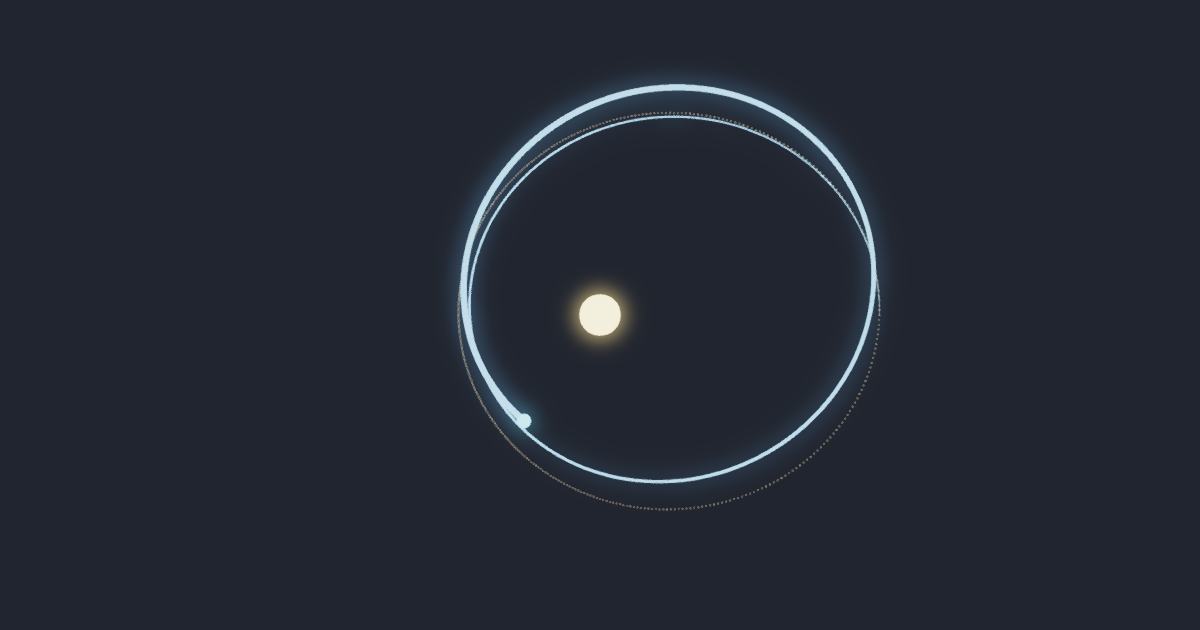
Mercury's perihelion recovered from the Schwarzschild geodesic with no precession formula coded: integrating the exact orbit equation u'' + u = B/2 + (3C/2)u² (A, B solved from Mercury's observed turning points, C = 2GM/c² fixed by the metric) returns 42.9806″/century vs the known 42.98 (rel 1.4e-5; 42.9805 ± 0.00004 across 24 element-jittered seeds), with the weak-field coefficient 6π EMERGENT from a 12-point (a,e) sweep (18.849560 vs 18.849556, slope −1.000000), the Newtonian control dead at 5e-6″/century, and the special-relativity-only rival precessing exactly 1/6 of GR (7.16″/century, 83% short) — flat-space relativity cannot save Newton; the missing 5/6 is the curvature of space
A timelike Schwarzschild geodesic in the orbital plane obeys the exact quadrature (du/dφ)² = A + Bu − u² + Cu³ (u = 1/r) with C = 2GM/c² fixed by the metric; its derivative is the orbit equation u'' + u = B/2 + (3C/2)u². Mercury's OBSERVED ellipse fixes the turning points u_p = 1/(a(1−e)), u_a = 1/(a(1+e)); du/dφ = 0 there gives two equations linear in (A, B) — solved, not fitted. RK4 integrates the ODE in φ from aphelion over 40 orbits; apsides are located as Newton-refined zero-crossings of du/dφ (apsis angles assembled as n·dφ + substep offset — a running phi-sum's rounding random-walk costs ~4e-4 relative, the estimator lesson of this world); the apsidal angle Φ is the LSQ slope of apsis angle vs index, and Δϖ = 2Φ − 2π per orbit converts to arcsec/Julian century via the sidereal period. The weak-field formula 6πGM/(c²a(1−e²)) appears ONLY in scoring gates. Controls run the SAME machinery: Newton (C = 0) and a special-relativity-only rival (γ-momentum in a flat-space −GM/r potential, exact SR quadrature ⇒ u'' + k²u = const with k² = 1 − (GM/cL)²). 10 gates, ~0.6 s. All knowns loaded from scripts/oracles/schwarzschild.reference.json only to score. ?world=schwarzschild.
Δϖ = 6πGM/(c²a(1−e²)) per orbit in the weak field — recovered, never coded: the measured Δϖ = 5.018655e-7 rad/orbit matches the closed form to 1.2e-7, and the dimensionless coefficient Δϖ·c²p/GM over a 12-point (a,e) sweep is 18.849560 vs 6π = 18.849556 (rel 2.3e-7) with log–log slope −1.000000 ± 0.001 — 6π is emergent
4.0000e-5
Einstein's 1915 perihelion result (Sitzungsber. Preuss. Akad. Wiss. 831): Δϖ = 6πGM/(c²a(1−e²)), the first empirical confirmation of General Relativity, resolving Le Verrier's 1859 anomaly. It VALIDATES, not derives: the Schwarzschild geodesic quadrature is the substrate (the metric's exact orbit equation, coded with C = 2GM/c² and nothing else), and the closed-form precession law, the 42.98, and the coefficient 6π are recovered by MEASURING apsides of the integrated orbit — the formula appears only in scoring. Non-circularity: the generator maps (GM, c, a, e) → integrated trajectory → apsis angles; no precession expression, no 6π, no arcsec target exists in that path (tamper test: falsifying known_value flips exit to 1 with the recovered value unchanged at 42.9806). The decisive twin controls — Newton null (5e-6″/cy) and the SR-only 1/6 rival (7.16″/cy) — establish that the recovered number needs curved spacetime specifically, not just relativistic kinematics.
CERTIFIED (refiner run 2026-07-25, gates H–M execute the shipped SchwarzschildModule.ts — sha-pinned, TS-stripped, Babylon/DOM recorder stubs). The live rosette measurement is proven a genuine apsis measurement: 1920 real fixedUpdate/render calls at fl(1/120) = exactly 4 leapfrog substeps every call (the accumulator sits at a float fixed point 2.6e-18 from call 1), with the full orbit + apsis-accumulator state, the 2400-slot trail ring (wraparound exercised at push 2401), the thin-instance buffer and the planet position bit-exact against a statics-built replica at EVERY call; the HUD writes exactly at frame%6 (321 writes incl. init) with every payload bit-equal to a template replica — LIVE content, the measured Δϖ appears at apsis 3 — while the chart writes at the same cadence with every payload IDENTICAL (live cadence, frozen content: it draws the frozen init sweep). The shown 'Δϖ measured 21.8°/orbit' is EARNED (double ≠ the law-fed 'GR law 19.7°' line) and priced against the module's own executed measurer at oracle grade (dt=1/2000, 12 apsides) in two telescoping stages: finite window +1.07e-2 rel + grid +2.63e-3 rel; the +9.1% excess over the weak-field line is REAL strong-field 2nd order — the oracle-grade excess 9.120% matches the module's own certified sweep excess Lagrange-interpolated to the demo ε to 4.8e-5 absolute. The law-fed 'real Mercury 43.0″/century' display is now DISCLOSED on screen ('weak-field LAW, sim strength exaggerated') and MONOMIAL-priced: shown 42.98874 vs oracle geodesic recovery 42.98060 decomposes exactly (the law is a monomial → 5 constant-rounding stages reconstruct the ratio to 6.7e-16): G·M☉ +2.5e-4 (module's separate G=6.674e-11 × M☉=1.989e30 vs the IAU product), c² −5.0e-5, a +2.9e-6, 1−e² −1.3e-5, period −1.8e-6, plus weak-field truncation −1.2e-7 — and at display precision both round to the SAME '43.0'. The init strength sweep is bit-exact vs replica and earned (excess 2.2%→17.3% strictly increasing with ε). The cert also CAUGHT a doc-comment overclaim by execution: 'energy conserved to ~1e-13' — the measured max |ΔE/E₀| over the certified trajectory is 6.27e-6 (bounded leapfrog oscillation, no secular growth); the comment now states the measured ~6e-6 and gate L pins the band [1e-6, 2e-5]. Measurement path proven answer-free (no 6π, no Mercury constants; the 3 '6 * Math.PI' occurrences all in disclosed law-fed display code; planted-violation self-test green). 3 tampers surgical: known→A/B only with recovery unchanged; sha→only H; post-strip dt ulp (5e-14 rel)→only doubles-pinned I/K fail while string-pinned H/J/L/M stay green BY DESIGN. 16/16 gates in 0.8 s.
npm run derisk -- schwarzschild (scripts/schwarzschild-derisk.mjs)scripts/oracles/schwarzschild.reference.jsonU. Le Verrier, 'Théorie du mouvement de Mercure' (1859) — 38″/century unexplained (Newcomb 1882: ~43″). A. Einstein, 'Erklärung der Perihelbewegung des Merkur aus der allgemeinen Relativitätstheorie', Sitzungsber. Preuss. Akad. Wiss. (1915) 831. G. M. Clemence, Rev. Mod. Phys. 19, 361 (1947) — observed excess 42.56″±0.94. C. M. Will, Living Rev. Relativity 17, 4 (2014) — modern GR value 42.98″/century; R. S. Park et al., AJ 153, 121 (2017) — MESSENGER ranging consistent with GR. Elements: J2000 mean orbital elements (JPL/Standish), IAU nominal GM☉ = 1.32712440018e20 m³/s².