Measured by the lab
2.0022
Do coupled oscillators spontaneously synchronise, and above what coupling strength?
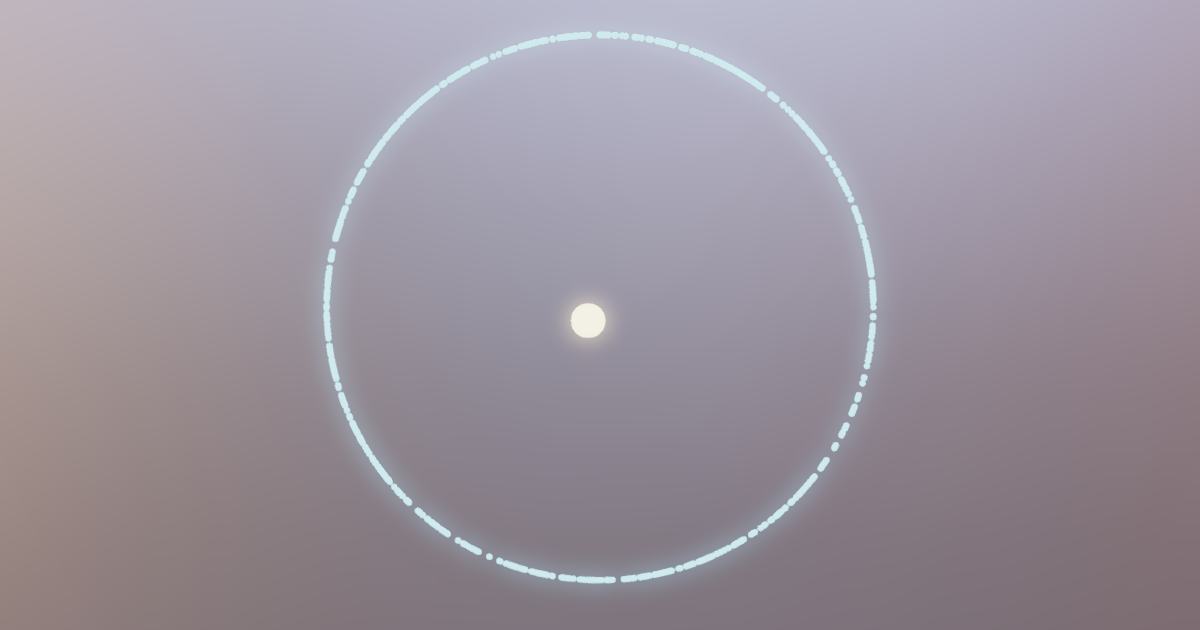
▶ Run the simulationSee the measured result
Units: critical coupling Kc in units of γ = 1 (Kuramoto 1975: Kc = 2/(π·g(0)) = 2γ for Lorentzian g; onset law r = √(1 − Kc/K))
Sweep the coupling K, let the order parameter r settle at each value, and plot the measured r(K).
the mean-field sync threshold Kc = 2γ, with r = √(1 − Kc/K)
Fireflies in a mangrove flash together. Pacemaker cells in a heart beat together. Generators on a grid stay in step, until the day they do not. Each of those is a population of oscillators that each want to run at their own speed, and the question Kuramoto settled in 1975 is whether coupling them is enough — whether there is a sharp coupling strength below which a heterogeneous population NEVER locks and above which order appears on its own. There is, and this page computes it rather than quoting it. The threshold is K_c = 2/(π·g(0)), and the only thing it asks about the population is how densely its natural frequencies pile up at the centre: g(0), one number. Nothing else about the spread matters to the threshold — not the tails, not the width in any other sense. For the Lorentzian that closes to K_c = 2γ and the π cancels exactly, so the answer is 2γ to the last bit and needs no transcendental at all; for a Gaussian it closes to σ√(8/π) ≈ 1.5958σ, which is the more useful number in practice and the one nobody tabulates. Above the threshold the order parameter grows as a square root, and the square root is where the arithmetic gets interesting: written the way every textbook writes it, r = √(1−K_c/K), the division happens BEFORE the subtraction and quietly throws away the second-order term, so the answer is wrong by a clean factor of K/K_c — not by noise, by a factor. Written as √((K−K_c)/K) the numerator is exact by Sterbenz's lemma throughout the critical region and the answer is correctly rounded. The page shows both and counts where they part. It also prices the rival this lab falsified — the Winfree-style arrangement where every oscillator is pulled at full strength toward the mean phase instead of at strength K·r — and that one has a closed form the oracle only ever measured: r = (√(K²+γ²)−γ)/K, which has no threshold at all, is positive at every coupling however small, and at the true K_c already sits at the golden ratio's reciprocal for every γ. Spelled that way it is also the page's sharpest arithmetic warning, because below K ≈ 10⁻⁸ it returns exactly zero and invents the very threshold the rival is supposed to lack; cleared through its conjugate, K/(√(K²+γ²)+γ), it does not. What this page will not do: it will not apply the Lorentzian's r = √(1−K_c/K) to any other density, because that law is Lorentzian-specific and is 24–67% wrong on a Gaussian; it will not print a near-threshold amplitude for the uniform density, whose g″(0) is zero and whose transition is not of this kind; and it will not revise a single number this lab recovered.
K_c = 2/(π·g(0)) · Lorentzian(γ): K_c = 2γ EXACTLY, because π cancels · Gaussian(σ): K_c = σ√(8/π) · r = √((K−K_c)/K), never √(1−K_c/K) · locked fraction = (2/π)·arctan(Kr/γ) · the falsified pinning rival: r = K/(√(K²+γ²)+γ), which at K = K_c is 1/φ for every γ