Measured by the lab
100.143
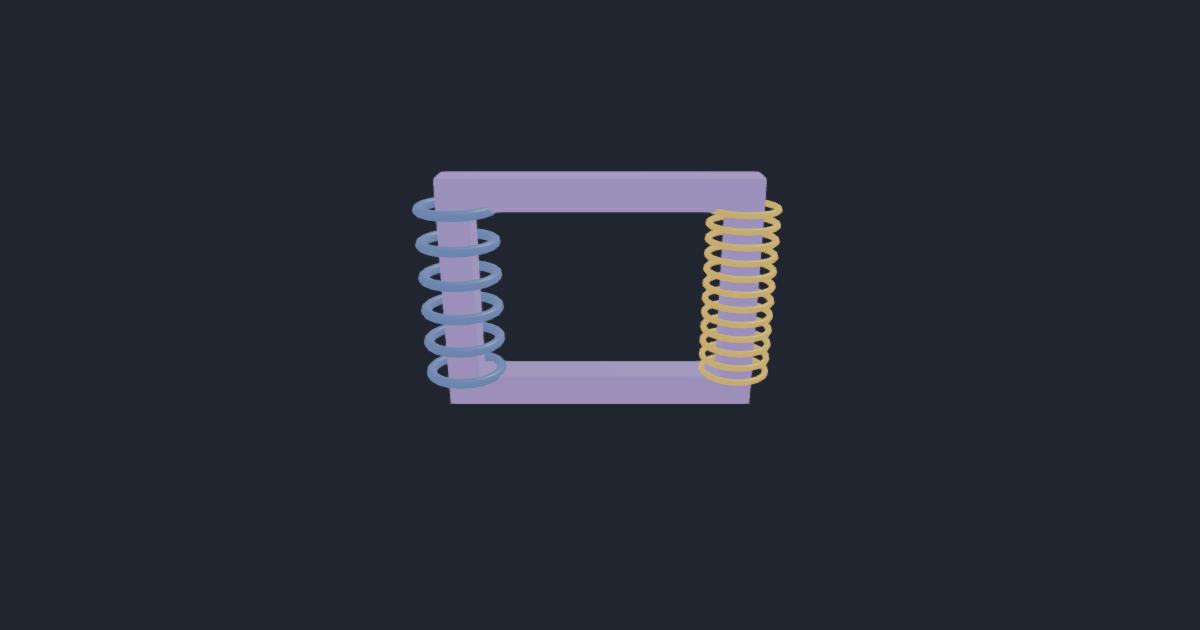
Two coils that never touch, wound on one iron ring: drive an AC voltage into the first and a different voltage comes out of the second. What sets the output voltage — the field, the frequency, the load, or just how many times each coil is wound?
▶ Run the simulationSee the measured result
Units: dimensionless — the nameplate turns ratio N₂/N₁ of the 4 kV→400 kV grid step-up unit (V₂/V₁ = N₂/N₁, Faraday's law applied twice to one shared flux)
Wind a primary of N₁ turns and a secondary of N₂ turns on a shared core so the SAME flux Φ(t) threads both. An AC primary makes V₁ = N₁ dΦ/dt; the secondary sees V₂ = N₂ dΦ/dt. The lab traces the shared flux Φ(t) against V₁(t) and V₂(t) (a scaled copy), and an ideal power balance V₁I₁ = V₂I₂ fixes the current. A real grid step-up — N₁=100, N₂=10000, fed a 4 kV station line — is read with 2% noise on its secondary peak.
V₂/V₁ = N₂/N₁ — output voltage is set ONLY by the turns ratio (the flux cancels), independent of frequency or load: a step-up coil makes hundreds of kV from a few kV. But it is no free lunch — power conservation V₁I₁ = V₂I₂ steps the current the OTHER way, I₂/I₁ = N₁/N₂, and DC (dΦ/dt = 0) transforms nothing. Inverting a real 4 kV→400 kV (×100) step-up recovers the ratio ≈ 100, and at 100× the voltage the line current is 100× smaller so the I²R loss falls 10⁴× (625 kW → 62.5 W on a 1 MW, 10 Ω line) — the reason the grid is high-voltage AC
A transformer is Faraday's law applied twice to one shared flux, and the whole of it is in one line: both windings sit on the same core, so both see the same dΦ/dt, and dividing V₁ = N₁ dΦ/dt by V₂ = N₂ dΦ/dt cancels the flux and leaves V₂/V₁ = N₂/N₁. That first direction is the one every datasheet prints, and it is the least interesting thing on this page. Nothing here is stored — the ratio is built by dividing the two turn counts you type, the currents come from ampere-turn balance, the core flux from √2V₁/ωN₁, and the five directions after it never use the transformer equation at all. They solve the SAME coupled-coil circuit the simulation integrates: self-inductance L = N²P and mutual M = kN₁N₂P out of turn-counting magnetostatics, Faraday's EMF and Kirchhoff's two loops, closed in phasors rather than in time. That solve is where a real transformer appears. Under the rated 1 MW load this one does not deliver 400 kV but 397.193 kV — a 0.386577% regulation sag — and its current ratio misses the turns ratio by 5.3e-5, which is not an error but the coupling k appearing once instead of twice. It is 99.378849% efficient with the power audit closing to 4.7e-16, and with the winding resistances zeroed it conserves power EXACTLY. The third direction prices the thing nameplates hide: a turns-ratio test reads low by (1−k) + R₂/R_L, and the second term shrinks with a lighter test load while the first does not — so there is a floor of 50.0 ppm here that no test load however light can get under, and the page will tell you when your target precision is below it. The fourth feeds it DC and the secondary steady state is not small but structurally ZERO, after one 245.613 kV inductive-kick pulse that decays with the leakage time constant; the same arithmetic prices Faraday's own pre-1831 expectation — that a steady current induces a steady voltage next door — at 134.963 MV, which is the rival this world exists to kill. The fifth is the War of the Currents as a number: the same source and load wired directly burn 38.3877% of the power in 10 Ω of line, through a ×100 step-up/step-down pair 0.0062%, and the payoff scales as n² because the line current scales as 1/n. The sixth re-executes the shipped simulation's own 600,036-step RK4 ratio test, seeded noise draw and all. Four things this page will not do: no saturation or B–H curve, no core/hysteresis/eddy loss (the copper loss is here, the iron loss is not), no inrush, and no three-phase or harmonic content.
V₂/V₁ = N₂/N₁, I₂/I₁ = N₁/N₂ · volts-per-turn V₁/N₁ = V₂/N₂ = ωΦₘₐₓ/√2 · L = N²P, M = kN₁N₂P; (R₁+jωL₁)I₁ + jωMI₂ = V, jωMI₁ + (R₂+R_L+jωL₂)I₂ = 0 · regulation = 1 − gain_load/gain_open · Z_in = R_L/n² · ratio-test floor (1−k) + R₂/R_L · line loss ∝ 1/n²