Measured by the lab
0.043945312
Drop a magnet down a copper tube and it crawls — taking seconds where free fall takes a flash, with nothing touching it. Does the magnet keep accelerating like any falling body, or does the braking it induces settle it at one steady speed?
▶ Run the simulationSee the measured result
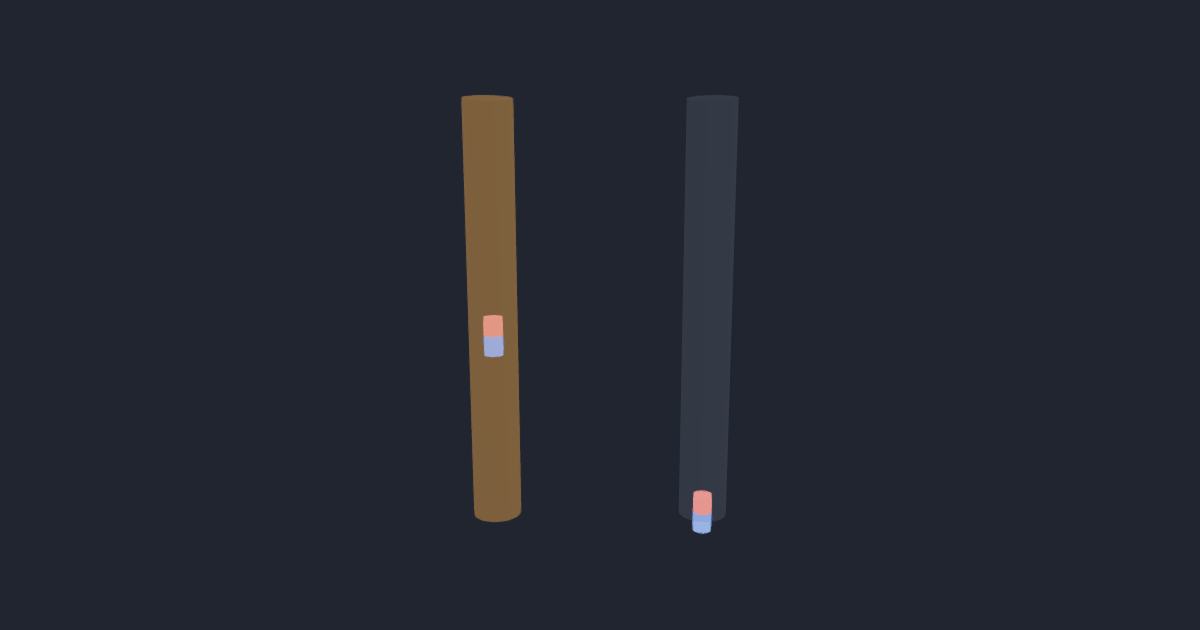
Release two identical bar magnets at once: one down a copper pipe, one in free fall beside it. The magnet's own moving field induces eddy currents in the pipe wall (Lenz's law — they oppose the change), giving a velocity-proportional brake F = −b·v, so M dv/dt = Mg − bv. The lab traces v(t) for both. A real NdFeB magnet (m = 0.55 A·m²) is also dropped through a real thin-walled copper pipe with 2% reading noise, using b = (45/1024)μ₀²m²σw/a⁴ for a point dipole on the axis of a thin tube.
TERMINAL VELOCITY — the brake grows with speed until it exactly balances gravity, so v saturates at v_term = Mg/b along v(t) = v_term(1 − e^{−t/τ}) (τ = M/b): the free magnet's v = g t runs off the top of the chart while the braked one flattens onto its asymptote. At terminal velocity kinetic energy stops growing, so ALL the lost gravitational PE becomes I²R heat in the tube; and measuring v_term ≈ 0.2 m/s inverts to recover copper's conductivity σ ≈ 5.96×10⁷ S/m
Drop a magnet down a copper pipe and it crawls, with nothing touching it and nothing magnetic about the pipe. This page computes how slowly, and it computes it from a coefficient that turns out to be a rational number. The falling magnet's field sweeps every ring of the wall, Faraday's law drives a current round each one, Ohm's law says how big, and Lenz's law says which way — back. Integrate the dissipation up the tube and the drag is F = C·μ₀²m²σwv/a⁴ with C = 45/1024, and that constant is assembled here rather than stored: the 3² comes from differentiating the ring's flux along the fall, a 2π from each ring's Ohmic conductance, and 5π/(128a⁷) from the Beta-function integral ∫z²/(a²+z²)⁵dz — at which point π cancels, exactly, which is the only reason an electromagnetic brake has a rational coefficient at all. 1024 is 2¹⁰, so the cancelled answer is a dyadic rational and an exact double, and no version of this page needs to keep a copy of it. Four spellings of that same product are evaluated side by side rather than asserted, and the a⁻⁴ the answer divides by is written as (a²)² because Math.pow(a,4) lands one ulp low at this page's own tube radius. From there three things follow that the simulation above measures and this page derives. The terminal velocity is Mg/β and the time constant is M/β, so their RATIO is g and nothing else — no magnet, no copper, no geometry survives into it, and every eddy brake ever built reaches its terminal speed in v_term/g seconds. Running that backwards weighs the pipe: one glide time down a measured tube returns σ = Mga⁴/(C·μ₀²m²w·v_term), which is a material constant read off a stopwatch with nothing electrical attached, and the same measurement will weigh the magnet instead if you already trust the copper — never both, because the brake only ever sees the product m²σw. And the transient is almost nothing: 99% of terminal velocity arrives 14.5 mm into a one-metre drop, 1.45% of the pipe, which is precisely why timing the glide measures anything. Both of this world's falsified rivals are priced here too, and the second one is where the page earns its keep. Ignore induction and the magnet is a stone that exits at 4.43 m/s, twenty-two times too fast and still accelerating — no terminal velocity to get wrong. Keep a drag but make it quadratic and tune it to the SAME terminal velocity and the asymptote tells you nothing; only the route does, and the route has a closed form on both laws: t₅₀/t₉₀ is ln2/ln10 = log₁₀2 for linear drag and exactly ln3/ln19 for the quadratic one, because artanh½ over artanh(9/10) cancels its halves. Neither number appears anywhere in this lab's records — the oracle measured 0.30103 and 0.37311 off integrated trajectories and never knew they had formulas. Every logarithm here is built on the page out of one compensated artanh series with exact rational arguments and no range reduction, and ln(1−φ) is never spelled as a subtraction that cancels; the engine's own spelling is called four times, purely to be measured against it, and the verdict is not the same in every browser: ECMAScript leaves the logarithm implementation-approximated, and the gate's Chrome and the Node that generates its expectations disagree about ln3/ln19 by one ulp while the series agrees with itself everywhere. That is the honest reason to ship it — reproducibility, not a precision win. The last direction scores the numbers this lab recovered — including the chart's +0.96% Euler systematic, which falls out of τ and the timestep in one line — and revises none of them.
F = C·μ₀²m²σwv/a⁴ with C = 45/1024 = (9/4)·(5π/128)/(2π) · β = C·μ₀²m²σw/a⁴ · v_term = Mg/β, τ = M/β, and v_term/τ = g exactly · σ = Mga⁴/(C·μ₀²m²w·v_term) · v(t) = v_term(1 − e^(−t/τ)), t₅₀/t₉₀ = ln2/ln10 = log₁₀2 · quadratic rival: t₅₀/t₉₀ = ln3/ln19