Measured by the lab
0.043945312
Drop a magnet down a copper tube and it crawls, nothing touching it. Is the brake really the F = −b·v of quantitative Lenz's-law theory — with b = (45/1024)·μ₀²m²σw/a⁴ for a point dipole in a thin tube — and can that coefficient, the terminal velocity, and even the tube's conductivity be recovered from nothing but the dipole's magnetostatic identity and Ohm's law?
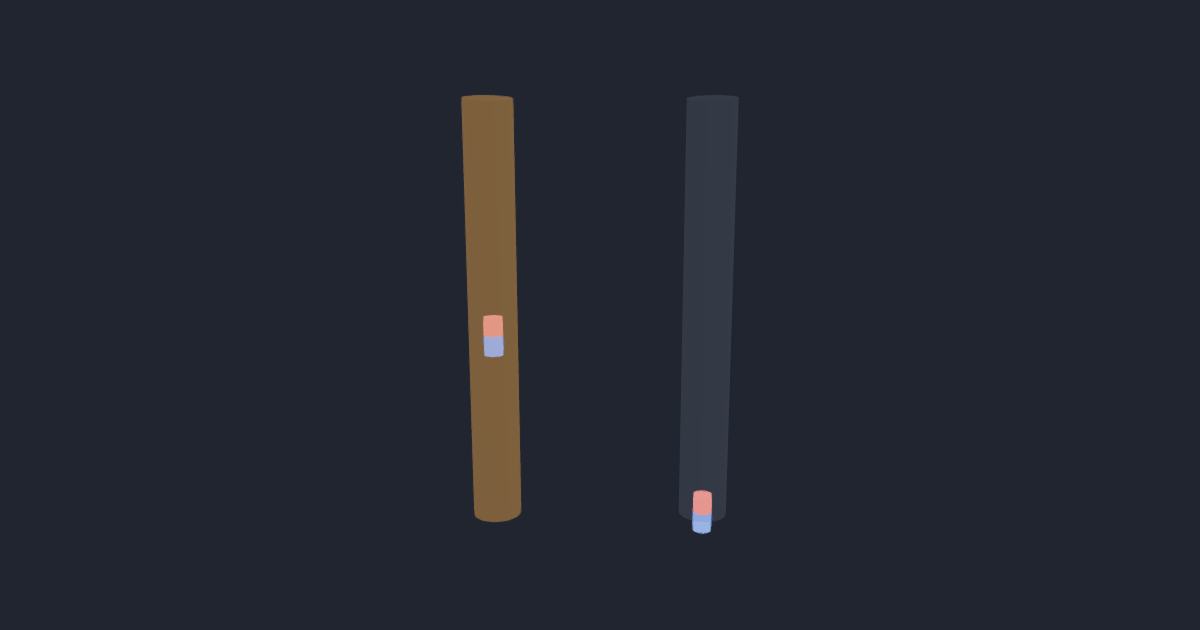
▶ Run this simulationRead how it works
Lenz's law weighed ring by ring — the Levin–Rojo eddy-brake coefficient 45/1024 emerges from raw dipole-field + Ohm's-law ring sums to 1.3e-8, the fall saturates on v_term = 0.1984 m/s, and 24 noisy terminal-velocity reads invert to copper's σ = 5.961e7 ± 0.015e7 S/m (0.07 SE); Lenz-less fall and matched-asymptote quadratic drag both rejected
Headless first-principles generator with NO closed-form drag: the tube is a stack of rings; each ring's flux is the line integral of the dipole vector potential Φ = 2πa·A_φ(a,ζ) (the faraday oracle's trick), its EMF a central finite difference of that flux as the magnet moves, its current EMF/R with R = 2πa/(σwΔz). The drag is assembled two independent ways — energy route Σ EMF²/R / v and Lorentz route Σ I·2πa·B_ρ — which must agree because ∇×A = B. The dimensionless Ĉ = βa⁴/(μ₀²m²σw) is scored against 45/1024 (loaded only to score). RK4 on M dv̇ = Mg − βv gives the saturating fall; 24 seeds of ±2% uniform reading noise on v_term (the module's noise model) invert to σ through the ring-sum geometry factor β/σ. Perturbations: β ∝ m² and β ∝ a⁻⁴ as free log-log fits of full ring-sum re-runs. Rivals through the same machinery: Lenz-less free fall (no terminal velocity) and a quadratic drag tuned to the same asymptote, killed by the approach-shape statistic t50/t90.
F = C*mu0^2 m^2 sigma w v / a^4, C = 45/1024; M dv/dt = Mg - beta*v => v_term = Mg/beta, v(t) = v_term(1-e^{-t/tau})
DISCLOSED + PRICED: the module's on-screen σ recovery is circular by construction — EddyBrakeModule._recover() computes b from the closed form with C_DRAG = 45/1024 and inverts the same formula — and the certification now closes the loop the old finding left open: on the SAME measured v_term the closed-form inversion and this oracle's non-circular ring-sum instrument differ by exactly the Ĉ-recovery gap C_module/Ĉ − 1 = +1.34e-8 (gate L reconciles them to |Δ| < 1e-10), so the display pipeline is the ring-sum instrument to 1.3e-8 and everything else in the shown +1.19% gap is the pinned seed's single noise draw: σ_shown·(1+ε) = σ_true is an EXACT float identity (resid 2.2e-16) with ε = −1.180% the one ±2% uniform draw at seed 0xed2b, located at z = +1.06 inside the module's own 24-seed ensemble. The dimensionless side is also priced: the chart legend claims v(t) = v_term(1 − e^{−t/τ}) but the drawn trace is semi-implicit Euler at dt = 1/240 whose decay rate is exactly ln(1−dt/τ)/(−dt) = 1.00959/τ — +0.96% faster than the claimed exponential, invisible at chart scale, measured from the executed trace to 3.8e-15; the v_term asymptote is the exact float fixed point 8×0.22 = 1.76 (G − v_term/τ === 0 in doubles).
The quantitative eddy-brake law of Levin, da Silveira & Rizzato (Am. J. Phys. 74, 815 (2006)) — F = (45/1024)μ₀²m²σwv/a⁴ for a point dipole on the axis of a thin conducting tube — itself the textbook completion of MacLatchy, Backman & Bogan's magnetic-braking experiment (Am. J. Phys. 61, 1096 (1993)), resting on Faraday induction + Lenz's law + Ohmic dissipation. Non-circular in the estimator sense: the generator codes only the dipole's A_φ and B_ρ (its magnetostatic identity, Jackson §5.6) and per-ring Ohm's law; 45/1024, the linearity in v, the m² and a⁻⁴ scalings, the exponential approach and the terminal velocity all emerge from the ring sum, and the known C is loaded only to score. Companion to ?world=faraday (same dipole primitives, EMF side) and ?world=transformer (induction with two coils); this world closes the induction arc with the force side — the current Faraday's law creates reacting back through the Lorentz force.
npm run derisk -- eddy (scripts/eddy-derisk.mjs)scripts/oracles/eddy.reference.jsonY. Levin, F. L. da Silveira, F. B. Rizzato, Am. J. Phys. 74, 815 (2006); C. S. MacLatchy, P. Backman, L. Bogan, Am. J. Phys. 61, 1096 (1993); copper σ = 5.96×10⁷ S/m (annealed, 20 °C).