Known value
6.6743e-11
Newton's G sets the absolute strength of gravity, but it had only ever been confirmed in the sky (orbits, the Moon's fall) — can you measure it on a tabletop, between two lab masses, and so weigh the Earth itself?
▶ Run the simulationSee the measured result
Units: m³ kg⁻¹ s⁻² (CODATA 2018/2022: G = 6.67430(15)×10⁻¹¹)
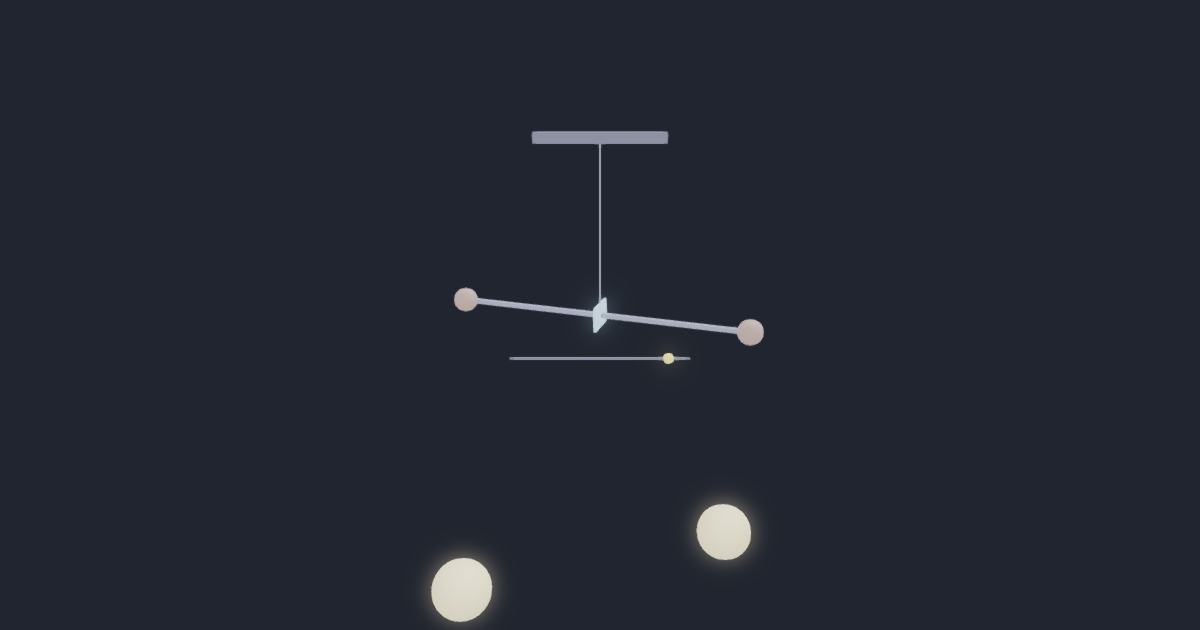
Hang a light beam carrying two small lead balls (mass m, half-arm L) from a thin torsion fibre. Bring two large lead balls (mass M) up beside the small ones at centre distance b, on opposite sides, so their pull twists the beam as a couple. Two observables pin down G without ever measuring the fibre's stiffness κ directly: the OSCILLATION PERIOD gives κ = 4π²I/T² (I = 2mL²), and the EQUILIBRIUM DEFLECTION balances the couple, κθ_eq = 2GMmL/b². Read the deflection by optical lever (a light beam off a mirror throws a spot a distance s = 2Dθ onto a far scale). Forward-model the real damped swing θ(t) = θ_eq[1 − e^(−t/τ)cos 2πt/T] with seeded reading noise; measure T from the peak spacing and θ_eq from the late-time mean.
the gravitational constant G = 6.674×10⁻¹¹ N·m²/kg² — recovered as G = 4π²b²Lθ_eq/(MT²) from only the apparatus geometry and the two measured numbers, NEVER from G or κ. The small mass m cancels entirely — it is never needed. With G in hand the lab inverts the surface field g = GM_⊕/R_⊕² to weigh the Earth: M_⊕ ≈ 6×10²⁴ kg and a mean density ~5.5× water — far denser than any surface rock, so the planet must hide a heavy core, exactly the conclusion Henry Cavendish drew in 1798 (building on John Michell's apparatus). The first time a fundamental constant of nature was extracted on a bench rather than from the heavens.
Newton's constant is the one fundamental number astronomy cannot reach. Orbits only ever measure the PRODUCT G·M — the Sun's pull tells you GM☉ and nothing about either factor — so until somebody put a known mass on both sides of the equation, nobody knew what the Earth weighed. Cavendish did it in 1798 with two lead balls on a wire, and every number on this page is that measurement taken apart. Nothing here stores G: the string 6.6743 appears nowhere in this calculator's code. It is recovered twice instead, once forwards and once backwards — forwards from the bench, where the period gives the fibre stiffness (κ̂ = I(ω_d²+γ²), the damped method of oscillations, because nobody can look up the stiffness of their own wire) and the deflection gives the couple; and backwards out of the number the simulation above actually displays, 6.5704×10⁻¹¹, divided by the three error stages that world discloses, which returns 6.674300000×10⁻¹¹ — the constant the simulation codes, to three parts in 10¹⁶. The bench boxes default to this lab's own published reading, θ_eq = 3.5348 mrad at T = 402.74 s, quoted to five digits, so they return 6.673917×10⁻¹¹ rather than the oracle's full-precision 6.674043×10⁻¹¹; the page inherits the rounding of the numbers it prints and says so. Two corrections the textbook formula hides are computed rather than assumed, because this world measures both: the far large ball pulls the other way and costs β = 7.42% of the couple by pure geometry, and damping lifts ω₀² above the swing's own ω_d² by 0.50%. Four things this lab does NOT measure, so the calculator does not pretend to: a real fibre, since κ and c are coded constants rather than a material — no anelasticity, no creep, no temperature drift of the torsion modulus, which is the dominant systematic in every real G measurement and a large part of why modern laboratory determinations still disagree by far more than their quoted error bars; the environment, because there is no tilt, no seismic background, no convection in the case and no building sway, and a real Cavendish run fights those rather than fighting gravity; finite-size masses, since every ball here is a point (exact for uniform spheres by the shell theorem, and only then), so no density gradient and no mass-distribution correction appears; and anything at all about why G has the value it has — this world measures a coefficient, it does not explain one.
Ĝ = κ̂θ_eq·b²/(2MmL(1−β)) · κ̂ = I(ω_d²+γ²), I = 2mL² · β = b³/(b²+4L²)^(3/2) · F = GMm/b² · ρ̄⊕ = 3g/(4πGR⊕)