Measured by the lab
1.7695
Newton lets gravity bend a light ray (treat the photon as a fast corpuscle) by 0.87″ at the Sun's limb. Einstein says 1.75″ — exactly twice. Which does starlight actually follow, and where does the missing factor of two come from?
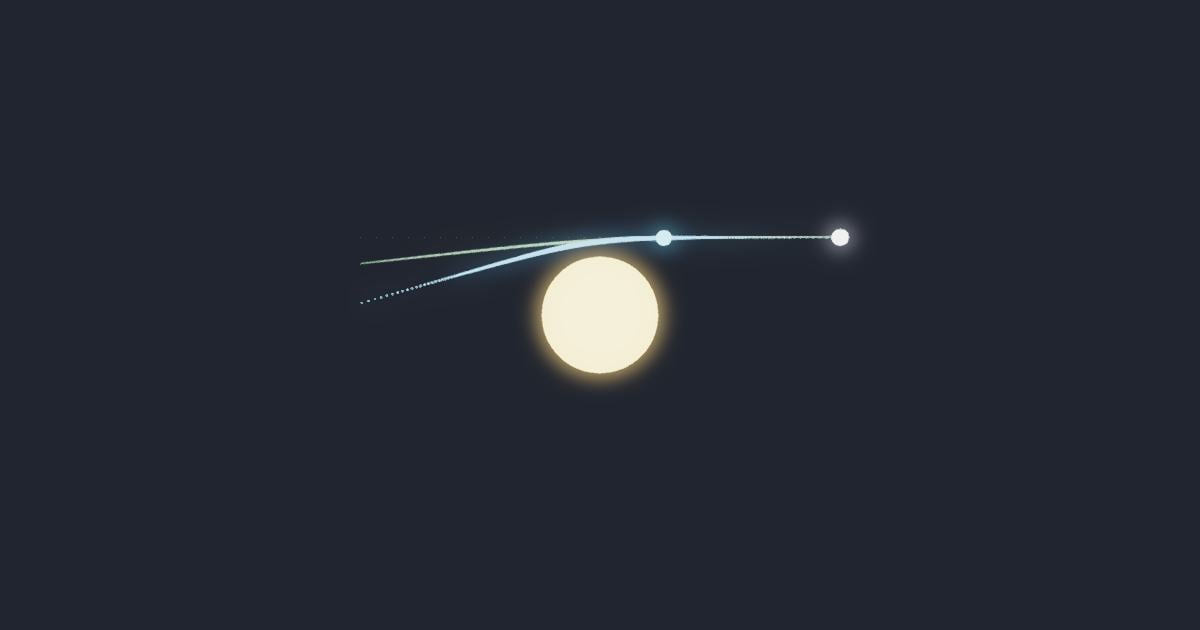
▶ Run the simulationSee the measured result
Units: arcsec (deflection of starlight grazing the solar limb b = R☉; Einstein 1916 predicted 1.75″, twice the Newtonian corpuscular value; modern VLBI 1.7509″, γ = 1 to 0.02%)
A photon is a NULL geodesic of the Schwarzschild metric, which in the orbital plane is the exact orbit equation u'' + u = 3(GM/c²)u² (u = 1/r) — Binet's straight-line equation u'' + u = 0 plus one relativistic curvature term (no Newtonian 1/L² term: the photon's mass cancels, so light would be perfectly straight in flat space). Integrate that ODE with RK4 from closest approach out to infinity, measure the total turn 2φ_∞ − π, and read the deflection at the real solar values (GM☉, c, R☉). No deflection formula is coded. A Monte-Carlo 'eclipse plate' of background stars at random impact parameters, with 10% astrometric noise, recovers the limb deflection by least squares; a Newtonian corpuscle at speed c through −GM/r² is integrated with the same machinery for the rival.
the ray BENDS by 1.751″ at the limb — matching Einstein's 1916 prediction and Eddington's 1919 eclipse (and modern VLBI to 0.02%), recovered from the traced geodesic with no formula fed. The deflection follows δ = 4GM/(c²b): the log–log slope of δ vs b comes back −1 (grazing rays bend most, which is why a total eclipse was needed), and the tiny residual above 4GM/c²b is the genuine second-order GR term (it halves when b doubles). The decisive control is the Newtonian corpuscle: integrated the same way it bends by EXACTLY half — 0.876″, ratio 2.0000 — the Soldner/Newton value Eddington's plates ruled out. The missing factor of two is the curvature of space itself (the same 'extra' curvature that supplies 5/6 of Mercury's perihelion advance in ?world=schwarzschild). The on-screen bend is exaggerated ~10⁵× so it is visible; the printed 1.751″ and 0.876″ are the true traced values, not the drawn angle.
How much a mass bends the light going past it, and what you can weigh with that. This is the measurement Eddington sailed to Príncipe for in May 1919: Newton's own theory, applied to light as a fast corpuscle, bends a ray grazing the Sun by 0.88 arcseconds, and Einstein's 1916 geometry bends it by twice that. The factor of two is the whole experiment, and this page does not take it on faith — it integrates the metric twice, by two routes that share no arithmetic, and reads the answer off. The exact Schwarzschild null geodesic is given nothing but the metric function 1 − 2GM/c²r and returns 1.751201273″ at the solar limb. Fermat's route reads the same metric as a refractive index and splits the answer in half: the part from g_tt — gravity slowing a clock, which is the entire content of Newton's version — comes back at a coefficient of 2.000006668, and the part from the curvature of space itself, which is what general relativity adds, comes back at 1.999993332. They sum to 4.000000000, which is the 4 in the formula, arrived at rather than assumed. The ratio between the two rivals comes out 1.999993332 rather than a flat two, and the reason is on the page: each half carries its own π·(GM/c²b) correction, and those cancel in the sum but not in the ratio. Two landmarks are found rather than quoted — the photon sphere, located by maximizing u²(1 − 2GM u/c²) and returning 5.196152422706633 against 3√3 to the last bit, below which the page refuses because a captured ray has no deflection to report; and the second-order coefficient, fitted out of five impact parameters as 11.780972446 ± 2.2e-8, which is 15π/4 and settles the most-confused number in the subject, since 15π/4 and 15π/4 − 4 are both correct and answer different questions. Run the chain the other way and it weighs a lens, which is what all of lensing astronomy does for a living; run it across three distances and it gives an Einstein radius. Four things this page will not do — strong fields, cosmological distances from redshift, the rest of the PPN formalism, and correcting the simulation above — are spelled out at the end of each direction.
δ = 4GM/(c²b) — the 4 measured, never typed · δ = 2(1+γ)GM/(c²b) in PPN, γ = 1 Einstein, γ = 0 Soldner · θ_E = sqrt( (δ·b)·D_LS/(D_L·D_S) ) · M from a measured δ · δ = 4GM/c²b + (15π/4)(GM/c²b)² + …