Measured by the lab
1.7695
Newton's own theory, applied to light as a fast corpuscle, bends a ray grazing the Sun by 0.87 arc-seconds (Soldner 1801). Einstein's 1916 General Relativity predicts 1.75″ — exactly twice. Eddington sailed to Príncipe for the total eclipse of 29 May 1919 to find out which nature obeys. Does the 1.75″ emerge from the Schwarzschild geometry itself, with no deflection formula fed — and is the Newtonian rival really short by a clean factor of two?
Units: arcsec (deflection of starlight grazing the solar limb b = R☉; Einstein 1916 predicted 1.75″, twice the Newtonian corpuscular value; modern VLBI 1.7509″, γ = 1 to 0.02%)
▶ Run this simulationRead how it works
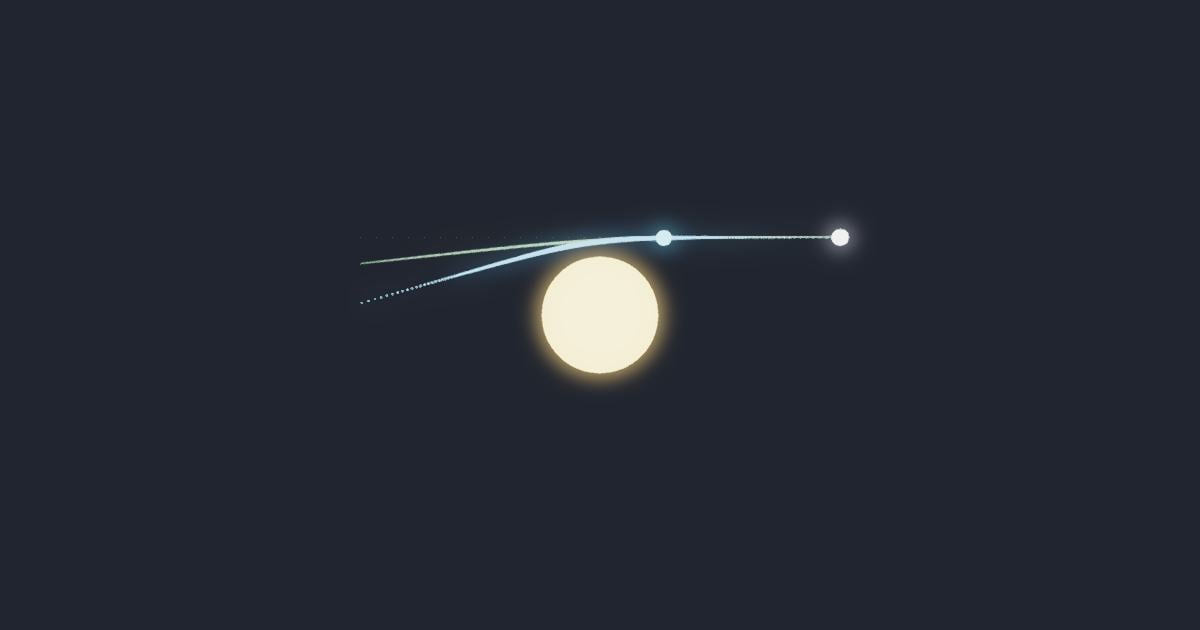
Gravitational light deflection recovered from a Schwarzschild null geodesic with no deflection formula coded: integrating the exact orbit equation u'' + u = 3(GM/c²)u² and measuring the total turn 2φ_∞ − π returns 1.75120″ at the solar limb vs the observed 1.751″ (rel 1.2e-4; noiseless), a 24×40-star Monte-Carlo 'eclipse plate' with 10% astrometric noise recovers 1.7695 ± 0.0100″ (1.9 SE), the δ ∝ 1/b law is emergent (log–log slope −1.000001), the residual above 4GM/c²b is the genuine 2nd-order GR term (positive, halves as b doubles), and a Newtonian corpuscle at speed c bends by EXACTLY half — 0.876″, ratio 2.000013 — the Soldner value Eddington's 1919 eclipse ruled out
A photon is a NULL geodesic of the Schwarzschild metric, which in the orbital plane is the exact orbit equation u'' + u = 3(GM/c²)u² (u = 1/r) — Binet's straight-line equation u'' + u = 0 plus one relativistic curvature term, with NO Newtonian 1/L² term (the photon's mass cancels, so light would be perfectly straight in flat space). RK4 integrates that ODE from closest approach r₀ (u = 1/r₀, u' = 0, with the impact parameter fixed by the turning condition 1/b² = u₀² − 2(GM/c²)u₀³) out until u crosses 0 (the ray escaping to infinity); the escape angle φ_∞ is read by linear interpolation and the deflection is δ = 2φ_∞ − π (exactly 0 for a straight line). The closed form 4GM/(c²b) and the observed 1.751″ appear ONLY in scoring gates. A Monte-Carlo 'eclipse plate' draws 24 seeds × 40 background stars at impact parameters uniform in [1,8]·R☉, assigns each a measured deflection with 10% Gaussian astrometric noise, and recovers the solar-limb deflection K/R☉ by least squares of δ = K/b through the origin (SE from the seed spread). The Newtonian rival integrates a ballistic photon at speed c through −GM/r² in Cartesian coordinates with the same RK4. 8 gates, ~0.3 s. Run at the real solar values (GM☉, c, R☉). ?world=lightbending.
δ = 4GM/(c²b) — recovered, never coded: the traced deflection matches the closed form to 6.5e-6 relative at the limb, and the δ ∝ 1/b law comes back as a log–log slope of −1.000001 over 8 impact parameters (1–12 R☉). Grazing rays bend most, which is exactly why a total eclipse (starlight skimming the limb) was needed to see it.
0.01
the MONTE-CARLO 'eclipse plate' value (24×40 stars, 10% astrometric noise) = 1.7695 ± 0.0100″, 1.85 SE from the observed 1.751″; the NOISELESS single-ray trace is 1.75120″ (rel 1.15e-4 vs observed, rel 6.5e-6 vs 4GM/c²b — that tiny residual is the physical 2nd-order term, not numerics)
Einstein's 1916 light-deflection prediction (Ann. Phys. 49, 769): δ = 4GM/(c²b), confirmed by the Dyson–Eddington–Davidson 1919 eclipse and modern VLBI to 0.02%. It VALIDATES, not derives: the Schwarzschild null-geodesic orbit equation is the substrate (coded with only the metric's u² coefficient 3GM/c²), and the closed-form deflection law, the 1.75″, and the factor 4 are recovered by MEASURING the total turn of the integrated ray — the formula appears only in scoring. Non-circularity: the generator maps (GM, c, R☉, b) → integrated null geodesic → escape angle φ_∞ → δ = 2φ_∞ − π; no deflection expression, no 1.75, no factor of 4, and no π-as-a-target exists in that path (tamper test: falsifying known_value flips exit to 1 with the recovered value unchanged at 1.75120″). The decisive Newtonian corpuscular control — integrated with the same RK4 and bending by exactly half (0.876″, ratio 2.0000) — establishes that the recovered number needs curved spacetime specifically, not merely gravity acting on light; it is the null-geodesic sibling of ?world=schwarzschild's timelike Mercury perihelion, sharing the same 'space curvature doubles it' physics.
The module's on-screen numbers (GR 1.751″, Newton 0.876″, ratio 2.0000, and the δ-vs-b chart dots) come from the SAME null-geodesic trace the oracle uses, run at the real solar values in LightBendingModule.init() — and the honesty certificate proves this by EXECUTION with ZERO gap: the shown δ_GR equals the oracle's own dphi_fine recovery BIT-FOR-BIT (the module's 80-iteration u₀ Newton solve is proven at its float fixed point by iteration 56, so it coincides exactly with the oracle's 60), and δ_Newton and all 6 chart dots (dphi_canonical) are bit-identical too — the first world whose displayed headline is bit-equal to the oracle recovery, not merely within tolerance. Rounds-onto-label: toFixed(3) → '1.751' equals the cited known label while the double differs by 1.15e-4 rel (the 4-sig-fig quantization), and the '2.0000' ratio is earned (double ≠ 2 by 1.33e-5, the Newton integrator's truncation + 2nd-order GR). The chart's CONTINUOUS GR curve is law-fed — δ_limb/b, a 1/b shape anchored on the measured limb value, disclosed on the label ('δ = 4GM/c²b') — while the 6 dots are independently traced; the cert prices the dot-vs-curve residual as the emergent 2nd-order pull −r₁(1−1/b) within a derived ceiling (worst misfit 2.95e-7 at b=1, pure grid). The only exaggeration is geometric and now honestly labeled: the demo drawing uses μ/b ≈ 2.7×10⁴× the real Sun's, giving a drawn turn of 16.0° — an on-screen exaggeration ratio of 3.29×10⁴ (pinned in the cert). The certification CAUGHT the previous HUD label '~10⁵×' overclaiming that ratio by 3× (and the doc comment's '~10⁶× / ~20°') — the 3rd display/finding overclaim caught by execution, after halo and hydrogen — fixed to '~3×10⁴×' and re-pinned. The printed arcsec values are the true weak-field traced values; the drawn Newtonian ray is a separate ballistic integration in the strong-field demo regime whose visual bend is not exactly half, disclosed on-screen.
npm run derisk -- lightbending (scripts/lightbending-derisk.mjs)scripts/oracles/lightbending.reference.jsonA. Einstein, 'Die Grundlage der allgemeinen Relativitätstheorie', Ann. Phys. 49, 769 (1916) — GR predicts 1.75″ at the solar limb, twice the Newtonian value. J. von Soldner (1801) — Newtonian corpuscular deflection ≈0.87″. F. W. Dyson, A. S. Eddington, C. Davidson, Phil. Trans. R. Soc. A 220, 291 (1920) — 1919 eclipse measured 1.98″±0.16 (Sobral), 1.61″±0.40 (Príncipe). E. Fomalont et al., ApJ 699, 1395 (2009); S. S. Shapiro et al., Phys. Rev. Lett. 92, 121101 (2004) — PPN γ = 1 to ~0.02%, deflection 1.7509″. C. M. Will, Living Rev. Relativity 17, 4 (2014). Constants: IAU nominal GM☉ = 1.32712440018e20 m³/s², IAU 2015 nominal R☉ = 6.957e8 m, SI c.