Measured by the lab
1.49993
Shine unpolarized light on flat glass — is there an angle where the reflection vanishes for one polarization, and what does that reveal?
▶ Run the simulationSee the measured result
Units: dimensionless (refractive index n₂ of glass, air n₁ = 1)
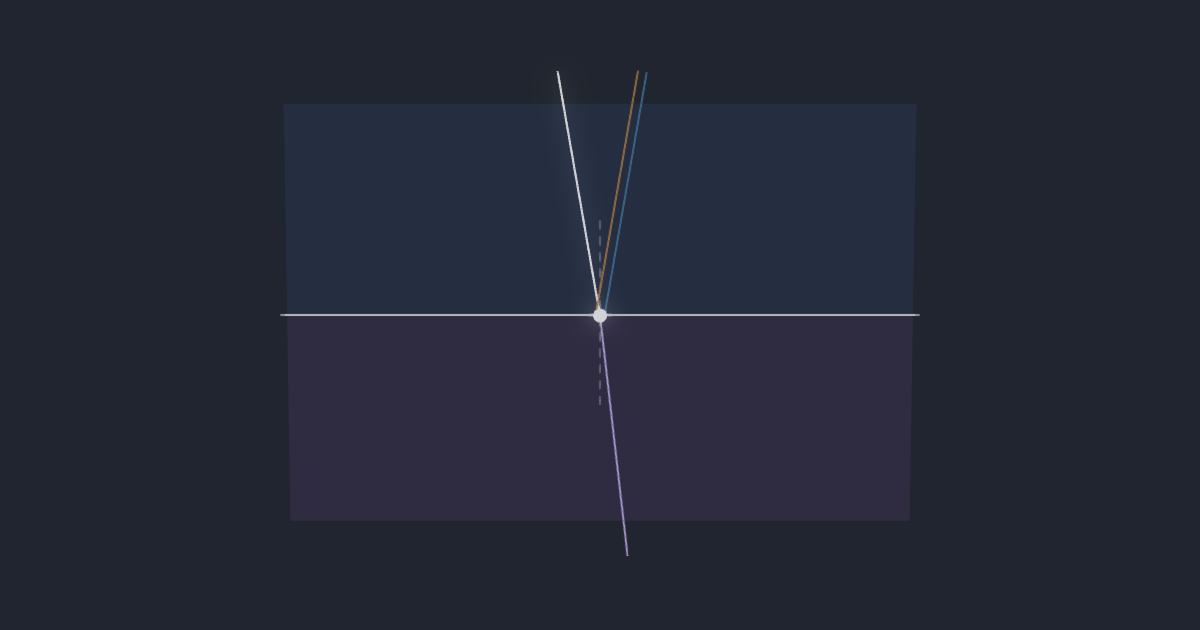
Sweep the incidence angle θᵢ for unpolarized light hitting flat glass and split the reflected beam with the Fresnel equations into its s- and p-polarized parts; locate the angle where the p-reflectance R_p falls to zero, and read the refractive index n = tan θ_B off that null.
Brewster's law — the p-reflectance hits EXACTLY zero at θ_B = arctan(n₂/n₁) ≈ 56.3° for glass, so the light reflected there is 100% s-polarized (the reflected and refracted rays come off perpendicular). Recovering n = tan θ_B from the R_p null is why polarized sunglasses kill glare and why laser cavities use Brewster windows. The polarization branch of the optics arc, after Snell, TIR, mirage and the rainbow.
Where a reflection goes dark, and what that darkness tells you about the glass. Turn a polarizer at a window and at one angle a whole component of the reflection does not dim but VANISHES — and that angle carries the refractive index of whatever you are looking at. Neither the angle nor the index is typed into this page. The only thing declared here is Fresnel's amplitude coefficient r_p, and θ_B is found by BISECTING it — 120 halvings of (0°, 90°) — so everything else falls out of a root: the refracted ray leaves at 33.690068°, the reflected and refracted rays stand 90.000000000° apart, and that right angle is an output rather than an assumption. It is also the whole mechanism, because a p-oriented dipole driven in the glass cannot radiate along its own axis, and at this one angle its axis points exactly where the reflection would have gone. The measured box is deliberately not the textbook 56.31°: it holds 56.308610752504805°, this lab's own reading off a 0.25° grid under ±0.4% reading noise, so inverting it returns 1.499925 and the page reports the −0.0050% instead of rounding it into agreement. The page will also re-run that measurement — the same 201 samples, the same fixed noise stream, the same parabolic refine — and one field decides WHICH reflectance is hunted. Ask it for the s-component, or for the unpolarized average, and the search finds no interior zero at all: it pins at the 30° edge of the window unrefined and reads n = 0.577350 instead of 1.5. That is this world's rival, and it is wrong for a reason the reflectance split makes arithmetic: unpolarized light reflects 7.3964% at Brewster's angle against 4.0000% head-on, so the reflection there is BRIGHTER than at normal incidence, not dimmer. Only its p-half goes. Five things the page refuses to do — metals and any absorbing medium, dispersion, birefringence, coatings and stacks, and correcting the simulation above — are spelled out under the reflectance split.
r_p(θ_B) = 0 ⇒ θ_B = arctan(n₂/n₁) · n₂ = n₁·tan θ_B · θ_B + θₜ = 90° · R = |r|², DOP = |R_s−R_p|/(R_s+R_p) · θ_B + θ_B′ = 90°