Measured by the lab
10.2185
A muon lives only 2.2 µs, so even at near-lightspeed it should decay within ~660 m of where it's born — yet muons made ~15 km up in the upper atmosphere reach sea level in force. How do they survive a fall that should cost them ~50 lifetimes?
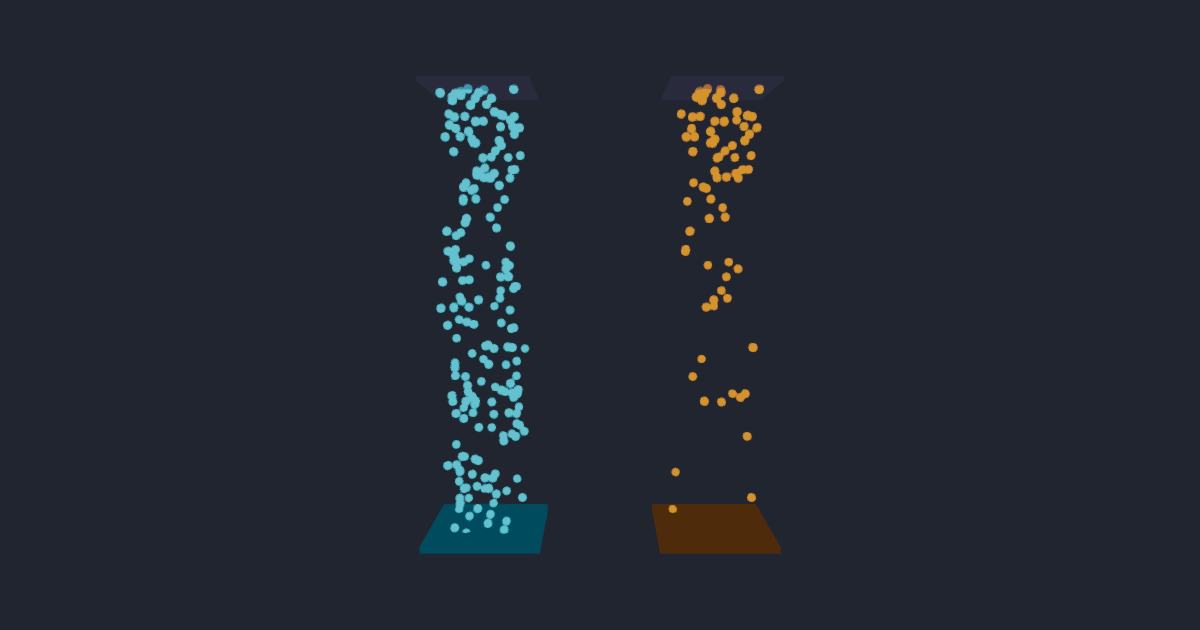
▶ Run the simulationSee the measured result
Forward-model the Frisch–Smith 1963 experiment (Mt Washington, h≈1907 m, β=0.9952, muon mean lifetime tau0=2.197 µs). A muon's decay clock ticks in its PROPER time; the lab sees it run slow by γ=1/√(1−β²), so survival to a detector h below is S=exp(−(h/βc)/(γ·tau0)). Run a SEEDED Monte-Carlo of millions of individual muons (proper lifetimes drawn from Exp(tau0)), measure the surviving fraction S, and invert γ=(h/βc·tau0)/(−ln S) — a formula that never contains γ. Repeat across five β, and run a Galilean control (no dilation, the clock ticks in lab time) as a falsification test. ?world=muon.
the special-relativistic Lorentz factor γ=1/√(1−β²) — recovered as γ=10.218 at β=0.9952 purely from how many muons survive the fall, and tracking the law to ~1e-3 across β∈[0.99,0.999] (γ from 7.1 to 22.4). The result is decisive because the Galilean alternative is RULED OUT: with no time dilation the same muons survive with probability S_gal≈5.5% — about 13.8× fewer than the relativistic S≈75% — and fed the real summit flux (563/hr) it predicts ~31/hr at sea level against the measured ~408/hr, while relativity predicts ~423/hr (within ~4%). The muon's reprieve is exactly the time dilation Einstein's 1905 kinematics demands; the lab's first special-relativity world, the SR companion to ?world=schwarzschild's general relativity.
How much longer a fast clock lasts, and the cheapest decisive measurement of it ever run. A muon made in the upper atmosphere lives 2.197 µs on average and moves at barely under c, so it should cover about 655 m before decaying — yet muons born ~15 km up arrive at sea level in force. Nothing about the muon changes: exponential decay is memoryless, so a muon has no age and no way to know it is moving. What changes is whose clock you read it in. γ is never typed in on this page — it is assembled as 1/√(1−β²) from the β you enter, exactly the refusal to inject the answer that makes the simulation above non-circular (it counts individual simulated muons and inverts the surviving FRACTION through γ = (h/βc·τ₀)/(−ln S), a formula that contains only h, β, c and τ₀). The measured-survival box defaults to 0.75211025, and that is deliberate: it is not the analytic survival but this lab's own count of 3008441 survivors out of 4000000 simulated muons, recomputed here from those two integers, so it inverts to γ = 10.212757 — the value the simulation actually prints on screen, −0.56 σ of its own binomial counting noise below the law's 10.218477, which is the gap the finding discloses rather than hides. Four things this lab does NOT measure, so the calculator does not pretend to: the cosmic-ray momentum spectrum, since real muons arrive across a broad band of speeds and Frisch and Smith had to select a velocity window with an iron absorber, where this page takes one β; energy loss on the way down, which really does slow a muon as it ionizes the air, so a constant β over 1907 m is an idealization; the production-height distribution, since muons are born throughout a thick shell near 15 km rather than at one altitude; and gravitational time dilation, which is a different effect of opposite sign — this is pure inertial special relativity, and the lab's general-relativistic companion is ?world=schwarzschild. Nothing here accelerates or turns around either, so no twin paradox arises to resolve.
γ = 1/√(1−β²) · β = √(1−1/γ²) · t = γτ, L = L₀/γ · S = exp(−(h/βc)/(γτ₀)) · γ = (h/βc·τ₀)/(−ln S)