Measured by the lab
0.549924
Drop a bar magnet through a coil and a voltage appears — even though nothing touches. Is the induced voltage set by how STRONG the magnet's flux is through the coil, or by how FAST that flux is changing?
▶ Run the simulationSee the measured result
Units: A·m² — the dipole moment coded into the generator's field formulas (an input coefficient, like copper's n in hall); a stock NdFeB N42 disk ~15×8 mm has m ≈ 0.5–0.6 A·m²
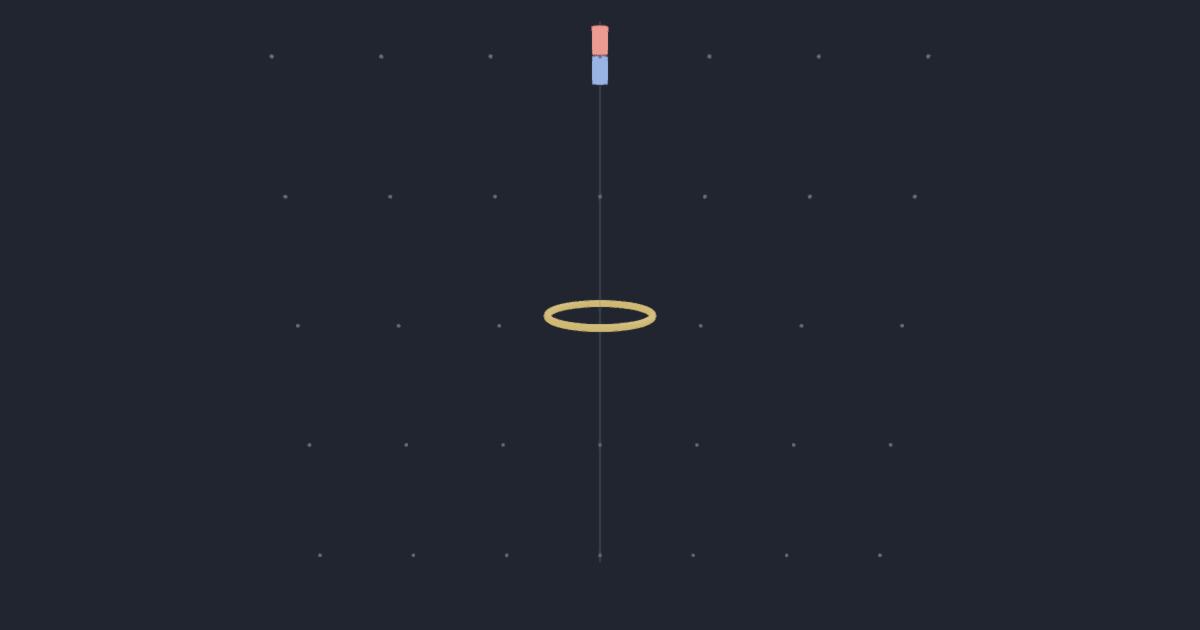
Let a magnet (axial dipole, flux Φ(z) = μ₀m·a²/2(a²+z²)^{3/2}) fall under gravity straight down the axis of an N-turn coil. The lab traces the flux Φ(t) — a single hump peaking when the magnet is centred — alongside the induced EMF = −N dΦ/dt, integrating the EMF to track ∮ EMF dt and the area of each lobe. A real NdFeB magnet is also dropped through a real 240-turn 13 mm coil with 3% reading noise.
Faraday's law EMF = −N dΦ/dt — the RATE, not the flux: the EMF is exactly ZERO when the magnet is centred (flux MAXIMUM) and peaks off-centre where the flux changes fastest, a BIPOLAR pulse whose two lobes carry equal & opposite impulse (∮ EMF dt = −N·ΔΦ = 0); because the magnet accelerates the exit lobe is taller & narrower yet equal in area, and ∫|EMF| dt = N·Φ_max = Nμ₀m/2a inverts to recover the magnet's dipole moment m ≈ 0.55 A·m² independent of fall speed
Weigh a magnet with a voltmeter. Drop it down the axis of a coil and the meter does not read the flux — it reads the rate, so the trace is a BIPOLAR pulse that crosses zero at the instant the magnet is centred and the flux is greatest. The area under one lobe is the whole measurement: ∫|ε|dt = N·ΔΦ = Nμ₀m/(2a), which contains the coil and the magnet and nothing about the fall. Invert it and the magnet's dipole moment drops out. Nothing here is stored: Φ is assembled from the on-axis point-dipole field, the peak coefficient (3/4)(4/5)^(5/2) is built as 0.64·√0.8 rather than typed as 0.4293, and the whole body reaches for Math.sqrt and Math.abs and no implementation-approximated function at all — no power, no cube root, no π — the one cube root the release-deficit inverse needs being a Newton loop of multiplies. The defaults are this lab's own bench: a 240-turn coil of radius 13 mm, an NdFeB disk of m = 0.55 A·m² released 0.25 m up, and a default lobe area of 6.3785242634627e-3 V·s, which is what the simulation's own ±3% meter actually read — invert it and you get 0.5498857355, the number on that screen, and the release-deficit correction moves it to 0.5499627294. That deficit is the honest part: releasing from a finite height leaves f = Φ(s₀)/Φ(0) = 1.400396e-4 of the flux unswept, so the raw law under-reads by exactly that, and the page computes the bias from geometry rather than fitting it away. Four things this relation does NOT cover, so the calculator does not pretend to: the load — this is the open-circuit EMF, with no current, so no Lenz braking and no terminal velocity in a copper tube, which is the falling-magnet demonstration everyone actually remembers; the magnet's finite size, treated here as a point dipole; any off-axis drop, where the per-segment contributions around the ring differ by ×12 and only the line integral survives; and the coil's own inductance and resistance. What it does rest on is in the finding: the flux rule emerges from a raw Lorentz-force sum at 4.5e-8 of peak, the lobes balance to 2.3e-10, and ×20 in drop height moves the weighed moment by 6.9e-7.
ε = −N dΦ/dt · Φ(z) = μ₀m a²/(2(a²+z²)^{3/2}), Φ_max = μ₀m/(2a) · ∫|ε|dt = NΦ_max ⇒ m = 2a·∫|ε|dt/(Nμ₀) · ε_pk = (3/4)(4/5)^{5/2}·Nμ₀mv/a² at z = ±a/2 · f = Φ(s₀)/Φ(0) = (a²/(a²+s₀²))^{3/2}