Measured by the lab
2.9977e+8
Maxwell's equations describe electricity and magnetism — so why is the speed of a wave they support numerically equal to the speed of light, and what happens to that wave when it hits glass?
▶ Run the simulationSee the measured result
Units: m/s (the wave speed, recovered as 1/√(μ₀ε₀))
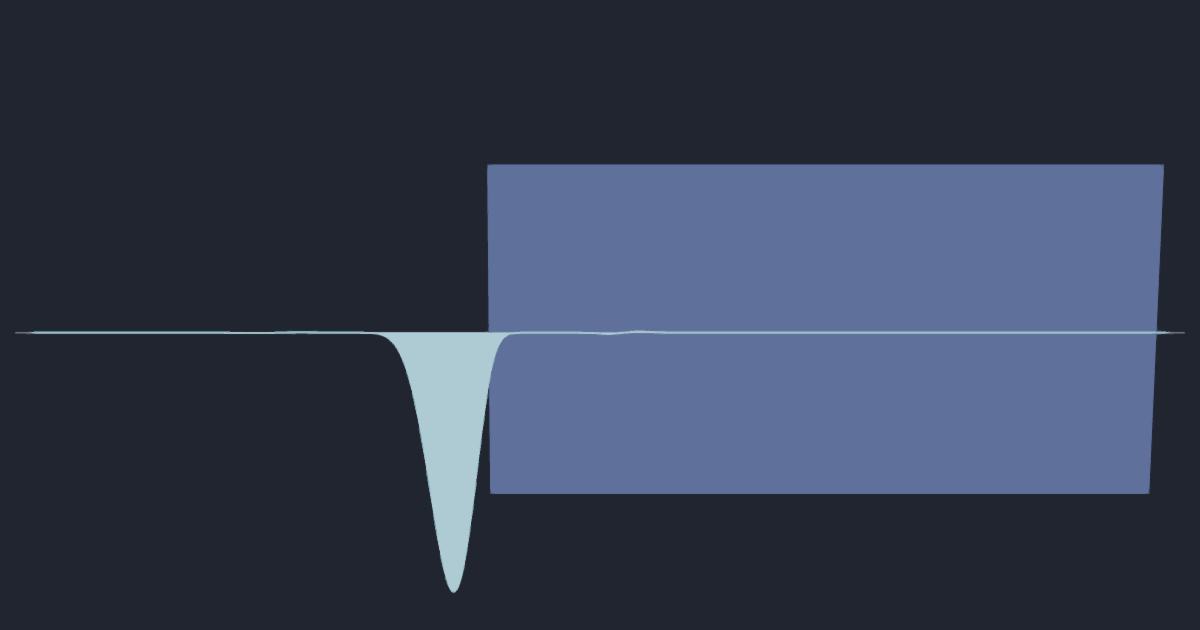
Integrate Maxwell's two 1-D curl equations ∂H_y/∂t=(1/μ)∂E_z/∂x and ∂E_z/∂t=(1/ε)∂H_y/∂x from scratch with the Yee (1966) finite-difference time-domain leapfrog. The number c is NOWHERE in the solver — the time step Δt=S·Δx·√(μ₀ε₀) is assembled from the two electromagnetic constants alone (Courant number S≤1) — so recovering it is not circular. Launch a Gaussian pulse and least-squares fit the field-energy crest position against time to get the wave speed; check the speed is invariant across 24 grids and converges to a limit as the mesh is refined (2nd-order). Then drop the pulse into a dielectric slab (ε_r) and measure the transmitted speed and the reflected-energy fraction.
the speed of light c = 1/√(μ₀ε₀) = 299,792,458 m/s — recovered from the field dynamics to ~1e-4 across 24 grids and converging to c as Δx→0 (the residual is bounded numerical dispersion, not a fudge). This is Maxwell's 1865 argument itself: a wave the electromagnetic equations support travels at exactly the measured speed of light, so light IS that wave. In a glass slab (ε_r=2.25) the transmitted wave SLOWS to v=c/n, recovering the refractive index n=√ε_r=1.50 — the very n Snell's law uses — and the normal-incidence Fresnel reflectance R=((1−n)/(1+n))²=4%. Decisively, the wave SLOWS in glass (v=0.67c<c), exactly Foucault's 1850 measurement, which FALSIFIES Newton's corpuscular theory that predicted light should speed UP (v=n·c=1.5c>c). The capstone bridging the electromagnetism arc (?world=field, faraday, generator) to the optics arc (snell, brewster, rayleigh), which all assume the n and c/n this world derives.
How fast light travels inside a material, from the material's electromagnetic constants alone — the same chain the simulation above runs: Maxwell's curl equations give v = 1/√(με), so a medium of relative permittivity ε_r slows the wave to c/n with n = √(ε_r μ_r), and the impedance step at its surface reflects ((n₁−n₂)/(n₁+n₂))². The speed of light is never entered: c = 1/√(μ₀ε₀) = 299,792,458 m/s is computed here from μ₀ and ε₀, as it is in the solver. One thing this lab does NOT measure: dispersion and absorption. Real glass has an ε_r that varies with wavelength (BK7 is n = 1.5195 at 486 nm and 1.5143 at 656 nm), so a single ε_r is a one-colour answer; the simulation's own recovery was checked against √ε_r to under 1% for ε_r ≤ 2.25.
n = √(ε_r μ_r) · v = c/n · η = η₀√(μ_r/ε_r) · R = ((n₁−n₂)/(n₁+n₂))²