Measured by the lab
2.9977e+8
Maxwell's equations describe electricity and magnetism — so why is the speed of a wave they support numerically equal to the speed of light, and what happens to that wave when it enters glass?
Units: m/s (the wave speed, recovered as 1/√(μ₀ε₀))
▶ Run this simulationRead how it works
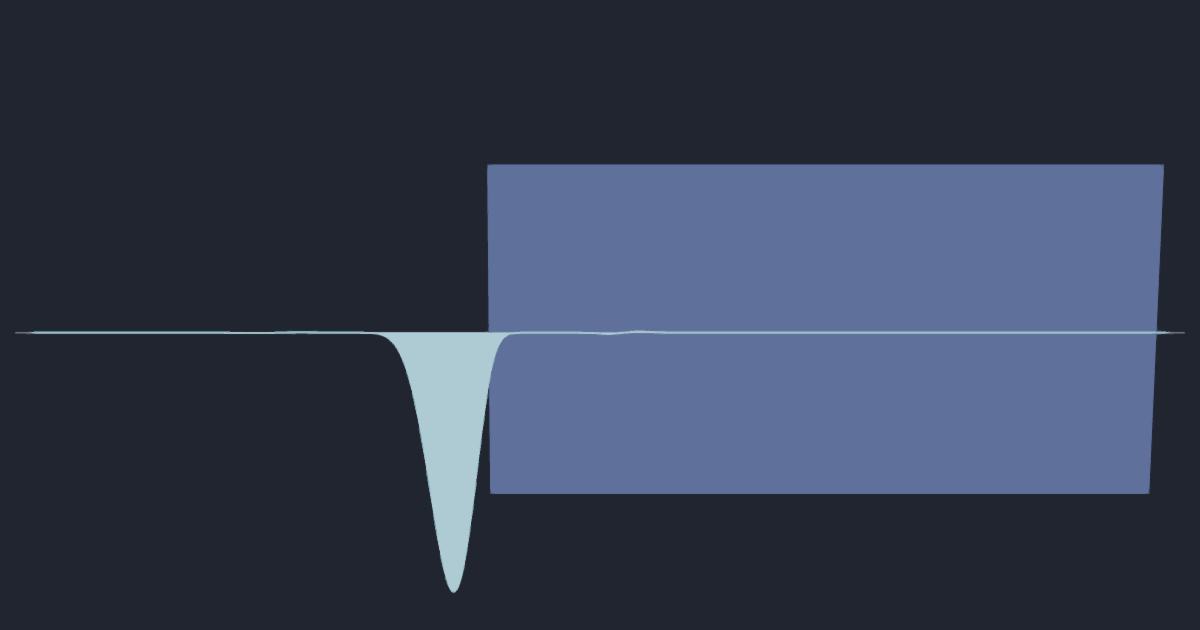
Light IS an electromagnetic wave: the speed of light c = 1/√(μ₀ε₀) = 299,792,458 m/s recovered from a from-scratch Yee-FDTD integration of Maxwell's two curl equations (c never in the solver) across 24 grids and converging 2nd-order to c, and — in a glass slab — the refractive index n = √ε_r = 1.5 (Snell's n) and the Fresnel reflectance R = 4%, with the wave SLOWING to c/n, falsifying Newton's corpuscular theory (Maxwell 1865 / Foucault 1850)
Integrate Maxwell's two 1-D curl equations ∂H_y/∂t = (1/μ)·∂E_z/∂x and ∂E_z/∂t = (1/ε)·∂H_y/∂x with the Yee (1966) finite-difference time-domain leapfrog: H_y[i] += (Δt/μ₀Δx)(E_z[i+1]−E_z[i]); E_z[i] += (Δt/ε[i]Δx)(H_y[i]−H_y[i−1]). The number c appears NOWHERE in the update — the time step Δt = S·Δx·√(μ₀ε₀) is assembled from the two electromagnetic constants alone (Courant number S ≤ 1) — so recovering the speed of light is not circular; it is Maxwell's own 1865 argument (compute 1/√(μ₀ε₀) from electrical constants, find it equals the measured speed of light). Launch a Gaussian pulse and recover the wave speed as the least-squares slope of the electromagnetic-energy CREST position (metres) against time (seconds), over an adaptive window in which the crest is clear of both the launch transient and the far wall. (A) Do this on 24 distinct grids (S ∈ [0.4,0.9], pulse width σ ∈ [24,44] cells, launch position) — the recovered speed must be grid-invariant. (B) Halve Δx at fixed physical pulse width — the c-error must fall ~4× (2nd-order), proving the residual is numerical dispersion and the limit is exactly c. (C) Put the pulse into a dielectric slab of permittivity ε_r and measure the transmitted-pulse speed → n = v_vacuum/v_medium; sweep ε_r over water→crown glass. (D) Measure the reflected-energy fraction at the vacuum→glass interface. (E) Compare the measured medium speed to Newton's corpuscular prediction.
∂²E_z/∂t² = (1/με)·∂²E_z/∂x² ⇒ v = 1/√(με); vacuum v = 1/√(μ₀ε₀) = c; medium v = c/√ε_r = c/n; Fresnel R = ((1−n)/(1+n))²
6.8000e-5
0.000182
| Eps r | Material | N recovered | N expected | Rel |
|---|---|---|---|---|
| 1.77 | water | 1.3365 | 1.3304 | 0.00455 |
| 2 | light glass | 1.423 | 1.4142 | 0.00621 |
| 2.25 | crown glass (BK7-like) | 1.5123 | 1.5 | 0.00821 |
Maxwell's 1865 discovery that light is an electromagnetic wave with speed c = 1/√(μ₀ε₀) (J. C. Maxwell, Phil. Trans. R. Soc. 155, 459), together with the wave theory's prediction — confirmed by Foucault's 1850 measurement — that light travels SLOWER in a dense medium (v = c/n), which falsified Newton's corpuscular theory. It VALIDATES, not derives: the lab assumes Maxwell's two curl equations and integrates them numerically (Yee 1966 FDTD) with only μ₀ and ε as coefficients — c is never in the solver — and shows the emergent, measurable pulse speed is 1/√(μ₀ε₀) to ~1e-4 over 24 grids, converging 2nd-order to the independently-known speed of light as the mesh refines. It is non-circular on four fronts: c is assembled into Δt only through μ₀,ε₀ (never as itself) and is loaded only to score; the grid-invariance and 2nd-order convergence rule out a mesh artifact; the refractive index n = √ε_r emerges from the transmitted-pulse speed (not plugged in) and equals the n Snell's law uses; and the Fresnel reflectance R = ((1−n)/(1+n))² emerges from the interface impedance mismatch. The decisive control is the wave SLOWING in glass (v = c/n < c) rather than speeding up (Newton's v = n·c > c) — Foucault's verdict. It does NOT derive Maxwell's equations, quantize the field, or model absorption/dispersion of real glass; it demonstrates that the electromagnetic field equations already contain light and its refraction. The lab's first Maxwell-PDE / wave-propagation world — the capstone bridging the electromagnetism arc (?world=field, faraday, generator) and the optics arc (?world=snell, brewster, rayleigh), which all assume the n and c/n derived here.
npm run derisk -- emwave (scripts/emwave-derisk.mjs)scripts/oracles/emwave.reference.jsonJ. C. Maxwell, 'A Dynamical Theory of the Electromagnetic Field', Phil. Trans. R. Soc. Lond. 155, 459 (1865). L. Foucault (1850) & A. Fizeau — light travels slower in a dense medium (v=c/n<c), the measurement that killed Newton's corpuscular prediction. K. S. Yee, IEEE Trans. Antennas Propag. 14, 302 (1966) — the FDTD leapfrog. A. Fresnel — normal-incidence reflectance R=((n₁−n₂)/(n₁+n₂))². CODATA 2018: μ₀=1.25663706212×10⁻⁶ H/m, ε₀=8.8541878128×10⁻¹² F/m, c≡299792458 m/s (exact, SI 2019).