Measured by the lab
1.4999971
What happens to the waves from a moving source — and what is a sonic boom?
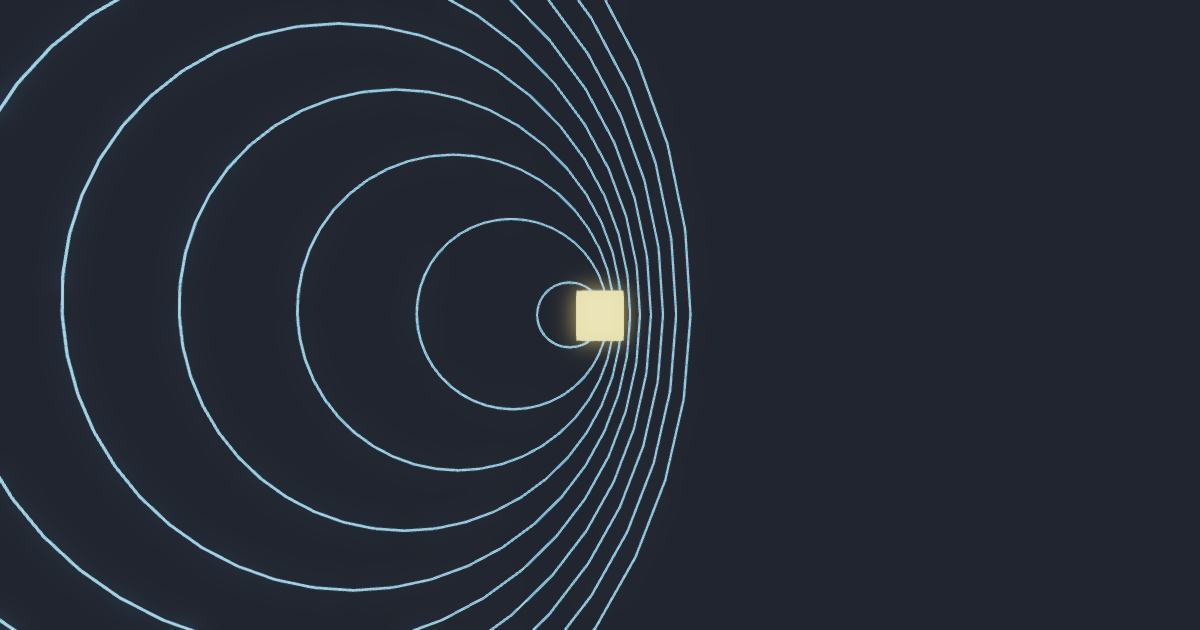
▶ Run the simulationSee the measured result
Units: f′/f ahead of a source approaching at M = 1/3 (exact 1/(1 − 1/3) = 3/2; Doppler 1842)
A source emits circular wavefronts at a fixed rate while moving at speed v = M·c. In the source's frame, read the wavelength ahead of and behind it straight off the wavefront pattern, and (above M=1) the Mach-cone half-angle; sweep the Mach number from subsonic through the sound barrier to supersonic.
the Doppler shift f′ = f·c/(c ∓ v) = f/(1 ∓ M) — wavefronts bunch ahead (blueshift) and stretch behind (redshift), and the wavelength read off the pattern recovers the ratio (exact to the digit at steady speed; it lags a few % while the speed sweeps); and past M=1 the source outruns its own waves into a trailing Mach cone of half-angle sin μ = c/v = 1/M (the sonic boom) — 90° (a flat pile-up) at the sound barrier M=1, narrowing as M grows
Why a siren drops as it passes, and what the drop is worth measuring for. The usual teaching order is backwards: the formula first, the reason afterwards. In this lab the reason comes first — the simulation above knows only that a source emits a ring of sound every T seconds while it moves, and the bunching ahead and the stretching behind are what you are looking at, not what it was told. This page carries both readings of that. The source direction DIVIDES by 1 − M and the receiver direction MULTIPLIES by 1 + M, and the gap between those two operations is the entire question this world exists to settle: is the shift a property of how fast the two are closing, or does the air itself have a say? At a third of the speed of sound the answer is 1.5 against 1.3333 — the same closing speed heard two different ways, 12.5% apart, second order in the Mach number and invisible to anyone who could not move fast enough, which is why the argument needed a trumpeter on a moving train in 1845. The measured boxes hold this lab's own recovered pair rather than tidy textbook numbers, so the speed direction returns M = 0.333334548 and a rest note 3.76e-6 under the 440 Hz entered: that residue is the lab's measurement, printed rather than rounded away. That direction is also the one that needs no note at all — a difference over a sum of the two ends of a pass-by, where the emitted frequency cancels, which is how a microphone clocks a siren it has never heard standing still, and how the harmonic mean of the two readings hands the note back anyway. Past Mach 1 the bunching closes into a cone and the page times the boom: from 11 km up it arrives nearly 28 seconds after the aircraft is overhead, by which time the aircraft is 19 km down-track. The last direction does something no other calculator here does — it REPLAYS the simulation's own tick loop, arriving on the module's certified end state bit for bit, and then decomposes the gap between the number on screen and the theory label beside it into a ramp lag and a one-time emission-quantization transient with zero free parameters. Move any of the module's constants and that identification is withdrawn, because the replay stops landing on the executed pin. Four things this page will not do: re-run the wave-equation recovery (the finding's ratios come from integrating u_tt = c²u_xx, which no closed form here reproduces), price a sonic boom, handle a moving medium — a wind is a change of frame, not of law — and treat light this way, because light has no medium to have a frame, and that difference is special relativity.
f′ = f/(1 ∓ M_s) · f′ = f(1 + M_o) · f′/f = (1 + w·M_o)/(1 − M_s − (1−w)·M_o) · M = (f_a − f_b)/(f_a + f_b), f = 2f_af_b/(f_a+f_b) · sin μ = 1/M · Δt = h√(M²−1)/(Mc)