Known value
6.6743e-11
Can the absolute strength of gravity — the feeblest fundamental constant, invisible to astronomy (which only ever measures G·M) — be pinned down from a tabletop torsion balance's swing alone, the way Cavendish did it in 1798, without the recovery ever containing the estimator formula it is supposed to validate?
Units: m³ kg⁻¹ s⁻² (CODATA 2018/2022: G = 6.67430(15)×10⁻¹¹)
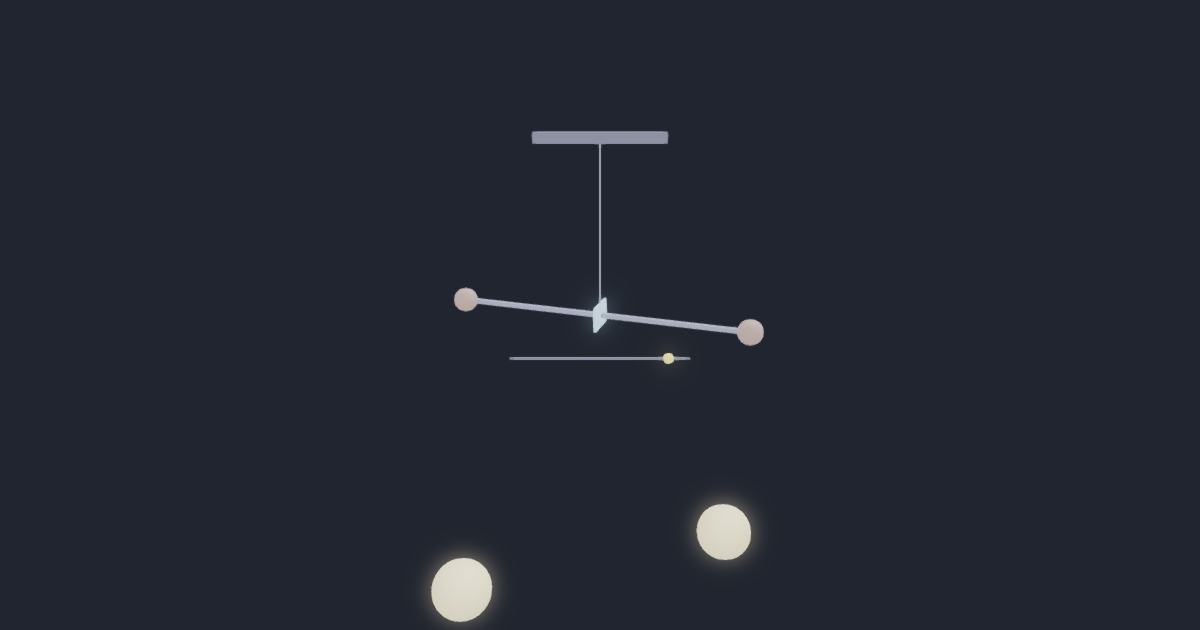
▶ Run this simulationRead how it works
Newton's G = 6.674043×10⁻¹¹ (rel −3.8×10⁻⁵ vs CODATA 6.67430×10⁻¹¹, noiseless; 6.6757×10⁻¹¹ ± 2.3×10⁻⁴ rel over 12 noisy seeds) recovered the way Cavendish did it in 1798 — from a torsion balance's swing ALONE. The generator codes ONLY raw pairwise vector gravity F = G·m·M·r̂/r² summed over ALL FOUR ball pairs (no couple closed form, no small-angle linearization), a linear fibre −κθ, damping −cθ̇, and RK4 on I·θ̈ = τ_grav(θ) − κθ − cθ̇; the estimator sees nothing but the noisy sampled angle trace plus bench geometry (b, L, M) and inverts Cavendish's two observables — the period (κ̂ = I(ω̂²+γ̂²), the damped 'method of oscillations') and the equilibrium twist (κ̂θ̂_eq = the measured couple). The estimator's closed form G = 4π²b²Lθ/(MT²(1−β)) appears nowhere in the dynamics, and two corrections it needs are shown to EMERGE from the 4-body sum rather than being assumed: the far-ball counter-torque deficit lands exactly on the geometric β = b³/(b²+4L²)^{3/2} = 7.417% (naive estimator reads 0.925796 of known vs 1−β = 0.925832, |Δ| = 3.6×10⁻⁵), and the damping period-shift lands exactly on the measured γ̂²/ω̂₀² = 0.505% (|Δ| = 3.8×10⁻⁵). The inverse-square exponent is TESTED, not assumed: the measured couple over a ×1.57 sweep in b fits a free power law with slope −1.99979, while a 1/r rival calibrated to the identical couple at the central b returns slope −0.99996 — off by 1.000 where Newton must sit within 10⁻³. Cavendish's design insight is measured too: ×16 in the small mass moves Ĝ by a log-log slope of −2.1×10⁻⁴ (it cancels), ×4 in the source mass by −1.1×10⁻⁴ (G is a constant, not an apparatus property). With Ĝ in hand the Earth is weighed: ρ̂_⊕ = 3g/(4πĜR_⊕) = 5506 kg/m³ = 5.51× water — denser than any surface rock ⇒ a heavy core, the 1798 headline.
Forward-model the bench from microscopic first principles only: two small balls (m = 14.8 g) on a massless beam (half-arm L = 5 cm) hung from a fibre coded as raw constants κ = 1.8262×10⁻⁸ N·m/rad and c = 1.6444×10⁻⁷ N·m·s/rad (the period is never coded); two large balls (M = 1.5 kg) fixed at (±L, ±b), b = 46.3 mm. The gravitational torque at each instant is the z-component of the raw vector force sum over all four small–large pairs at the CURRENT twist θ — near ball and far ball alike, no couple formula, no linearization (points are exact for spheres by Newton's shell theorem). RK4 integrates I·θ̈ = τ_grav(θ) − κθ − cθ̇ from rest; the released beam swings about its deflected equilibrium. The estimator is Cavendish's: fit the sampled noisy trace to θ_eq + e^(−γt)(a·cosω_d t + b·sinω_d t) by variable projection (golden-section coordinate descent on ω, γ; the linear subspace solved exactly), form the fibre stiffness from the period with the damping correction ω₀² = ω_d² + γ², and balance the couple: Ĝ = κ̂θ̂_eq·b²/(2MmL)/(1−β), β from pure geometry. Known G is loaded from the reference ONLY to score. 20 gates: noiseless canonical (to the predicted −3(L/b)²θ_eq² ≈ −5×10⁻⁵ second-order floor), 12-seed noisy recovery through a 2% optical lever with SE, fitted γ̂ vs coded c/2I, damping-deficit match, far-ball-β match, free inverse-square slope over a ×1.57 b-sweep, 1/r rival falsified (calibrated to the same couple at b₀), m-cancellation (×16), M-linearity (×4), Earth mean density, verbatim module-emulation pin (headless-scrape verified) + disclosed on-screen bias, a scoring self-test, and the HONEST-MODULE CERTIFICATION L–P: the derisk EXECUTES the shipped CavendishModule.ts (sha-pinned, mechanically type-stripped, 25 strip pairs asserted unique) — all statics, the 900-point noisy trace, the 3 detected peaks + 6 turning points and the six measurement doubles bit-for-bit vs an independently-coded replica at the module's own seed 0x0ca7e0d1 (the ENTIRE 1800-draw mulberry32 stream is consumed at init; fixedUpdate/render draw nothing, so the shown G can never drift); 2400-call lockstep at FIXED_DT = fl(1/120) with the sim clock, beam rotation and optical-lever spot bit-exact at every call, the trace wrap branch exercised once, and HUD + chart bit-FROZEN at their single init write; HUD/chart label/chart svg === replica templates bit-equal and sha-pinned; the display priced by execution; an answer-free census (G_TRUE ×6, all declaration/forward-model/HUD-truth, planted shortcut caught, degenerate T̂-fallback proven dead); tamper self-test ⇒ exit 1 (known ⇒ 7 scoring gates fail with recovery unchanged and cert green; CAV_TAMPER=sha ⇒ only gate L; CAV_TAMPER=ulp 1-ulp M_BIG ⇒ doubles-pinned L/M/O plus a display-string flip in N).
F = G·m·M/r² inverted through κ̂ = I(ω̂_d²+γ̂²) and κ̂θ̂_eq = 2GMmL/b²·(1−β)
6.6740e-11
-3.8400e-5
6.6757e-11
0.000233
0.0021
12
3.5348
402.74
true
the live module displays G = 6.5704×10⁻¹¹, error −1.56% — now CERTIFIED BY EXECUTION (gates L–P): the shipped CavendishModule.ts is sha-pinned, type-stripped and RUN headless, and the shown value is bit-identical to the replica's at the module's own seed. Because G ∝ θ̂/T̂², the −1.56% gap obeys the EXACT identity (1+gap) = (θ̂/θ_true)·(T/T̂)², reconstructed to 3.4×10⁻¹⁶, and telescopes into executed stages: deterministic estimator bias on the NOISELESS trace = period −0.056% (the smoothed peak locator is nearly unbiased) × θ_eq turning-point-midpoint +1.165%, times this seed's 2%-reading-noise draw −2.637% (z = −2.15 inside the module's own 24-seed ensemble 6.7444×10⁻¹¹ ± 8.1×10⁻¹³). The earlier claim here that the miss was 'peak-spacing period bias −2.6% partially cancelled by midpoint bias +1.1% plus omitted damping +0.5%' was WRONG by execution (11th overclaim caught): the deterministic period stage is only −0.06%, no damping term exists in the module's self-consistent gap (a perfect estimator returns its coded G exactly), and the bulk of the −1.56% is the pinned seed's noise draw. The screen discloses the total on its own error line. Module honesty debt (closed-form forward model, no ODE; cruder estimator than the oracle's damped fit) remains disclosed for a future rung.
all 20 derisk gates pass in ~4 s; hand tamper (known_value → 6.81×10⁻¹¹) ⇒ 7 scoring gates FAIL, exit 1, recovered value unchanged, cert gates L–P stay green, restored by hand; in-process scoring self-test (G×1.02) gated every run; CAV_TAMPER=sha ⇒ only gate L fails; CAV_TAMPER=ulp (post-strip 1-ulp M_BIG, a direct couple factor and recovery divisor) ⇒ doubles-pinned L/M/O fail and a display string flips in N. Tolerances justified from measured floors: noiseless −3.84×10⁻⁵ vs predicted second-order floor −5×10⁻⁵ → 1×10⁻⁴; noisy gates cover 4 independent 12-seed batches (|mean rel| ≤ 4.8×10⁻⁴, worst seed ≤ 3.0×10⁻³). Module wording fixed this rung with zero numeric change: the doc header claimed the demo 'recovers G = 6.674×10⁻¹¹' (it lands 6.5704×10⁻¹¹ at its seed, disclosed) and header + chart label said θ_eq comes from a 'late-time average/late mean' (the code uses turning-point midpoints).
The Cavendish experiment (H. Cavendish, Phil. Trans. R. Soc. 88, 469, 1798; recast as a G measurement by C. V. Boys, 1895): the first laboratory determination of Newton's constant, G = 6.674×10⁻¹¹ m³ kg⁻¹ s⁻² (CODATA 2018: 6.67430(15)×10⁻¹¹). This world VALIDATES, not derives: the generator codes the microscopic law (pairwise vector 1/r² attraction with G as an input coefficient, exactly as faraday codes the magnet's dipole moment) and the recovery is NON-CIRCULAR at the estimator level — the closed form G = 4π²b²Lθ_eq/(MT²(1−β)) that every Cavendish lab inverts appears nowhere in the dynamics, which only sums forces pair by pair and integrates. The substantive content beyond the number: (1) the two corrections the textbook formula hides are MEASURED to emerge — the far large ball's counter-torque lands on the pure-geometry β = b³/(b²+4L²)^{3/2} = 7.42% to 3.6×10⁻⁵, and the damping period-shift lands on the data-internal γ̂²/ω̂₀² = 0.50% to 3.8×10⁻⁵; (2) the inverse-square exponent is itself tested at laboratory scale (free-fit slope −1.99979 over ×1.57 in separation) against a 1/r rival matched at one distance and rejected by 1.000 in slope — the lab-scale counterpart of what only astronomy had shown before 1798; (3) Cavendish's design insight — the small mass and the fibre constant both cancel — is measured as ×16 and ×4 sweeps that move Ĝ by ≤ 2×10⁻⁴. DISTINCT from ?world=orbits / ?world=threebody (Kepler-scale gravity where only G·M is observable) and from ?world=pendulum (a torsion-free oscillator): cavendish is the lab's first ABSOLUTE-STRENGTH gravity measurement, the world that turns g and the orbits into masses — its Earth-density inversion (5.51× water ⇒ a heavy core) is the payoff the module already narrates. First finding of the gravity.* family beyond orbital mechanics.
npm run derisk -- cavendish (scripts/cavendish-derisk.mjs)scripts/oracles/cavendish.reference.jsonH. Cavendish, 'Experiments to Determine the Density of the Earth', Phil. Trans. R. Soc. 88, 469–526 (1798) — reported mean density 5.448× water. C. V. Boys, Phil. Trans. R. Soc. A 186, 1–72 (1895) — the experiment as a measurement of G. E. Tiesinga et al., 'CODATA recommended values of the fundamental physical constants: 2018', Rev. Mod. Phys. 93, 025010 (2021) — G = 6.67430(15)×10⁻¹¹ m³ kg⁻¹ s⁻² (scoring value). Y. T. Chen & A. Cook, 'Gravitational Experiments in the Laboratory' (Cambridge, 1993) — the far-ball correction and damped method of oscillations. Earth mean density 5514 kg/m³ from GM_⊕ and the mean radius (IAU/NASA).