Measured by the lab
39.47187
Does Kepler's harmonic law — T² ∝ a³ with the absolute scale 4π²/μ, blind to eccentricity — emerge from Newton's inverse-square force alone, and can the same timed-orbit machinery tell gravity apart from the other closed-orbit force?
Units: dimensionless (μT²/a³ = 4π²; companion known exponent p = 3/2; secondary knowns: sidereal year 365.25636 d, AU 1.495978707e11 m)
▶ Run this simulationRead how it works
Kepler orbits: validated → validated + honest-module — the derisk now EXECUTES OrbitsModule.ts (7 sha256-pinned slices, mechanical strip, 7200 engine ticks at fl(1/120) = 2·fl(1/240) bit-exact, accumulator === 0 every tick) and pins the 60 s executed state and HUD strings strict-===: the displayed 'measured 0.0987 (6/6)' deviates from 4π²/μ by +5.6695e-5, and that deviation telescopes EXACTLY into +3.9201e-5 crossing-timer quantization (every planet's detection−interpolation gap ∈ (0, h], one substep per orbit count) plus +1.7494e-5 leapfrog period bias === (ωh)²/3 per planet to 6.3e-5 — the same closed-form 1/3 at all six radii, zero fitted parameters; Richardson (h, h/2) on the module's OWN executed step returns μT∞²/a³ = 4π² to 1.1e-9 (screen↔oracle reconciled by the module's own machinery); a clockwise twin fleet is an exact BIT-MIRROR on executed floats (px/vx bit-identical, py/vy exactly negated over 14400 substeps) whose crossing timer NEVER fires — the clock only ticks counter-clockwise; angular momentum conserved to 2.3e-14 and energy bounded to 2.9e-9 on the screen's own floats; underlying validation unchanged (p = 1.500114 ± 7.4e-5 vs 3/2, μT²/â³ = 39.4719 ± 0.0020 vs 4π², Hooke isochronous p̂ = 0, Mysterium p = 2 rejected by 6722 SE, Earth's NASA perihelion state → the sidereal year to 2.8e-4); 24/24 gates 0.8 s first attempt, both tampers (known_value, slice sha) ⇒ exit 1; ZERO module edits — 4th zero-edit certificate
Generator = 2-D symplectic leapfrog under a = −μr̂/r² and NOTHING else — no period formula, no vis-viva, no Kepler constant anywhere in the recovery path. Bodies launch tangentially at (r0, 0), r0 log-uniform in [4, 18], with speed f·√(μ/r0), |f−1| ∈ [0.05, 0.14] so e ∈ [0.10, 0.30]. The period is TIMED: upward +X-axis crossing times (windowed linear fits of y(t)) regressed against crossing index; the semi-major axis is MEASURED: the trajectory segmented into periods, one periapsis + one apoapsis per segment located by smoothed argmin/argmax and measured by windowed quadratic-vertex fits, â = (r̂_peri + r̂_apo)/2. 12 seeds × 8 bodies under 2e-3 relative observation noise → pooled exponent and prefactor with SE; noiseless floor run; μ ∈ {100, 400, 1600, 6400} perturbation at fixed geometry; Hooke rival a = −k·r through the identical harness; Earth run in real SI from NASA fact-sheet perihelion state under IAU GM_sun; deterministic mirror of OrbitsModule (μ=400, dt=1/240, its own step-quantized crossing timer) predicting the on-screen digits, cross-checked by a live headless-browser scrape. MODULE-HONESTY CERTIFICATE: seven sha256-pinned slices of OrbitsModule.ts executed via new Function at the engine's fl(1/120) schedule for 7200 ticks — state + HUD strings pinned strict-===, the displayed deviation decomposed into timer quantization + (ωh)²/3 leapfrog bias with no fitted parameters, Richardson on the executed step reconciling screen with oracle, a clockwise twin fleet pinned as an exact bit-mirror, and L/E invariants checked on the executed floats.
8.6100e-8
24/24 pass in 0.8 s, first attempt; tamper 1 (known_value → 40.178) ⇒ exit 1 with all recovered values unchanged (5 gates fail incl. the certificate's Richardson reconciliation); tamper 2 (step-slice sha corrupted) ⇒ exit 1 via gate K
Kepler's third (harmonic) law, Harmonices Mundi Book 5 (1619), as derived from inverse-square gravitation in Newton's Principia Book I Prop. XV (1687) — T² = (4π²/μ)a³, e-blind, with Prop. X's isochronous linear-force ellipses as the classical foil (Bertrand 1873: the only two closed-orbit central forces). Non-circular because the recovery path contains no orbit formula: the force is integrated, the period is timed from crossings, a is measured from radial turning points, and 3/2, 4π², and the sidereal year are loaded only to score. The Earth run inverts history — Kepler fit the law to observed planets; here the observed perihelion state plus the coded force MANUFACTURES the year.
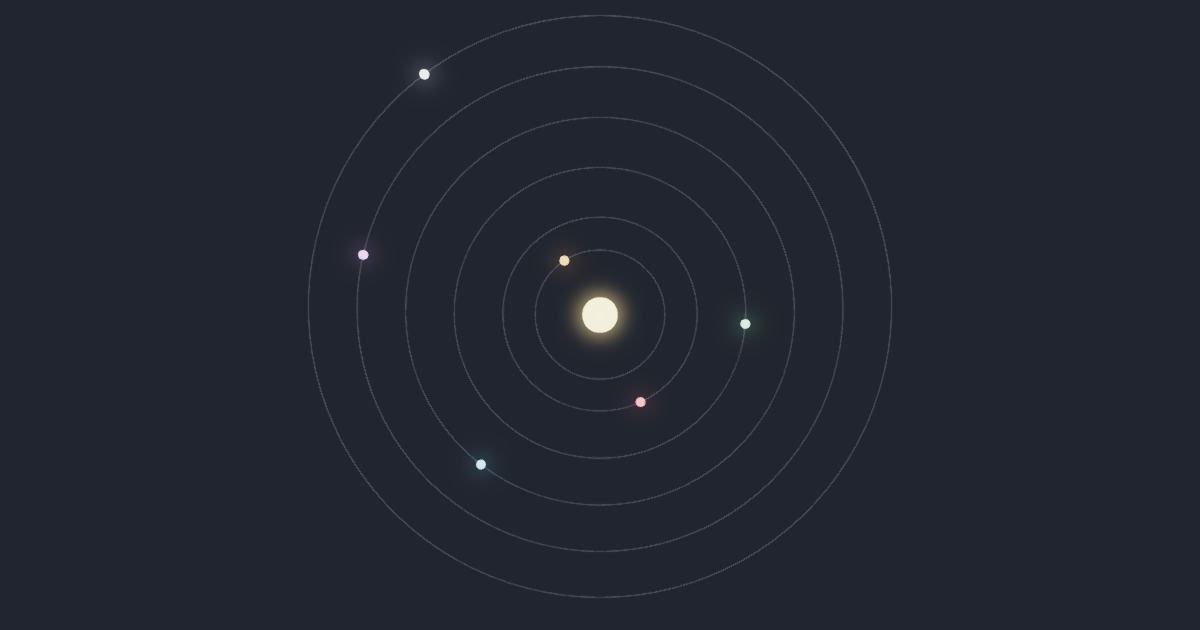
The on-screen OrbitsModule measures the SAME observable the oracle gates (mean T²/a³ over its six circular planets) with its own step-quantized crossing timer (dt = 1/240 s, no interpolation). The certificate now EXECUTES the shipped source and accounts for the displayed value exactly: at 60 s the measured 0.098702 sits +5.6695e-5 above 4π²/μ, decomposed with zero fitted parameters into +3.9201e-5 timer quantization (each planet's detection−interpolation crossing gap lies in (0, h], i.e. at most one substep per orbit count — bias positive by construction) and +1.7494e-5 leapfrog period bias, which equals the closed form (ωh)²/3 at every radius to 6.3e-5 and vanishes under the module's own Richardson h → h/2 to 1.1e-9 of the known. Both terms are invisible at the 4-digit display, which pins at 0.0987 = the theory digits printed beside it. The module's planets are circular starts (e ≈ 0), so the e-independence and eccentric-a estimation live only in the oracle; the module honestly displays both measured and theory values.
npm run derisk -- orbits (scripts/orbits-derisk.mjs)scripts/oracles/orbits.reference.jsonJ. Kepler, Harmonices Mundi, Book 5, Ch. 3 (1619); I. Newton, Principia (1687), Book I, Prop. XV (period law) and Prop. X (isochronous linear force); J. Bertrand, C. R. Acad. Sci. 77, 849 (1873). Reference numbers: 4π² = 39.4784176044; sidereal year 365.25636 d (Astronomical Almanac); GM_sun = 1.32712440018e20 m³/s² (IAU/DE421); AU = 1.495978707e11 m (IAU 2012); Earth perihelion 1.47095e11 m, max orbital speed 30.29 km/s, e = 0.0167 (NASA Earth fact sheet).